


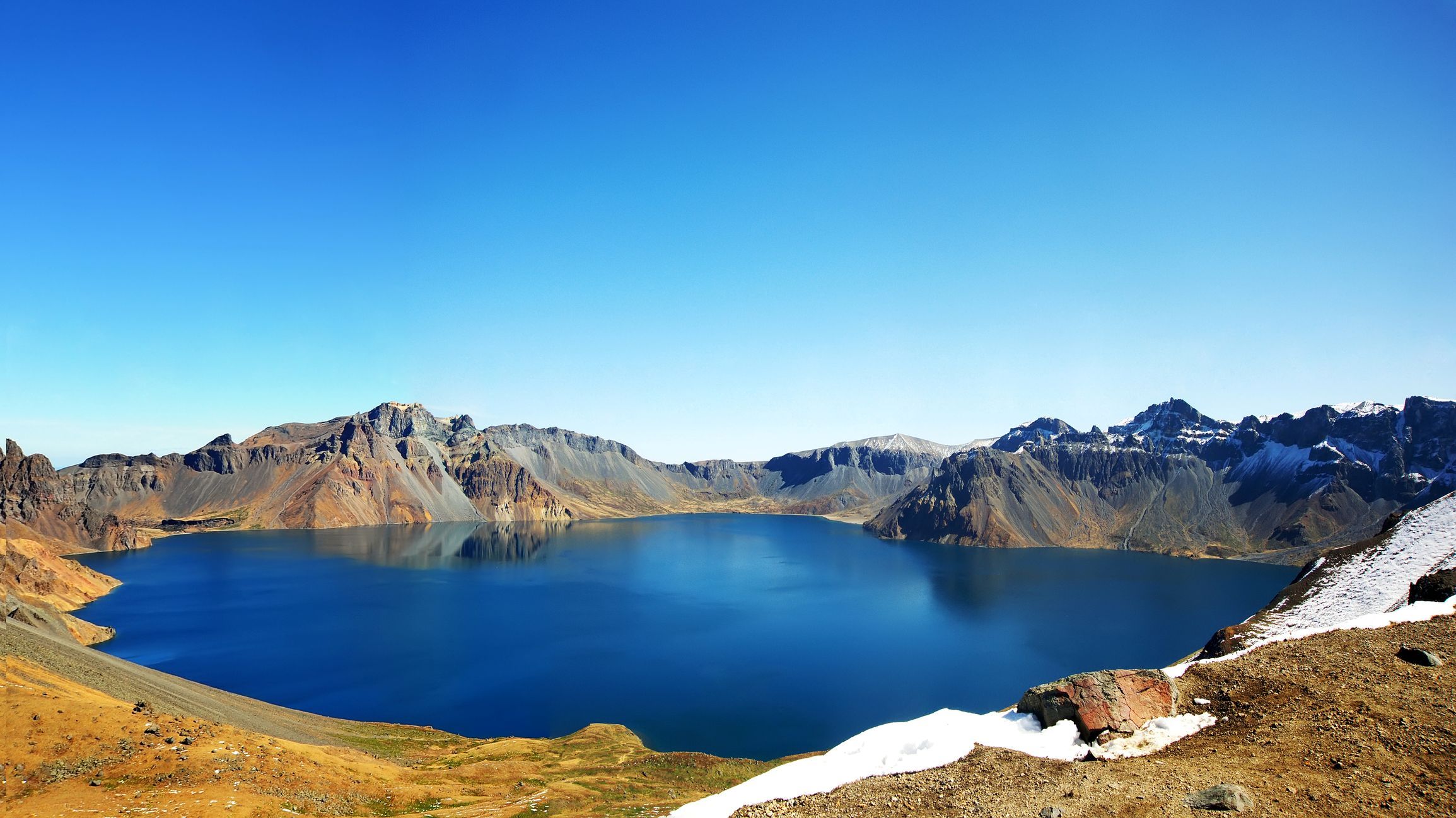
Fascinating Facts about Tianchi Lake
Name: Tianchi Lake (also known as Heaven Lake)
Location: Border of China and North Korea
Coordinates: 42.0091, 128.0593
Interesting Fact: It is the deepest lake in China, situated atop an immense volcano.
Tianchi Lake, a stunning crater lake atop Changbaishan (known as Paektu Mountain), is formed by a series of eruptions over the last 2.6 million years. This dormant volcano creates a breathtaking landscape that attracts visitors from around the world.
Commonly referred to as Tianchi in China, this lake holds the title of the highest and largest crater lake in Northeast Asia, as noted by UNESCO. It is also recognized as China’s deepest lake, with research indicating it sits at an elevation of approximately 2,200 meters (7,200 feet), spans around 3.6 square miles (9.2 square kilometers), and reaches a maximum depth of 1,224 feet (373 meters).
Tianchi Lake is encircled by 16 peaks of the Changbai Mountain range, which are remnants of ancient eruptions, including the significant “Millennium Eruption” that occurred in 946 AD, marking one of the largest eruptions in modern history.
Following the Tianwenbeng eruption, which scientists dated between 70,000 and 40,000 years ago, water began to fill the caldera of Changbai Mountain. The lake continues to be replenished by precipitation, snowmelt, and geothermal activity beneath the volcano that actively pushes water through geological fault lines.
Despite numerous sensational reports in the early 2000s claiming the existence of a monster resembling a horse within the lake, scientific consensus suggests that any large creatures could not survive in the lake’s unique environment.
According to UNESCO, Changbaishan is one of the most well-preserved stratovolcanoes, showcasing detailed records of multiple eruptions. Its composite nature, built from layers of lava, ash, and rock, makes it an educational resource for volcanic activity.
In North Korea, Changbaeksan is called Mt. Baektu or Mt. Baek, translating to “white-topped mountain,” while its Chinese name means “eternally white mountain.”
Get the world’s most fascinating discoveries delivered straight to your inbox.
China, North Korea, and South Korea have historically clashed over the significance of this volcano, with two treaties signed in 1962 and 1964 dividing the region, leaving North Korea with 54.5% of the lake.
In the 2000s, China initiated development projects around the volcano, including the establishment of Changbaishan Airport and the Changbaishan Eastern Railway for improved connectivity.
The geological park around this iconic site was designated as a UNESCO Global Geopark in 2024, emphasizing its cultural and environmental value.
Discover more amazing places and delve into the intriguing history and science behind some of Earth’s most dramatic landscapes.
Source: www.livescience.com