


Artificial Blood Breakthrough: ErythroMer and SynthoPlate Could Transform Emergency Care
Researchers are developing artificial blood products designed to address two critical challenges in emergency medicine: delivering oxygen and stopping bleeding. One product, called ErythroMer, is a new type of hemoglobin-based oxygen carrier (HBOC).
How ErythroMer Delivers Oxygen
ErythroMer is surrounded by a membrane that helps prevent hemoglobin degradation, limits the dangerous removal of nitric oxide, and enables hemoglobin to absorb and release oxygen more effectively.
Each ErythroMer cell contains a lipid called KC-1003, which acts like a sentinel. In response to the high pH found in the lungs, other molecules inside ErythroMer move away and take in oxygen. In oxygen-starved tissues with lower pH, KC-1003 restores those molecules, allowing them to release oxygen where it is needed.
Room-Temperature Storage Could Improve Emergency Response
Using freeze-drying, a process similar to the one used by World War II-era scientists to preserve plasma, the research team can store ErythroMer at room temperature. The product remains stable for two years.
A 2016 study in mice and rats found that ErythroMer stabilized blood pressure and oxygen delivery after 70% of the animals’ blood was removed. It did so without causing the catastrophic vasoconstriction that contributed to the failure of HemAssist. FSHARP promoted that research and helped fund studies examining how HBOCs interact with plasma and platelets.
Like the handle of a Swiss Army knife, synthetic platelets have special appendages, peptides that act as the biological equivalent of a corkscrew or a nail file.
Producing Hemoglobin for Artificial Blood
There is still much to learn about KaloCyte. Haynes said the company can source only about 1,000 to 2,000 units of expired hemoglobin each month. To increase its supply, the company licensed a yeast strain intended for laboratory use to produce its own hemoglobin.
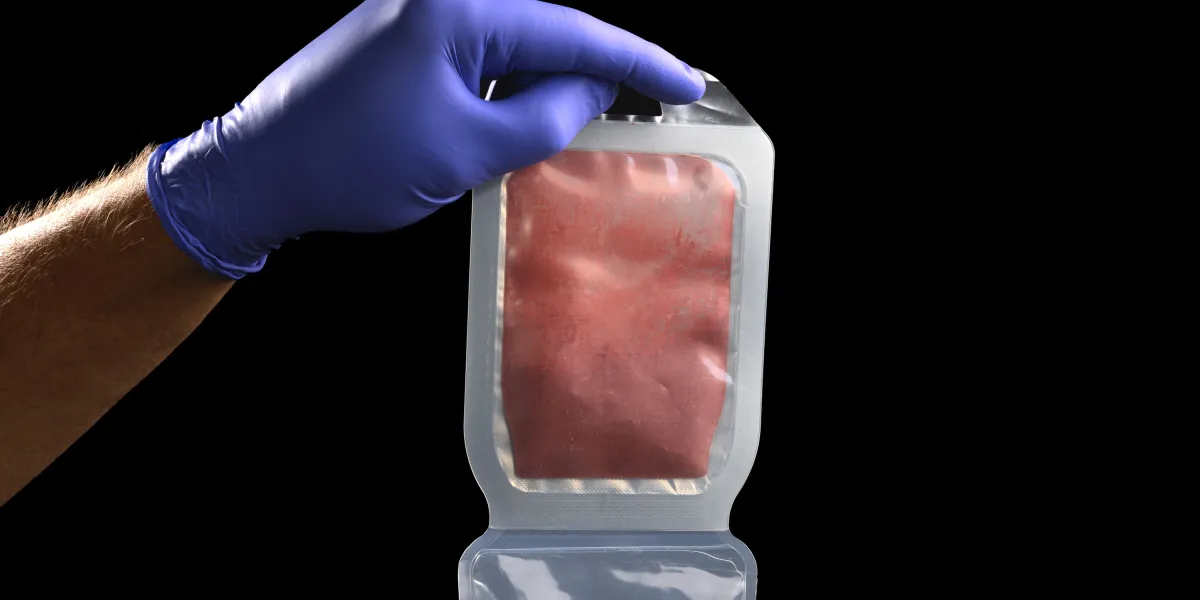
Haynes showed me a ready-to-use sample of ErythroMer during a video call from his desk. The product was packaged in a sturdy storage bag with two chambers. One contained scarlet hemoglobin powder, while the other held sterile water for rapid rehydration in the field.
Ultimately, she explained, based on Murray’s master plan, “there would be another container with synthetic platelets, and then a third container with plasma.”
Achieving that vision, however, depends on developing effective synthetic platelets.
SynthoPlate: Synthetic Platelets Designed to Stop Bleeding
To advance synthetic platelet research, DARPA turned to Anirban Sen Gupta, a professor of bioengineering at Case Western Reserve University.
“The way I see it, they are like drones, continuously monitoring the blood vessel walls, looking for signs of damage,” he explains.
Sen Gupta’s team, including collaborators at the University of Pittsburgh, used FSHARP funding to continue developing a product called SynthoPlate. He compares the product to the handle of a Swiss Army knife. It is made from lipid nanoparticles with specialized peptides attached to their surface.
The first version contains three types of peptides:
- One binds to von Willebrand factor, helping synthetic platelets adhere to damaged blood vessel walls.
- Another attaches to collagen and provides a scaffold for cells to regrow.
- The third mimics fibrinogen, acting like a Lego connector that links synthetic platelets to real platelets near a wound.
Like ErythroMer, SynthoPlate is lyophilized and can be reconstituted with sterile water. It remains stable for more than a year at room temperature and for at least three months at a desert-like temperature of 122°F.
Studies Show Reduced Bleeding in Animals
In a 2026 paper, researchers reported that SynthoPlate reduced bleeding time and blood loss by more than half in mice with low platelet counts.
In another study, researchers safely injected the synthetic platelets into the bone marrow of rats. This could provide a more useful delivery site because patients experiencing severe bleeding may not have accessible veins.
Sen Gupta and his colleagues spun off the research into a company called Hyma Therapeutics.
Why Lipid Nanoparticles Could Make Synthetic Platelets Scalable
Sen Gupta believes the pharmaceutical industry’s experience producing large quantities of lipid nanoparticles could help make synthetic platelets practical. Operation Warp Speed demonstrated that these “fat blobs” could carry delicate mRNA in coronavirus vaccines.
“The magic of engineered platelets lies in all the peptides decorating the surface of the particles, but the scalability of the platform is very well established,” he says.
Other Artificial Blood Research Around the World
Researchers around the world are developing additional blood substitutes and blood products. Researchers at the University of Cambridge in the United Kingdom are studying cultured red blood cells. Other teams are investigating cultured platelets and red blood cells for people with rare blood types and blood disorders such as sickle cell anemia.
Japanese scientists have also tested their own version of encapsulated human hemoglobin in human subjects.
Together, these efforts could help create blood products that are easier to store, transport and administer when donated blood or conventional transfusions are unavailable.
Source: www.technologyreview.com