


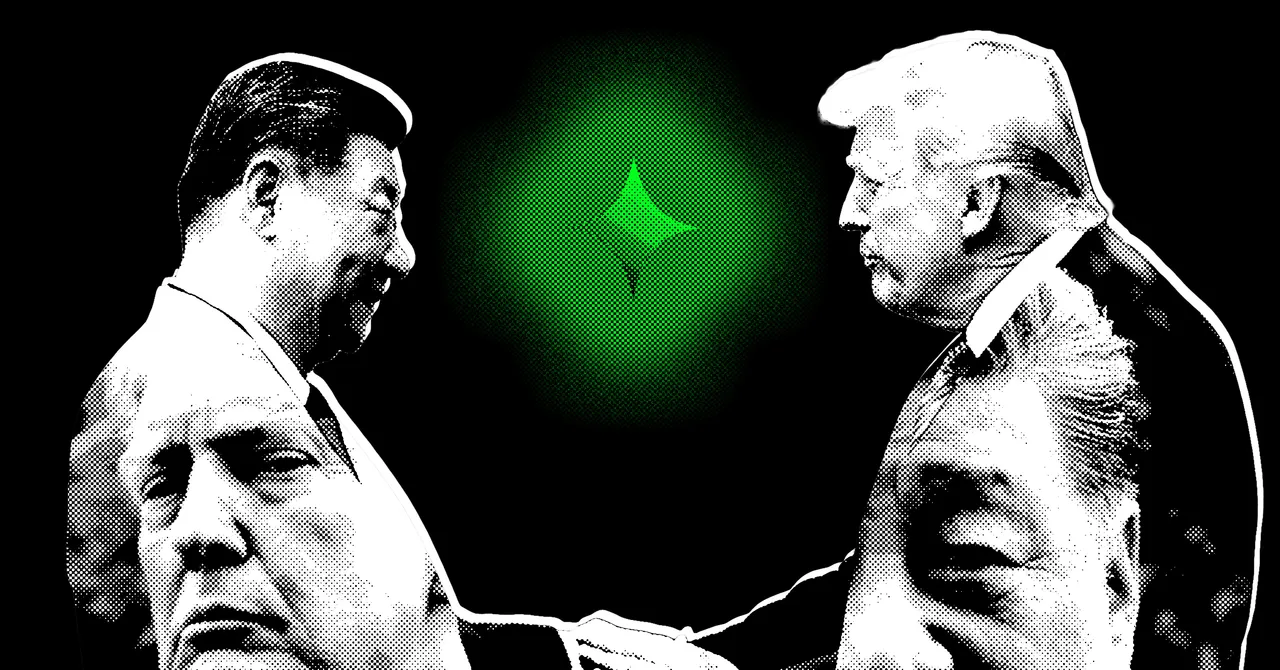
U.S. and China Consider AI Hotline as Trump and Xi Prepare for White House Meeting
AI policy is a top priority as President Donald Trump and Chinese President Xi Jinping prepare to meet in Washington on Thursday for a state dinner at the White House. Technology executives from OpenAI and Nvidia are among those confirmed to attend.
U.S. proposes AI reporting system with China
The United States has proposed creating an AI reporting system with China modeled on the Cold War hotline between Washington and Moscow. The system would allow both countries to alert each other to national security issues involving artificial intelligence.
Treasury Secretary Scott Bessent announced the proposed notification system Sunday alongside Chinese Vice Premier He Lifeng.
Trump administration officials told Innerloop that they are optimistic a hotline could be established by the end of the year, although a final agreement is expected to take several more weeks.
Several details still need to be worked out, including benchmarks for determining which AI-related incidents rise to the level of national security concerns. China’s explicit commitment also remains uncertain.
By the time Bessent meets with Lifeng again in Shenzhen, China, in two months, Trump administration officials hope to have a basic framework for the system—and, crucially, President Trump’s support.
AI hotline faces questions over enforcement
The debate over an AI notification mechanism reflects growing concern about the rapidly evolving capabilities of frontier AI models as the United States and China compete for leadership in the technology industry.
Trump administration officials have been debating the standards that would require either country to issue a warning. They are also considering an enforcement framework to ensure that the United States does more than simply alert China about potential threats.
However, as the United States weighs whether to extend the trade ceasefire, President Trump remains reluctant to halt exports of cutting-edge Nvidia chips to China. Sources said developing strong enforcement measures could take time to win White House approval.
Earlier this year, the administration granted Nvidia a limited license to sell its H200 chip to China. The chip is a key component for AI research laboratories seeking additional computing power to train models.
Nvidia supporters argue that restricting chip sales would encourage Chinese companies such as Huawei to develop their own semiconductor technology. Recent reports, however, suggest that Huawei has already reached that milestone with commercially available AI chips.
Trump administration weighs next AI czar
Some Trump administration officials have suggested that the notification system could also be delayed while Trump decides whom to appoint as the next “AI czar.” The position would lead the so-called “AI Corps” and coordinate AI policy across government agencies.
Bessent is among the officials mentioned for the role, although it is unclear whether he is a leading contender. Commerce Secretary Howard Lutnick and White House AI officials Michael Kratsios and Sean Cairncross are also involved, according to two sources who spoke with Innerloop.
It remains unclear whether Trump will select someone to hold the AI role alongside an existing position or appoint someone who would leave their current job. The previous AI czar, David Sachs, served as a special government employee. Sources said Sachs is not considered a candidate to return.
Bessent role draws on past U.S.-China dialogue
Support for Bessent is partly based on comparisons between the proposed AI notification system and the U.S.-China dialogue conducted by former Treasury Secretary Hank Paulson and China’s former vice premier for finance, Wang Qishan.
During the 2008 financial crisis, Paulson praised the work of the hotline, saying it would help prevent China from selling large portions of U.S. government-backed bonds issued by Freddie Mac and Fannie Mae.
Meanwhile, some Trump administration officials have objected to giving Lutnick greater authority over AI. He remains a controversial figure while overseeing the Center for AI Standards and Innovation, which he successfully guided through a crisis this summer involving a cutting-edge AI model company.
This is an edition of Hugo Lowell’s Innerloop newsletter. Read previous newsletters here.
Source: www.wired.com