


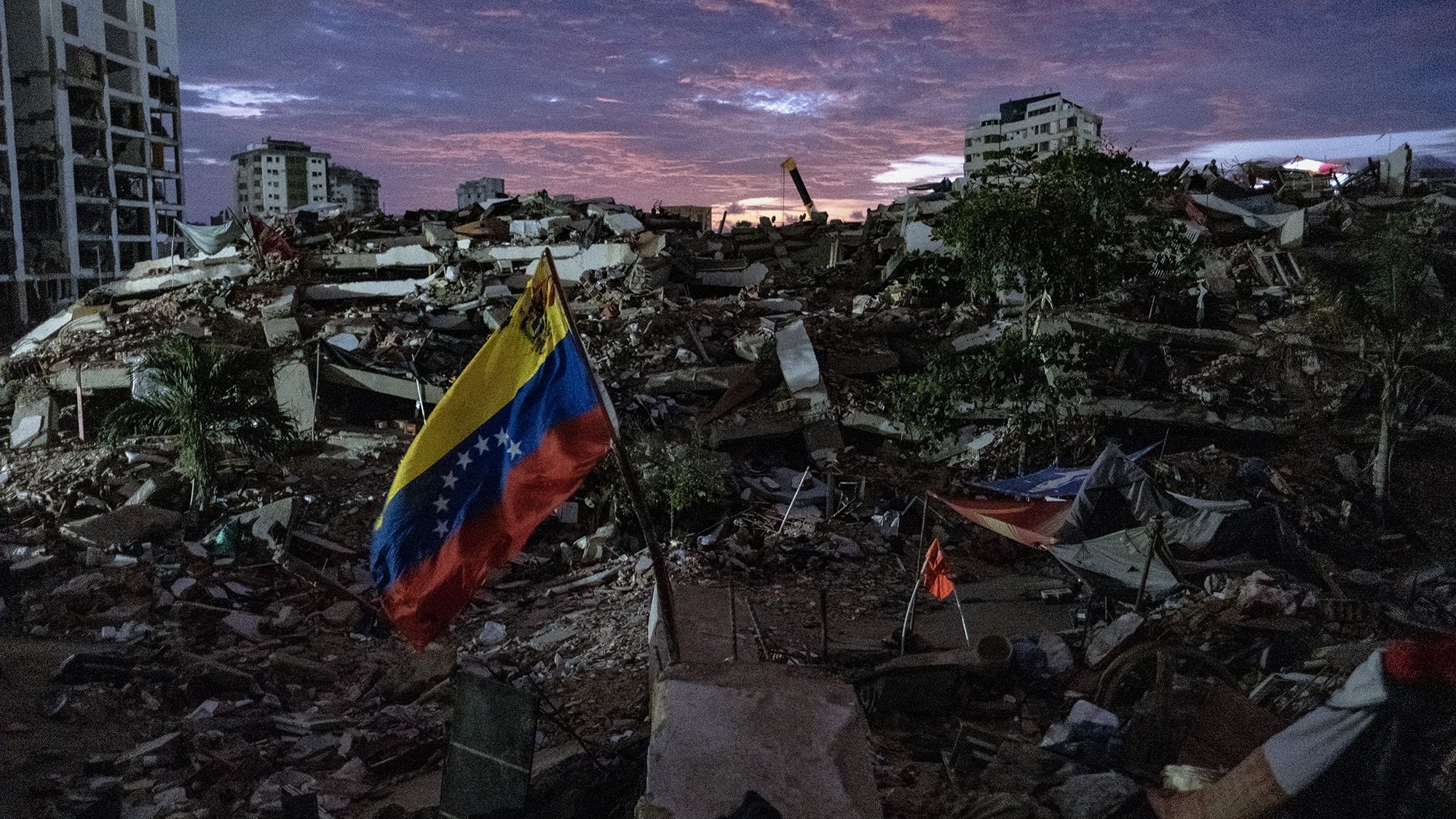
On June 24, two significant earthquakes rocked north-central Venezuela, occurring just 39 seconds apart. The initial quake measured M7.2 near San Felipe, followed by a stronger tremor of M7.5 near Umalé, resulting in the tragic loss of thousands of lives and numerous injuries. As reported by government officials. Beyond the immediate devastation, this unusual “double earthquake” presents a unique scientific opportunity. Researchers believe it can shed light on the interplay of large fault systems and the dynamics of destructive earthquakes.
Typically, small aftershocks follow a major earthquake. However, a strong quake can alter stress levels in nearby faults or within the same fault line, potentially triggering another significant quake.
While this scenario is rare, it’s not without precedent. The 2023 earthquakes in Kahramanmaras, Turkey and the 1997 double earthquake in Harnai, Pakistan serve as notable examples.
The Venezuelan earthquakes further highlight a growing consensus among seismologists. Treating faults as individual entities can lead to an underestimation of the catastrophic potential in regions where multiple crustal faults converge, such as in Venezuela and along California’s San Andreas fault system. This is concerning since many seismic hazard models for California fail to consider these multiple fault interactions.
A Natural Laboratory for Understanding Major Earthquakes
The fault systems implicated in the Venezuelan earthquakes include Bocono, Moron, San Sebastian, and El Pilar faults, sharing crucial characteristics with California’s San Andreas fault. Both are right-lateral strike-slip systems where crustal blocks slide horizontally past each other along the boundaries of tectonic plates: the South American and Caribbean plates in Venezuela, and the Pacific and North American plates in California.
Despite these similarities, researchers caution that critical differences exist between the two systems.
“The main distinction lies in the complexity of the fault structure in the Venezuelan plate boundary,” said Julian García Mayordomo, a senior scientist at the Spanish Institute of Geology and Mining.
Receive the latest discoveries right in your inbox.
This complexity stems from the Maracaibo block and its interaction with surrounding faults, resulting in a more intricate plate boundary compared to that of California.
“Additionally, the speed of plate movement differs,” García Mayordomo pointed out.
In Venezuela, tectonic plates shift at about 0.8 inches (20 millimeters) per year, while the San Andreas fault experiences movement at around 1.2 inches (30 millimeters). Faster movement can lead to quicker stress build-up in the crust, affecting the frequency of large quakes over the long term, though it doesn’t predict when the next quake will occur.
Aerial view of the San Andreas Fault in California.
(Image credit: Kevin Schafer/Getty Images)
Typically, earthquakes of magnitude 7 or higher occur along the San Andreas Fault roughly every 100 to 200 years. Nevertheless, the recurrence rate varies along the fault line. The last major quake in Southern California was the magnitude 7.9 Fort Tejon earthquake in 1857, while estimates indicate that Venezuela’s slip rates suggest a recurrence of about 1 to 2 centuries. The region also suffered two significant earthquakes in 1812 as part of a sequence of destructive events, including magnitude 7.5, 7.2, and 6.5 earthquakes. A 2018 survey concluded that the Bocono fault has already built up sufficient strain for another major earthquake to occur.
However, these are statistical averages, and the recurrence of significant earthquakes is irregular, influenced by numerous factors, many of which remain poorly understood. Consequently, major seismic events could occur hundreds of years from now or even as soon as tomorrow.
Looking Beyond Individual Faults
This uncertainty makes the Venezuelan double earthquake particularly significant for seismologists.
“Such natural phenomena allow us to rigorously test concepts of fault interactions, which can only be indirectly inferred through paleoseismic models,” stated Lilianne Burkhardt, a geologist and geophysicist at the University of Bern. Her recent research suggests that the phenomenon is observed at the junction of the San Andreas and San Jacinto faults in Southern California, where they experience some of the highest crustal stress levels seen in a millennium.
In her study of Cajon Pass, Burkhardt emphasized that historical paleoeharthquake reconstructions inform how stress evolves but lack real-time data captured by seismic instruments. This highlights how different faults interact during seismic events.
The Venezuelan doublet provides such an opportunity. Burkhardt argues that the key takeaway for California is the significance of interactions between neighboring faults in shaping large earthquakes.
“Whether we’re talking about Cajon Pass or the Bocono-San Sebastian area in Venezuela, these locations reveal how single-failure risk models fail to consider the reality of how stress is shared and transferred between adjacent faults,” she concluded.
Often, the winner is not the boxer who lands the hardest punches, but the one who endures the longest.
Julian García Mayordomo, Senior Researcher, Institute of Geology and Mining
While both systems are distinctly different, the Venezuelan earthquake pattern exemplifies a different kind of cascading destruction compared to what Burkhardt’s study discusses. In Cajon Pass, researchers investigate whether a single rupture can traverse from one fault to another within moments, while the Venezuelan sequence suggests that two separate faults may have been triggered in succession.
For Burkhardt, the Venezuelan earthquakes underscore the necessity for seismic hazard models that advance beyond the treatment of faults as standalone entities and account for their interconnections. This is particularly pressing for California, where nearly 300 active faults could interact in ways that traditional models overlook.
New Zealand has already heeded this lesson, updating its national seismic hazard models following the 2016 Kaikoura earthquake, which ruptured multiple faults simultaneously.
García Mayordomo advocates for incorporating complex failure scenarios into seismic risk assessments and building codes in both Venezuela and the United States. Earthquakes involving multiple faults can lead to prolonged shaking, elevated structural fatigue, and an increased risk of collapse.
“It’s akin to a boxing match,” García Mayordomo remarked. “Often the winner is not the competitor who delivers the hardest blows, but the one who sustains them the longest.”
Nevertheless, researchers warn against drawing universal conclusions from a single earthquake event.
“Every earthquake provides a unique case study,” stated Judith Hubbard, a seismologist and structural geologist at Cornell University. “The spectrum of earthquake behavior is vast.”
Source: www.livescience.com