


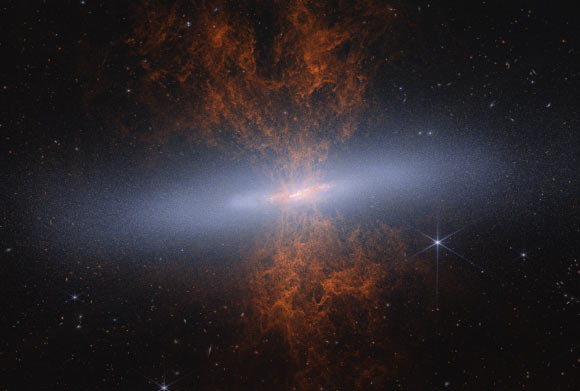
The NASA/ESA/CSA James Webb Space Telescope (JWST) has unveiled around 16.5 million stars in the edge-on spiral galaxy Messier 82 (M82, NGC 3034, or Cigar Galaxy), offering astronomers an unparalleled insight into a region of intense star formation.
This image illustrates the edge-on spiral galaxy Messier 82. Image credits: NASA / ESA / CSA / Adam Smercina, STScI, Tufts / Thomas Williams, University of Manchester / Alyssa Pagan, STScI.
Located approximately 12 million light-years away in the northern constellation Ursa Major, Messier 82 is a fascinating celestial object.
First identified by German astronomer Johann Erath Bode in 1774, this galaxy spans around 40,000 light-years in diameter.
Commonly referred to as the Cigar Galaxy due to its elongated elliptical shape, Messier 82’s tilted star-like disk provides a unique appearance from our vantage point.
The galaxy is renowned for its exceptional rate of star formation, birthing stars at ten times the pace of the Milky Way.
“Messier 82 is a mess, but it’s also a beautiful mess,” says Dr. Adam Smersina from the Space Telescope Science Institute and Tufts University.
“We still don’t completely grasp the processes at play, especially regarding its evolutionary journey.”
“What triggers this accelerated star formation? How long have plumes of material been ejected from its center?”
“Messier 82 serves as an excellent laboratory for galaxy evolution studies, as its unique characteristics allow us to probe essential physical processes like star formation in dynamic environments and the effects that follow.”
“It can answer crucial questions in astrophysics that no other galaxies in the local universe can.”
Using Webb’s NIRCam (near-infrared camera), astronomers have uncovered unprecedented details about Messier 82, revealing its expanded disk structure and millions of individual stars.
This groundbreaking Webb image showcases roughly 16.5 million individual stars scattered throughout the galaxy.
The light emitted by these stellar objects appears as glowing blue grains, highlighting only a fraction of the total stars believed to exist in galaxies like Messier 82—most of which remain too faint for visibility.
“The number of stars Webb has uncovered is astounding,” said Dr. Benjamin Williams from the University of Washington.
“It’s truly a different realm compared to what we’ve observed with any other telescope.”
“Collectively, these stars provide a detailed fossil record of Messier 82’s formation and evolutionary history.”
“While the Webb telescope can see through the dust, the galaxy’s disk might not strike as spectacular at first glance,” noted Dr. Eric Bell from the University of Michigan.
“However, Messier 82 is an intricate system, and Webb’s findings will help decipher ongoing mysteries regarding the evolution of star formation in Messier 82 over billions of years.”
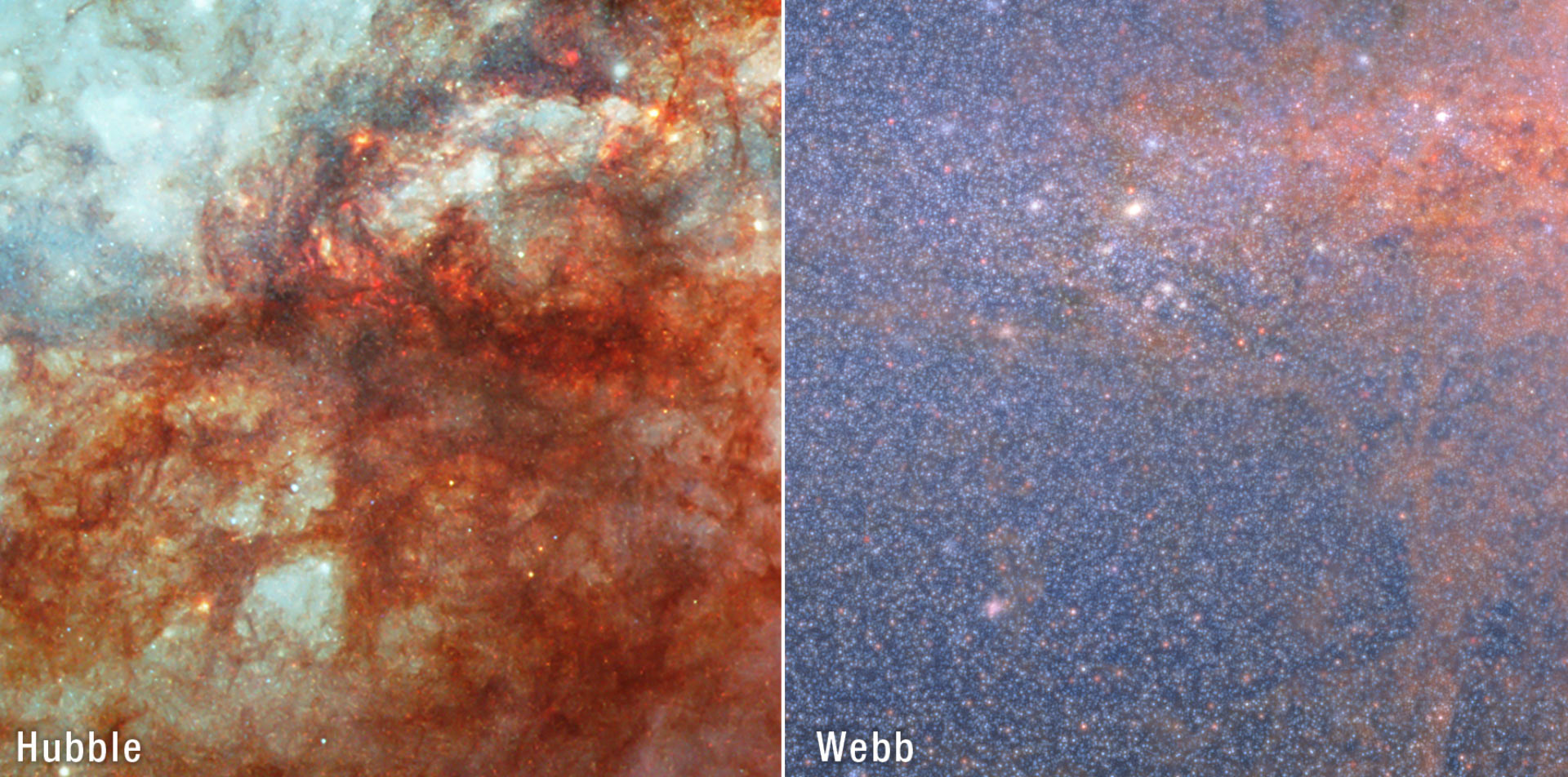
Comparison of Messier 82 captured by Hubble (left) and Webb (right). Image credits: NASA / ESA / CSA / Adam Smercina, STScI, Tufts / Thomas Williams, University of Manchester / Alyssa Pagan, STScI.
The extraordinary level of star formation in Messier 82 occurs at a rate ten times that of the Milky Way, resulting in eventual star birth suppression.
This galaxy’s vibrant star population is ejecting bipolar plumes of material both above and below its disk.
Despite its chaotic appearance, the outflow resembles a layered structure in an hourglass shape.
Yellow filaments of material closest to the galaxy’s disk signify ionized gas, while more distant orange materials indicate small dust particles.
These particles, known as polycyclic aromatic hydrocarbons, assist in tracing material within the interstellar medium of galaxies.
“Galaxies are highly complex ecosystems, so to truly understand them, we must integrate data from various missions,” stated Dr. Kristen McQuinn from the Space Telescope Science Institute.
“No single mission can completely unravel all the complexities of Messier 82.”
“Combining observations from different telescopes like Webb and Hubble unlocks powerful insights.”
“This merging of datasets broadens our investigative scope, allowing us to pose more intricate questions.”
Source: www.sci.news