


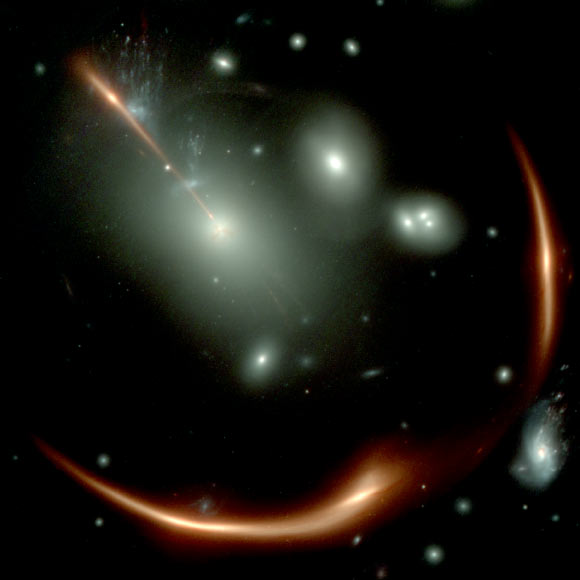
A supermassive black hole, six billion times the mass of the Sun, has been identified in the galaxy MRG-M0138. This finding comes from data analyzed using the NIRSpec Integral Field Spectrometer aboard NASA/ESA/CSA’s James Webb Space Telescope. MRG-M0138 is a quiescent galaxy that has been significantly affected by gravitational lensing and was observed when the universe was just three billion years old.
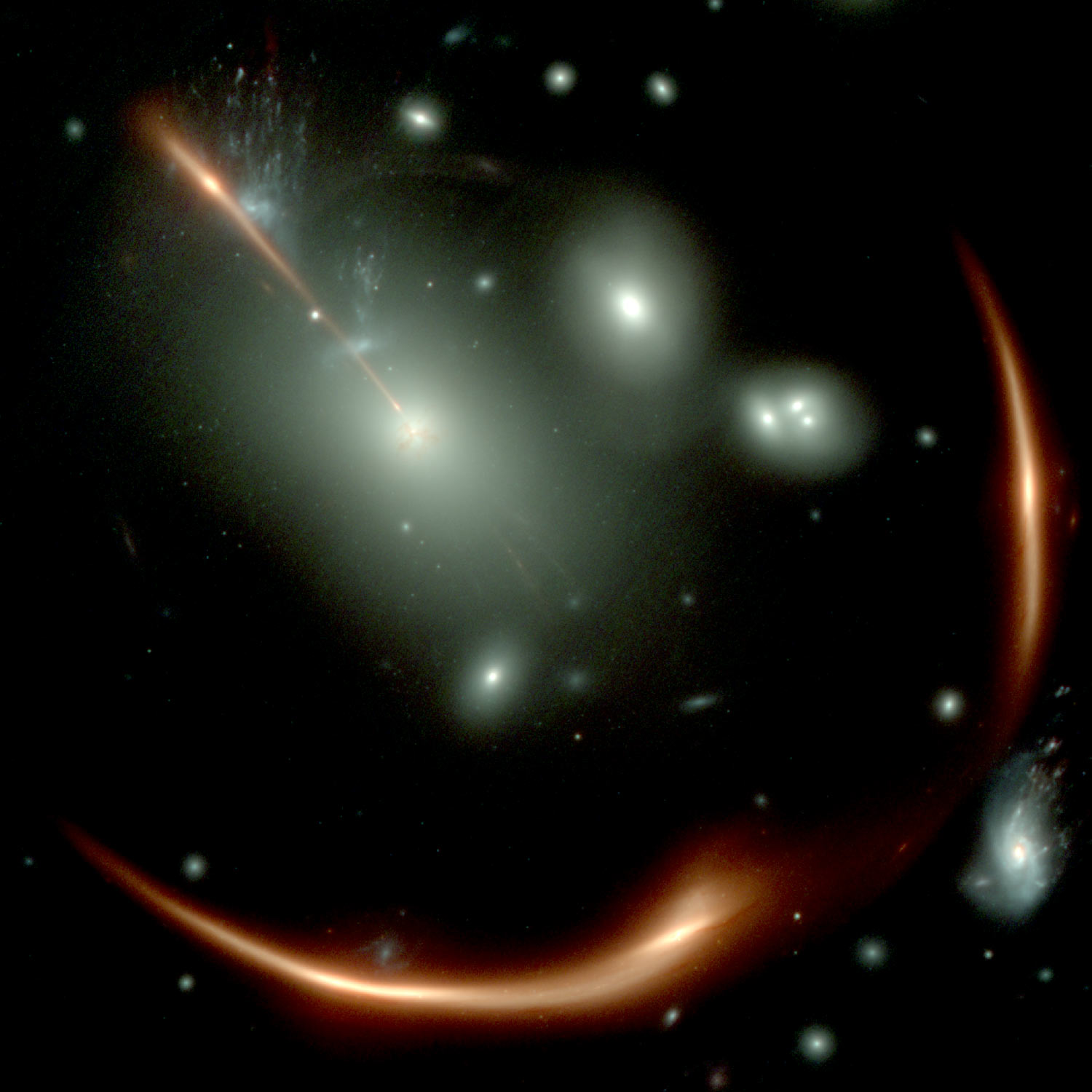
An image showcasing the highly distorted red galaxy MRG-M0138, viewed through a foreground galaxy cluster. Image credit: NASA / ESA / CSA / Webb.
MRG-M0138 is positioned over 10 billion light-years away, hidden behind a massive galaxy cluster that magnifies and distorts its view.
As a result, distant galaxies appear approximately 30 times larger than their usual size.
Currently, MRG-M0138 is no longer actively forming stars, and its central black hole remains dormant.
“Combining Webb’s advanced imaging capabilities with the natural magnification effect of gravitational lensing enabled us to detect this black hole at a distance of 10 billion light-years,” stated Dr. Andrew Newman, an astronomer from the Carnegie Institution for Science and the University of Southern California.
Dr. Newman and his team utilized Webb’s NIRSpec Integrating Magnetic Field Spectrometer to explore MRG-M0138.
“By merging Webb’s observational data with gravitational lensing techniques, we were able to peer into the region influenced by the black hole’s gravity, where star speeds increase substantially,” he added.
“This method is one of the most effective for measuring black hole masses, and we’re thrilled to apply it to much earlier epochs in the universe’s history.”
Only a small number of dormant black holes of this magnitude have been discovered within a close range.
This groundbreaking discovery sheds light on the co-evolution of black holes and galaxies in the early universe.
Studies of nearby galaxies indicate a strong correlation between the mass of central black holes and the characteristics of their surrounding galaxies.
However, validating these relationships for galaxies billions of years old has proven challenging.
Recent findings hint that the densest galaxies served as hotspots for rapid black hole growth in the universe’s infancy.
Though currently inactive, MRG-M0138 likely functioned as a powerful quasar in its past.
Professor Richard Ellis from University College London remarked: “By analyzing the collective motion of stars within this distant galaxy, we can now estimate the mass of a supermassive black hole that would typically remain undetectable.”
“Validating these techniques for early galaxies will allow for a more comprehensive investigation of black hole development over time and help us understand their influence on galaxy evolution.”
The findings are published in the journal Science.
_____
Andrew B. Newman and others. 2026. Dynamic mass measurements of an inactive black hole star at redshift 2. Science 392 (6802): 1065-1068; doi: 10.1126/science.adx5816
Source: www.sci.news