


2,000-Year-Old Warrior Tomb in Russia Reveals Gold Coins, Weapons and Possible Human Sacrifice
Archaeologists uncovered an elite warrior’s burial in the Kuban region alongside horse remains, luxury goods and two gold coins depicting Alexander the Great.
Image credit: Abramzon et al., 2015
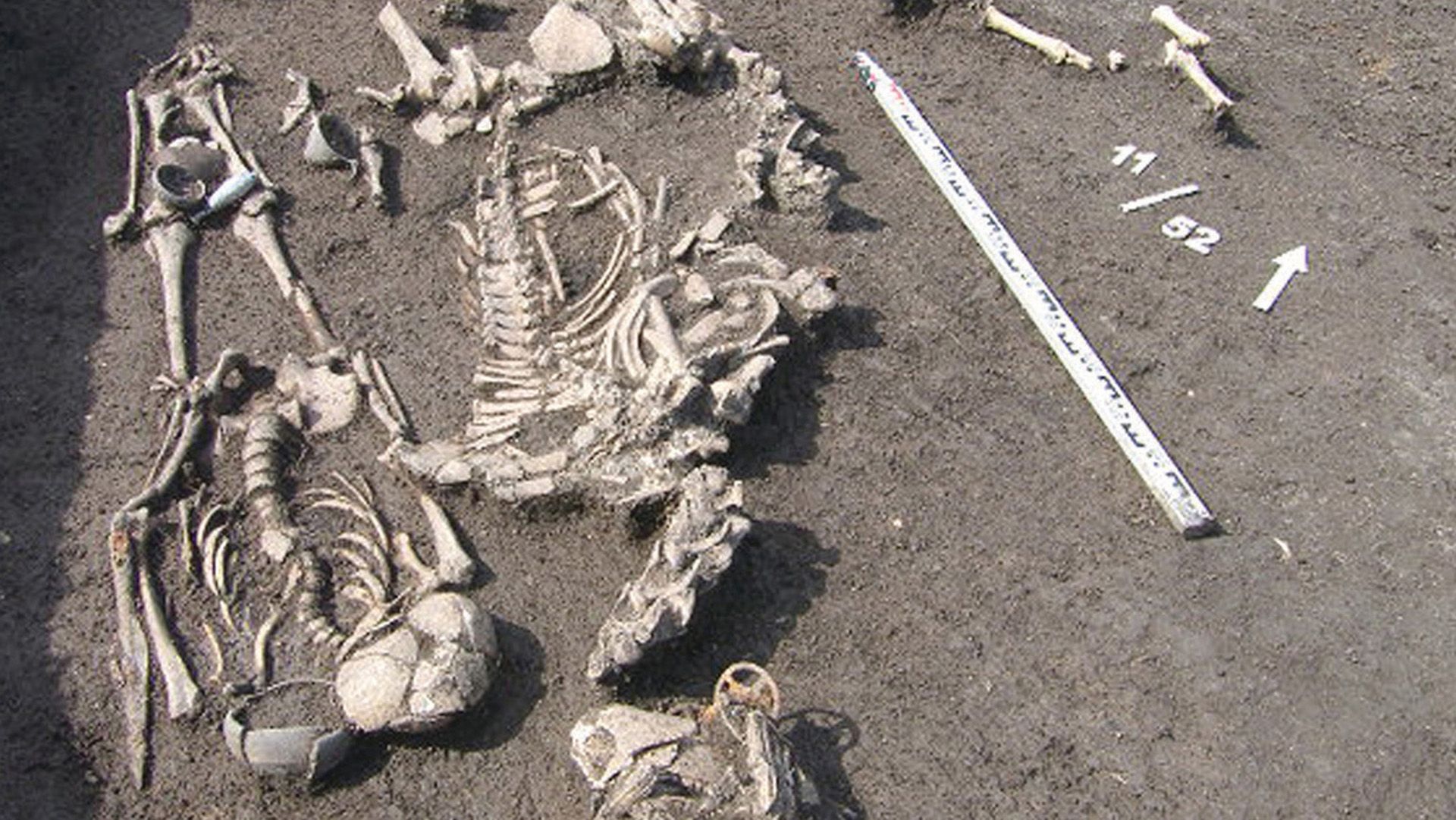
Archaeologists in southern Russia have uncovered a 2,000-year-old tomb belonging to an elite warrior who was buried with weapons, horses and possible human sacrifices. The burial also contained luxury objects, including two gold coins depicting Alexander the Great.
The warrior’s tomb was discovered in Russia’s Kuban region, east of Crimea, within a cemetery containing more than 150 ancient burials. Its central location suggests that the man held an elevated position in society, according to a study published in September in the journal Russian Archaeology.
Evidence of animal and possible human sacrifice
A separate burial complex beside the warrior’s grave contained the remains of three horses, two cows, a pig and a dog. Researchers also found fragments of a human pelvis, which they believe may have belonged to one of the sacrifice victims.

Image credit: Abramzon et al., 2015
Two gold coins found at the site help date the burial to the early first century B.C. The location and style of the tomb indicate that the warrior was likely an indigenous Maeotian aristocrat.
At the time, the Maeotians were allied with the neighboring Mithridatic Empire, a Hellenistic kingdom that was an enemy of the expanding Roman Republic.
The coins were probably not used as ordinary currency. Instead, researchers suggest they were luxury objects used to store wealth. “This is probably not money in the traditional sense, but rather…a means of storing wealth similar to cryptocurrencies,” study lead author Mikhail Abramzon, a professor at the Institute of Archaeology of the Russian Academy of Sciences, told Live Science by email.
Gold coins depicting Alexander the Great
One of the gold coins was found in a ceremonial shaft near a burial site at the center of the cemetery. Researchers believe it may have been placed there as an offering to the gods.
The second coin was discovered beneath the jaw of the warrior’s skeleton. It appears to have been placed in his mouth before burial, a practice known as Charon’s obol—a traditional ancient Greek payment to the mythical ferryman who carried the dead into the afterlife.

Image credit: Abramzon et al., 2015
Both coins were Greek-style gold staters bearing a portrait of Alexander the Great, who lived from 356 to 323 B.C. However, experts determined that the coins were minted much later, during the reign of Mithridates Eupator, also known as Mithridates the Great, who lived from 135 to 63 B.C.
Mithridates claimed descent from both Alexander and Persian nobility and initiated the three Mithridatic Wars against Rome. The researchers noted that the portrait of Alexander on the coin was also designed to resemble Mithridates Eupator.
According to the first-century A.D. Greek geographer Strabo, the Maeotians were an indigenous people who were incorporated into the nearby Bosporan Kingdom. This Greek and Scythian state was founded north of the Black Sea in the fifth century B.C.
The Greek historian Appian wrote that the Bosporan Kingdom became part of the expanding Mithridatic Empire in the second century B.C. The Maeotians therefore appear to have been allies of the Mithridatics when the warrior was buried in the first century B.C.
Weapons, horse gear and protective symbols
The warrior was buried with two iron spearheads, an iron arrowhead, riding equipment and a horse. The tomb also contained luxury items, including rare glass alabasters—small containers used for oils and perfumes—that were probably imported from Cyprus or the Levant, in the eastern Mediterranean.
Archaeologists also found a two-handled clay cup called a kantharos in ancient Greek. Its surface was engraved with a pentagram, a sun symbol that researchers believe may have been viewed as spiritual protection against magical threats.
What the animal sacrifices may have meant
The sacrifices in the nearby burial complex may have served several purposes. Researchers suggest that the cows could have been offered in a ritual known as a hecatomb—a mass slaughter of animals intended to please the gods.
The horses may have been intended for the afterlife, while the pigs may have been meant to provide food. The dogs could have been intended to guide the spirits of the dead warriors. The role of the people represented by the human remains is unclear, although the researchers suggest they may have been intended to serve the warriors in the afterlife.
Overall, the gold coins and other grave goods reveal the extent to which Maeotian beliefs were influenced by the ancient Greek traditions of the neighboring Bosporan Kingdom.
Source: www.livescience.com