



White Dwarf Stars Can Appear Green, Pink, and Blue, Astronomers Find
Astronomers led by Dr. Mark Hollands of the University of Warwick have converted white dwarf spectra into color-accurate images showing how these dense stellar remnants could appear to the human eye.
The study reveals that although most white dwarfs appear white or bluish-white, unusual atmospheric chemistry can produce unexpected colors—including deep salmon pink, bright blue, and chartreuse green.
Most white dwarfs appear white
“Most stars, including most white dwarfs, behave like ‘perfect radiators’, so their color is determined almost entirely by temperature,” Hollands said.
“But no one seriously considered what else was possible with white dwarfs.”
“We found that these incredibly dense stars can produce colors that no one expected, some of which were truly surprising.”
The researchers analyzed 152 white dwarfs within approximately 65 light-years of the Sun. Their median color corresponds to a blackbody temperature of about 6,800 K—very close to the white displayed on computer screens.
The familiar image of a bluish-white dwarf is influenced by the hot, luminous white dwarfs that are most likely to dominate surveys of objects in the darkest parts of the sky.
Only about 3% of the nearby sample consisted of five stars whose colors differed substantially from those expected for blackbody radiation.
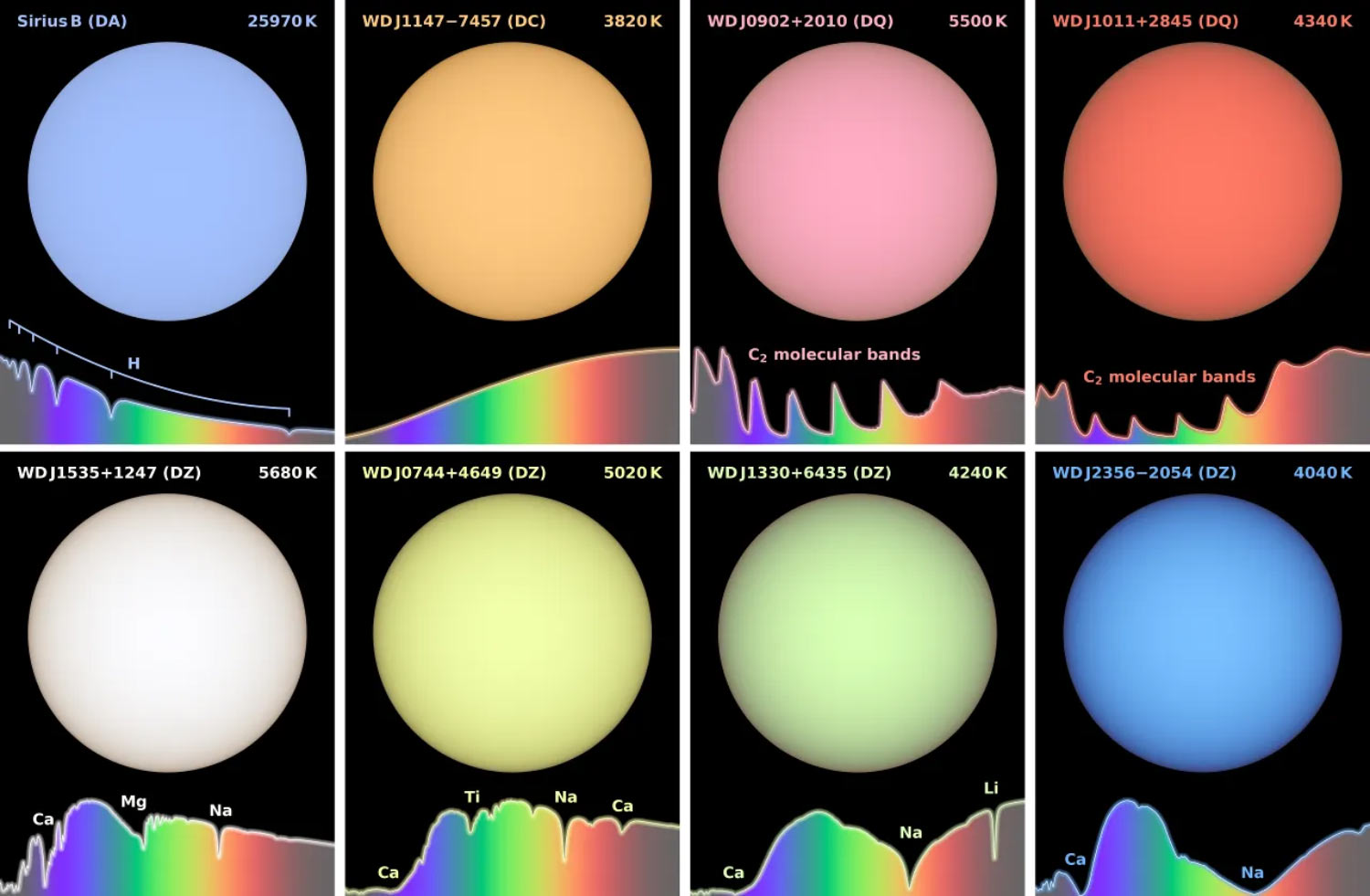
Why some white dwarfs have unusual colors
Among the known examples, one of the most striking is WD J1011+2845, located just 48 light-years from Earth. The white dwarf has a deep salmon-pink color, making it perhaps the reddest known star in terms of perceived color.
“WD J1011+2845 has a deep convective zone that lifts carbon from its core to the surface,” the researchers said.
“The resulting carbon molecules distort the star’s light so strongly that almost all of the light is focused to wavelengths above 600 nm, creating a deep salmon-pink glow not seen in normal stars.”
WD J1330+6435 may be the only known green star
The most unexpected color belongs to WD J1330+6435, which appears chartreuse green.
“To our knowledge, no other type of star has been claimed to exhibit a green hue, making white dwarfs so far the only known way to produce green stars,” the scientists said.
“Trace amounts of sodium in this white dwarf’s atmosphere absorb the orange part of the spectrum, leaving behind a ghostly green glow,” Hollands added.
“Imagine standing on a planet and looking up at a green star. It feels like something out of science fiction.”
WD J1330+6435 is a cool white dwarf accreting sodium-rich rocky material from its planetary system. Because its atmosphere is extremely dense, sodium absorbs light across a broad range of yellow, orange, and red wavelengths, producing its unusual green appearance.
A cool white dwarf that looks bright blue
Another cool white dwarf, WD J2356-2054, appears bright blue despite having a temperature of only about 4,000 K.
“We examined the chromaticity distribution of a 65-light-year local sample of white dwarfs with limited volume and found a median correlated color temperature of 6,800 K, proving that, on average, white dwarfs are indeed white in color,” the authors concluded.
“We show how a spectral model of a white dwarf star can be used to produce accurate images of the stellar disk in the same colors as it appears when viewed from up close.”
The study was published in RAS Techniques and Instruments.
Mark A. Hollands et al. 2026. “Favorite color: Various chromaticities of white dwarfs.” RAS Techniques and Instruments 5: rzag069. Read the study.
Source: www.sci.news