


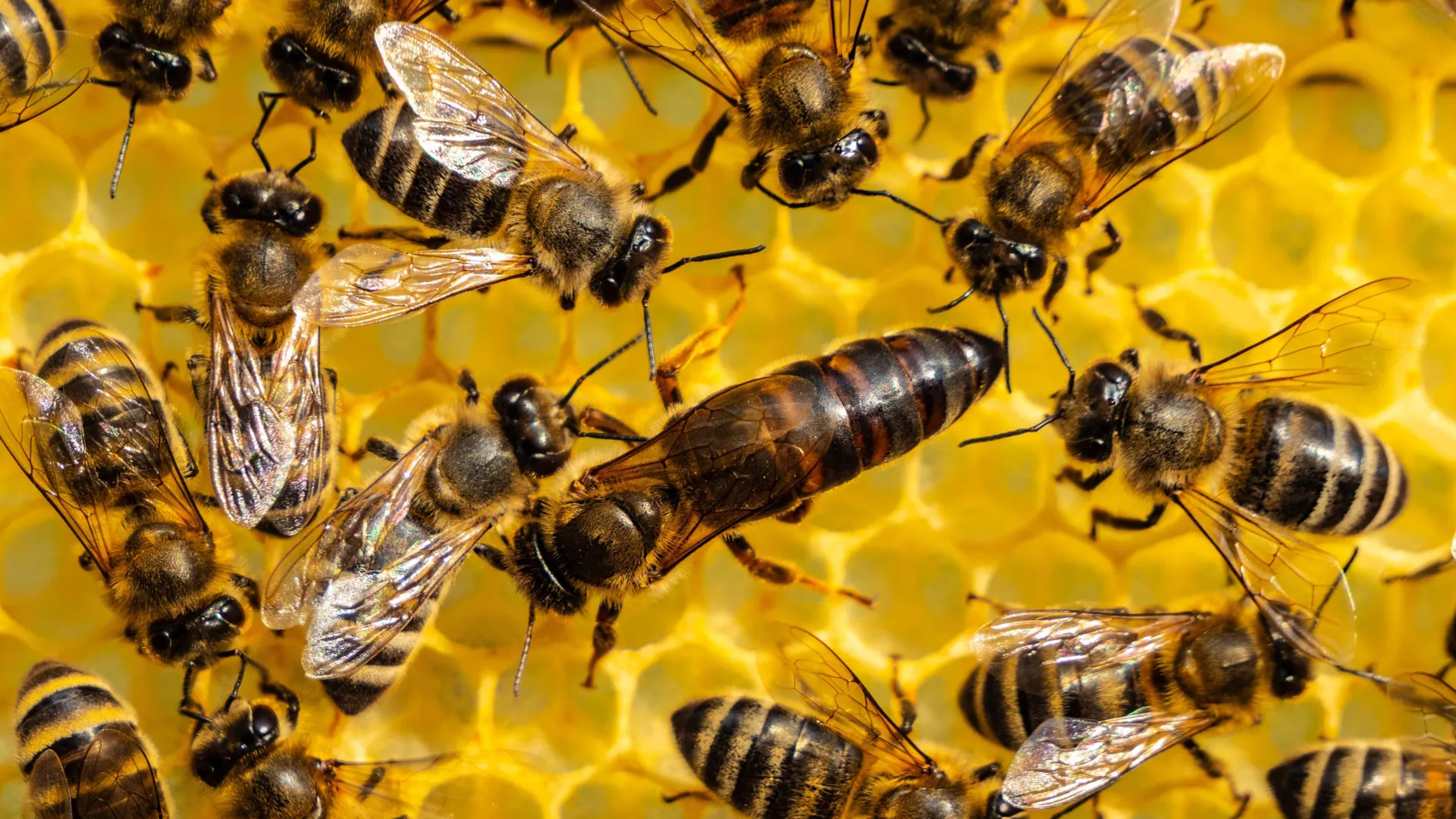
Worker honey bees are often considered the colony’s first line of defense against contamination, filtering harmful substances before they spread throughout the hive. New research, however, shows that honey bee queens also have their own mechanism for managing pesticide exposure.
When honey bee queens are exposed to pesticides over extended periods, some chemicals can accumulate in their bodies and transfer into their eggs. Researchers refer to this process as “maternal offloading.”
Published in Current Biology, the study provides the first evidence showing how honey bee queens may reduce their internal chemical burden by transferring contaminants to their eggs. The research was led by scientists at the University of California, Davis.
“The queen bee protects herself by removing these chemicals and incorporating them into her eggs,” said lead author Sasha Niklisch, an associate professor in the Department of Environmental Toxicology. “No one had demonstrated this process in honey bees before.”
Pesticides may accumulate inside the hive
The findings suggest that pesticides can continue to build up within a honey bee colony after exposure begins, particularly when worker bees can no longer remove contaminants effectively. This may have important implications for beekeepers, agricultural producers, and integrated pest management planners during periods of active foraging and colony growth.
The research was conducted in collaboration with Lawrence Livermore National Laboratory (LLNL) and the U.S. Department of Agriculture’s Agricultural Research Service (USDA-ARS).
“A tipping point may occur when pesticides accumulate and the queen’s eggs become too contaminated to develop normally,” Niklisch said. “This gradual buildup of chemicals could contribute to delayed colony decline or collapse.”
Most honey bee toxicity studies have focused on worker bees. In this study, researchers tracked where pesticides moved throughout the colony and examined their effects on the queen, ovaries, eggs, and beeswax. Worker bees typically feed and care for the queen and developing larvae.
Worker bees can provide only limited protection
Scientists have long believed that worker bees help protect the queen from pesticide exposure by filtering contaminants from food. The new findings indicate that this protection may be effective only up to a certain point, said lead author Angela Encerrado-Manriquez, a recent Ph.D. graduate of the University of California, Davis.
“Our study suggests that pesticides gradually accumulate in the queen bee, potentially overwhelming the queen’s natural filtration capacity,” Encerrado-Manriquez said. “When that happens, the queen activates another defense mechanism. By reducing her chemical burden, she transfers some toxic substances to her eggs.”
To investigate this process, researchers created small experimental colonies known as “nanocolonies.” Each system was designed to replicate key functions of a honey bee nest and contained one queen bee and 60 worker bees inside a conical plastic container with a mesh bottom.
The bees consumed pollen, water, and food contaminated with the pesticide methylparathion. Researchers attached a low-level radioactive marker to the insecticide so they could track its movement through the colony.
On the first day of the experiment, worker bees removed 95% of the pesticide from the food and transferred it into the hive. By the tenth day, that figure had fallen to 86%.
Tracking extremely low pesticide concentrations
The project combined USDA expertise in honey bee biology and experimental design with LLNL’s advanced analytical capabilities. LLNL researchers used bioaccelerator mass spectrometry (BioAMS) to detect extremely low concentrations of the radioactive pesticide marker.
“BioAMS allows us to track very low levels of pesticides,” said Bruce Buchholz, an LLNL scientist and paper author. “The pesticide concentrations used in the study were not lethal and reflected environmentally relevant levels found in nature.”
A honey bee queen can lay between 1,500 and 2,000 eggs each day, supplying the colony with the workers it needs to survive. Honey bees also pollinate approximately one-third of the world’s food crops, making pesticide-related colony losses a concern for agriculture and global food security.
“The queen bee is the only member of the colony that can lay eggs capable of becoming the next generation of worker bees,” Niklisch said. “Understanding how pesticides affect the queen and her offspring is essential because the queen is central to colony survival.”
Researchers examine the long-term effects on bee colonies
Scientists do not yet know how long honey bee queens can continue transferring contaminants to their eggs, whether the process causes lasting effects on colony health, or whether maternal offloading varies among different insecticides. These questions will be the focus of future research.
Julia Fine and Eliza Litsey of USDA-ARS, along with David Baliu-Rodriguez, Sean Leonard, and Bruce Buchholz of LLNL, contributed to the study.
The research was supported by the USDA’s National Institute of Food and Agriculture, the Non-Assistance Cooperative Agreement Program, and the University of California National Laboratory Expenses Research Program. Work at LLNL was conducted under contract with the U.S. Department of Energy.
Source: www.sciencedaily.com