


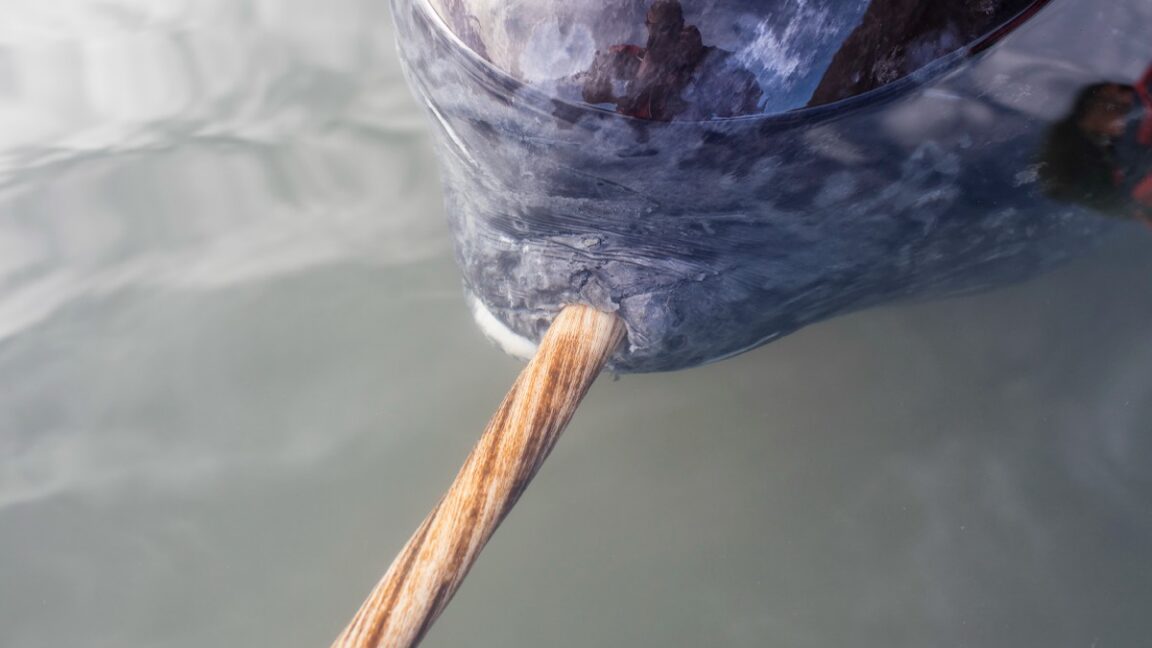
The Double-Helix Structure of Narwhal Tusks
Narwhal tusks are known for their distinctive left-handed twist. Each tusk is made primarily of dentin covered by a thin cementum layer and contains a central pulp chamber. Both dentin and cementum consist of microscopic collagen fibrils reinforced with hydroxyapatite nanoparticles. Researchers have long suspected that the tusk’s large-scale helical shape is linked to the organization of these fibrils, which also determines its strength, flexibility, and durability. A key question was whether similar helical structures exist at the microscopic and nanoscale levels.
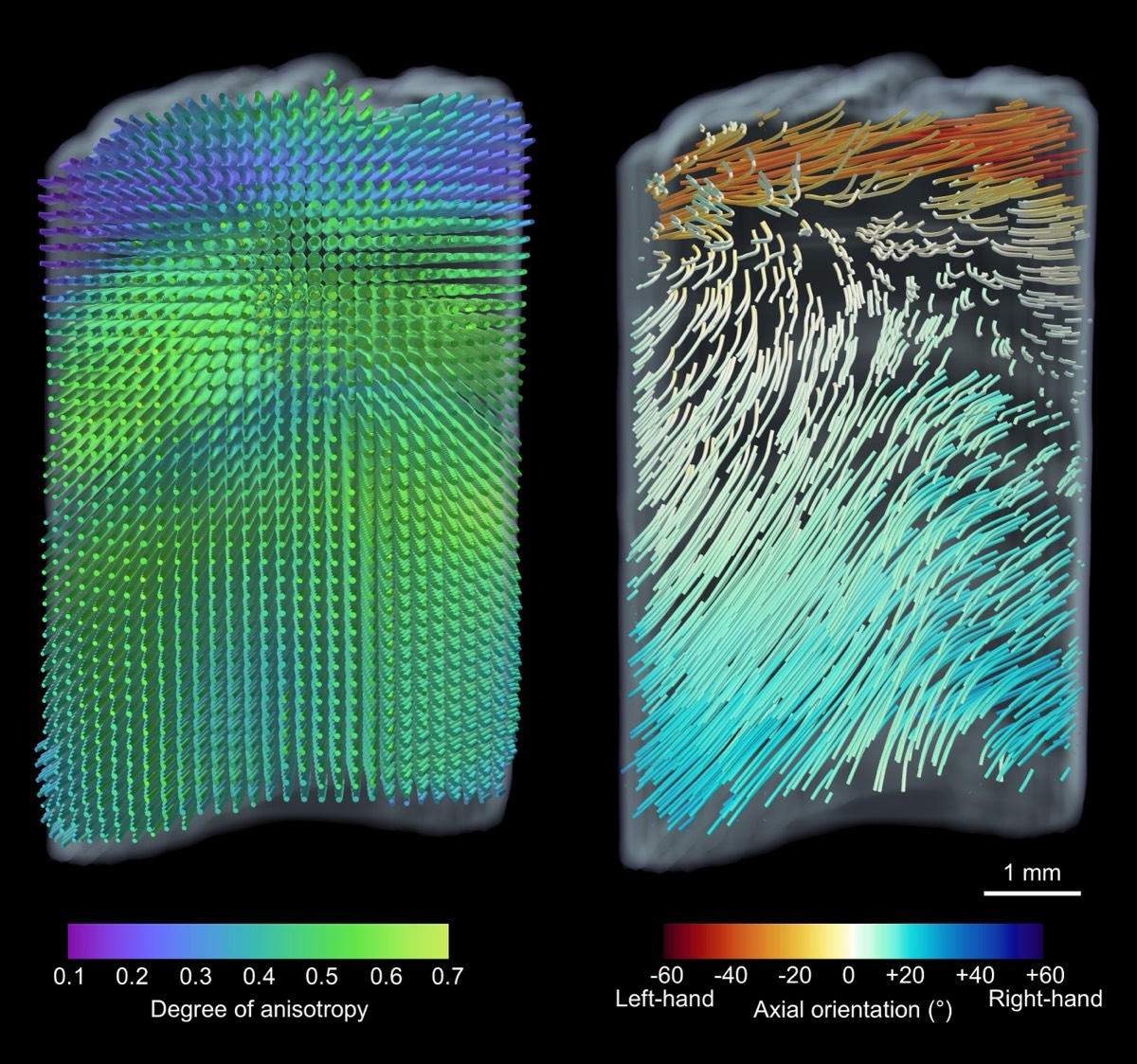
To investigate the internal structure of narwhal tusks in three dimensions, researchers combined several advanced imaging methods. These included X-ray computed tomography, scanning X-ray diffraction, scanning small-angle X-ray scattering, tensor tomography, and birefringence microscopy. The team examined tusk and skull specimens from two male narwhals, conducted standard morphological measurements, and performed mechanical three-point bending tests. The work required access to three major synchrotron facilities in Sweden, Switzerland, and France.
The findings show that collagen fibrils and hydroxyapatite nanoparticles are aligned primarily along the tusk’s longitudinal axis. This alignment creates consistently high anisotropy across every scale. However, the researchers identified small, systematic angular deviations in the fibrils’ orientation. These deviations combine to produce the tusk’s twisted architecture: the cementum forms a left-handed spiral, while the dentin forms a right-handed spiral.
This double-helix structure helps explain the remarkable strength and rigidity of narwhal tusks. Flexible collagen fibers are combined with a hard mineral matrix, allowing the tusk to withstand bending and twisting forces while resisting cracks. The structure may also help narwhal tusks grow relatively straight, unlike the curved tusks of elephants.
The researchers also found that the internal microstructure of the cementum contains fine bundles of collagen fibers that radiate outward. They plan to study this structure in greater detail through future microbeam and nanobeam experiments.
“Because whales can live up to 80 years, whale teeth form a kind of historical record of changing environmental conditions throughout the animal’s life,” said co-author Henrik Birkedal, a researcher at Aarhus University in Denmark. “Because the North Atlantic is currently experiencing very rapid changes, it is important to investigate whether we can track those changes in the hard tissues of narwhal tusks. That is what we are currently working on.”
Study: Nature Communications, 2026. DOI: 10.1038/s41467-026-75689-z
Source: arstechnica.com