


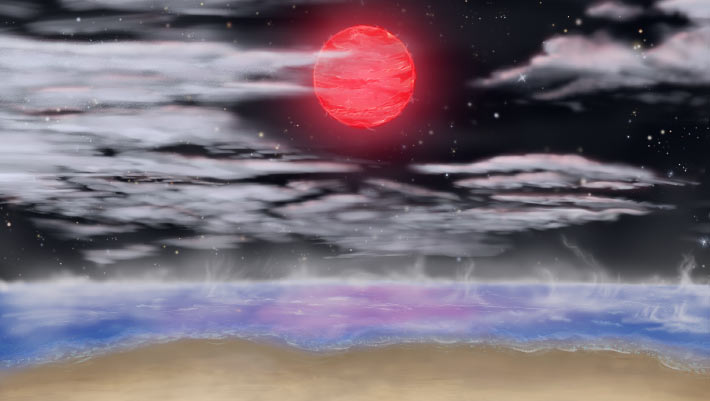
Astronomers have identified a rocky exoplanet, Gliese 3378b, which is approximately twice the size of Earth. This intriguing planet orbits within the habitable zone of its parent star, Gliese 3378, located just 25 light-years away.
Artist’s concept depicting the view from the surface of Gliese 3378b. Image credit: Nikolai Berman / UC Irvine.
Gliese 3378, also known as GJ 3378, LHS 1805, or TIC 322347050, is a red dwarf star located 25 light-years away in the northern constellation of Camelopardalis.
The recently discovered planet Gliese 3378b has around 2.3 times the mass of Earth and completes an orbit every 21.45 days.
Gliese 3378b resides in the habitable zone of its host star—a “Goldilocks” zone where conditions are just right for liquid water to potentially exist on its surface.
“Nearly 70% of the stars in our galaxy are red dwarfs, which is significant,” said Dr. Michael Endl, an astronomer at the University of Texas at Austin. “Understanding the planetary systems around these stars is crucial.”
“This is exciting,” noted Dr. Paul Robertson from the University of California, Irvine. “While 25 light-years may seem far, considering the Milky Way spans about 100,000 light-years, it’s one of our closest cosmic neighbors.”
To study Gliese 3378b, Dr. Endl, Dr. Robertson, and their team utilized the Habitable Zone Planet Detector at McDonald Observatory in Texas and the NEID spectrometer on the WIYN Telescope at Kitt Peak National Observatory in Arizona.
“This super-Earth is ideally placed, receiving approximately 90% of the solar radiation that Earth receives from our sun,” Dr. Robertson explained.
A key mystery remains regarding Gliese 3378b’s atmosphere, or whether it possesses one at all.
This planet sits on what researchers describe as the edge of a cosmic coastline, an area around a star where intense solar radiation could strip away an atmosphere if the planet’s position varies.
For reference, Mars is believed to have once had an atmosphere similar to Earth’s before it was eroded by solar radiation.
“If you reduced Earth to the size of an apple, its atmosphere would be as thin as the skin of that apple,” Robertson stated. “This thin atmosphere is sufficient to maintain surface pressure for liquid water to exist.”
“It could support breathable air, offering some protection against the harsh radiation of space.”
The discovery of Gliese 3378b contributes to the list of potentially habitable exoplanets.
“If a planet in this habitable zone has an appropriate atmosphere, it could warrant extensive studies for biosignatures, liquid water, and other indicators of life that require both atmosphere and adequate heating from the host star,” said Gogod James, a student at UC Irvine.
These findings will be published in the Astrophysical Journal.
_____
Paul Robertson et al. 2026. Revision of the mass and period of the habitable zone super-Earth GJ 3378b: a planet that spans the cosmic coastline. APJ 1005, 32; doi: 10.3847/1538-4357/ae732b
Source: www.sci.news