


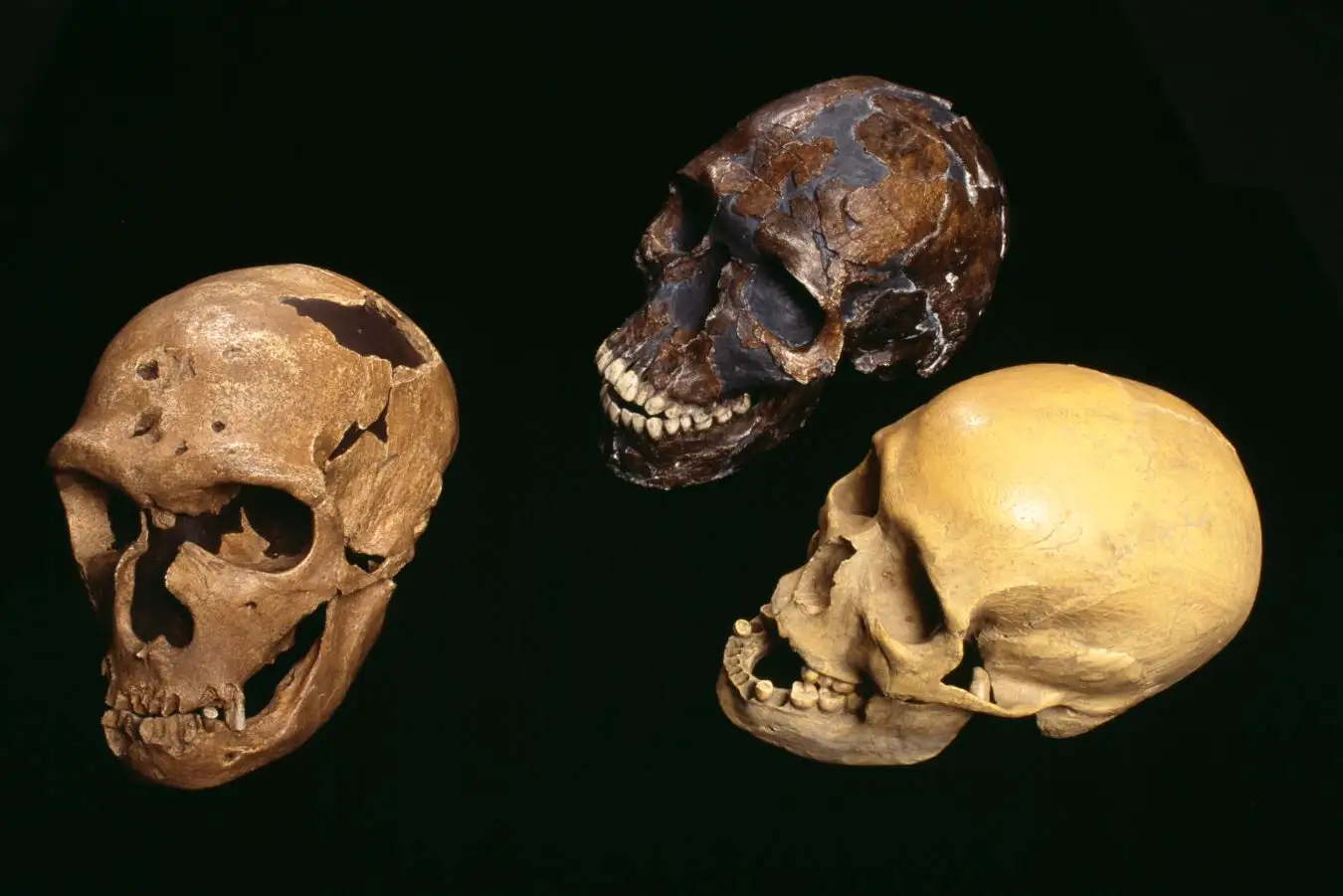
Neanderthal Skull and Homo sapiens: A Comparison of Size and Shape
Photo Credit: Pascal Goetheruk/Science Photo Library
The remarkably large human brain is a defining characteristic of our species. However, recent studies analyzing fossil skulls indicate no strong evolutionary pressure favoring larger brains over the past two million years.
According to Katerina Harvati from the University of Tübingen, Germany, brain size has increased while facial structure has decreased in size. Yet, this growth is not attributed to natural selection.
The evolution of the human brain appears to be influenced by other biological pressures that maintain a consistent size. Periodically, certain factors might have relaxed these constraints, allowing for larger brain growth.
Additionally, Mark Hubbe at the University of Tennessee, Knoxville, examined 87 hominin skulls, including 24 from modern humans (Homo sapiens) and several extinct species, such as Neanderthals (Homo neanderthalensis), Homo erectus, and Homo habilis. They focused on the shape and size of the braincase and facial features.
Over the past two million years, the human braincase expanded to accommodate a larger brain, while human faces flattened, exhibiting less prominent jaws and reduced eyebrow ridges.
“A prevalent hypothesis posits that evolutionary pressure is driven by cognitive enhancement,” notes Harvati. The belief that cognitive abilities confer advantages suggests that ancestral humans gradually evolved larger brains.
To investigate this, Haverty and Hubbe employed a mathematical model to evaluate six different evolutionary scenarios related to skull shape and size. Some scenarios proposed a gradual natural selection for increased brain size, while others suggested random changes or periods of stasis followed by rapid modifications.
Their findings indicated that changes in braincase size are most effectively explained by neutral evolution, where random mutations lead to alterations that accumulate without conferring advantages over existing designs. They also observed evidence of stagnation, suggesting evolution tends to stabilize brain size and shape.
While human facial changes occurred, the pressures to maintain facial features appeared even stronger.
This study sheds light on the mechanisms behind human evolutionary changes, as stated by Amelie Baudet from the French National Center for Scientific Research in Poitiers, emphasizing the need for further investigation into these aspects.
Although this study primarily relied on skull data, it acknowledges that brain size alone does not tell the whole story. Research by Bode indicates that brain structure reorganization, especially in areas like Broca’s area associated with language, significantly changed over two million years.
Some scholars, like Gerhard Weber from the University of Vienna, caution that the sample size may be too limited for definitive conclusions. However, he questions the notion that evolution consistently kept ancestral brain sizes uniform, arguing that our social nature may have led to a division of labor where intelligence wasn’t necessarily a significant advantage.
Weber is intrigued by the idea that our brains may have expanded not because of natural selection, but as constraints were alleviated. “It’s a compelling concept,” he states.
Harvati suggests that learning to cook could have been a pivotal development. Cooking provides more accessible energy through calories, which may have facilitated the evolution of larger brains due to higher energy demands.
Topics:
Source: www.newscientist.com