


The Future of TV: Evolving Yet Again Hisense has introduced a groundbreaking mini RGB TV that not only emits white and blue light, but also showcases vibrant red, green, and blue hues through an advanced LCD panel. This innovative technology aims to deliver “pure color directly at the source,” according to Hisense, a pioneering brand in RGB LED TVs.
The result? An LED TV that offers enhanced color accuracy, superior contrast, and brighter displays, positioning itself as a potential alternative to OLED technology. However, the extent of this improvement can vary based on the types of content you watch and your adaptability to adjust the settings. In my testing of five latest models, I discovered key insights to help you decide which (if any) are worth the investment.
For expert-curated TV recommendations, explore our comprehensive guides, including Best TVs, Best Large TVs, Best OLED TVs, and Best Budget TVs. Learn how to choose the perfect TV for 2026.
The initial RGB TVs debuted in 2025, but it wasn’t until 2026 that various sizes and prices became widely available. Unlike traditional LED models that use standard white or blue LEDs, RGB TVs utilize red, green, and blue backlight modules. However, the terms vary: Samsung and LG refer to it as “Micro RGB,” while TCL and Hisense use “Mini RGB.” Sony emphasizes “True RGB,” claiming no fundamental difference between mini and micro RGB.
My goal during testing was to sift through the marketing jargon. I conducted several benchmarks across all models, enjoying the same movies, and even the World Cup, while testing. The standout finding was that mini RGB (which I collectively refer to all as such) provides remarkable vibrancy, enhanced contrast, and superior clarity even in daylight. Additionally, mini RGB models excel in off-angle viewing.
However, there’s no need to rush and sell your OLED just yet. While mini RGB represents a significant technological advancement, it still relies on LCD panels, unlike OLED, where individual pixels can independently emit color or turn off entirely. My side-by-side comparisons suggest that while mini RGB is a worthy enhancement, it isn’t the ultimate display technology. Current costs are similar, but price reductions for mini RGB TVs are anticipated soon.
Why Choose Mini RGB Over Other Models?
The “mini-RGB” designation highlights emphasis on vibrant colors: red, green, and blue. However, this technology also enhances contrast and brightness by projecting these colors through an LCD panel.
During my tests, I found that brightness, clarity, contrast, and picture mode settings affected visual quality far more dramatically than standard LED or QLED models. I liken it to being behind the wheel of a sports car—you can cruise at low speeds, but true performance emerges when you activate Track mode and fine-tune your setup. Similarly, mini RGB offers extensive customization options.
What is the Cost of an RGB TV?
New technologies often come with a higher price tag. The Hisense UR9 RGB Mini-LED is the most affordable at $1,999 for a 65-inch model, while other mini RGB and micro RGB units start around $4,000—approximately $1,300 more than a comparable OLED. Flagship models from LG and Samsung hover around $2,700 for the same screen size, while LED and QLED options can be found for as low as $500.
How Easy is TV Installation?
As with most contemporary TVs, ample information exists online regarding wall mounting. I found a YouTube tutorial detailing step-by-step instructions. Primarily, use a stud finder to ensure that the brackets are affixed to the studs rather than just the drywall, a quick process that takes merely minutes.
However, for larger mini RGB models, such as the TCL RM9L RGB-Mini LED, circumstances change if your TV exceeds 100 pounds; you will need to utilize multiple studs or install additional mounting brackets.
Best Overall RGB TV
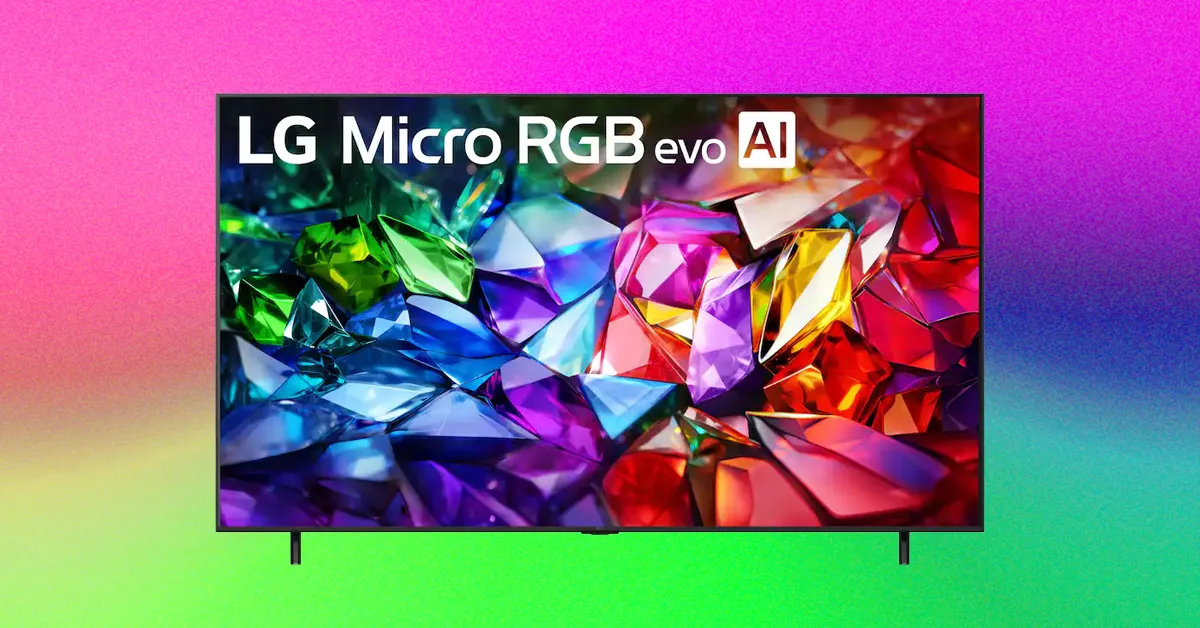
LG’s high-end offerings may carry a higher price tag, but they often deliver exceptional value. The LG Micro RGB Evo is no exception. The 75-inch model I tested retails for $4,500 (currently discounted by $500) and stands out with its bright, colorful display.
Setup was straightforward: just insert the legs and secure them. My one minor critique is that the legs could be a bit sharper. In terms of connectivity, the LG Micro RGB Evo features four HDMI 2.1 ports, one Ethernet port, one optical digital output, one coaxial connection, and two USB 2.0 ports. Its WebOS platform is versatile but can become cluttered with too many apps and advertisements.
Once I familiarized myself with the picture settings, the visuals appeared impressively vibrant on this TV. However, some default settings, such as Filmmaker mode, resulted in visuals that appeared overly dark on Netflix’s Awake but came alive with rich colors in Disney+’s Tron: Ares.
The LG Micro RGB Evo performed exceptionally well for console gaming, although I encountered compatibility issues with my gaming laptop. Using the Alienware 16X Aurora, LG’s variable refresh rate option, termed Motion Booster, didn’t function as expected. Nevertheless, its native 165Hz refresh rate made gaming a visually stunning experience, especially in Crimson Desert.
Source: www.wired.com