


Close Menu
HitechubHitechub
    What's Hot
    Science

    NASA’s Hubble and Webb Telescopes Discover Ancient World Preserving Clues to the Past

    Technology

    A bricklayer robot has set a new record

    Science

    New Study Finds Some of the Smallest Bee Species Are the Most Visible

    Important Pages:
    • About Us
    • Privacy Policy
    • Terms & Conditions
    Facebook X (Twitter) Instagram Pinterest
    Facebook X (Twitter) Instagram
    HitechubHitechub
    Tuesday, November 24
    • Shop
      • Fashion
        • Mens
        • Womens
        • Accessories
          • Handbags
          • Keychain
          • Masks
          • Money clicps
          • Neck Pillow
          • Rings
          • Towels
          • Wallets
        • Jewelry
        • Watches
        • T-shirts
        • Hawaiian shirts
        • Vests
        • Swim trunks
        • Swimsuits
      • Fun
        • Magic cubes
        • Magnifiers
        • Misc
        • Photo books
        • Puzzles
        • Toys
      • Home
        • Cleaning/Care
        • Mailbox covers
        • Mugs
        • Pot Holders
        • Spoon
      • Office and Electronics
        • Chairs
        • Office Supplies
        • IPad cases
        • Laptop stickers
        • Mouse pads
        • Notebooks
        • Pencil bags
        • Pens
        • Phone cases
      • Personalized
      • Pets
      • Sports
        • Cycling
          • Balaclava Mask
          • Bike Bell
          • Bike Computer
          • Bike Fender
          • Bike Grips
          • Bike Kickstand
          • Bike Light
          • Bike Locks
          • Bike Mitts
          • Bike Pumps
          • Bike Repair Stand
          • Bike Seat
          • Bike Trainer
          • Bike Wheels
          • BIKES
            • Folding Bikes
            • Road Bikes
          • Carbon Fiber Bike Products
          • Cycling Mask
          • Kid’ Bike Helmets
          • Inner Tube
          • Motorcycle Bag
          • Nylon Pedals
          • Adult Helmets
          • Photochromic Sunglasses
          • Soft Coolers
          • Suction Cup Bike Rack
          • Tool accessories
          • Winter Cloth
          • Heart Rate Monitor
        • Outdoors/Camping
          • Outdoor Bags
        • Sweatband
    • Technology
      1. AI
      2. Gadgets
      3. View All

      This is the most popular CEO in the world

      Sectors in which “Chat-GPT” is most often used

      Artificial intelligence has begun to “swallow” professions

      The unusual robot conductor of a concert in Seoul

      Here’s how you can tell if your phone is being tapped

      PlayStation 5 becomes a completely silent console and gets more space

      This is the first phone that can be used to park a car

      Best Gaming Laptops 2023: Powerful Portables for PC Games

      Amazon Reveals AI Hacker Agents Discovered and Exploited a Zero-Day With Minimal Human Intervention

      Meta’s Muse AI Is Now Available in the UK: Helpful but Tedious

      Spanish La Liga Confirms Hackers Stole Soccer Fans’ Personal Information

      Please provide the title you want rewritten.

    • Science
      1. Space
      2. Wheels
      3. View All

      Space Perspective: A Journey to the Edge of Space

      5 Fascinating Facts About Space

      Space Exploration: Unveiling the Wonders of the Universe

      Toyota wants to make a new generation battery with a range of up to 1,200 km

      Meet Toyota’s lunar “baby” that could make exploring the Moon easier

      What does a night drive look like with one of the most beautiful cars in the world: the Rolls-Royce Ghost

      2,200-Year-Old Roman Shipwreck Reveals Ancient Waterproofing Technique

      Accelerating Drug Development Through Public Funding and Private Innovation

      2,900-Year-Old Artemis Sanctuary Discovered on Greek Mountaintop May Have Been Ancient Worship Destination

      NASA’s Webb Telescope Reveals How Supernova Dust Records Stellar Evolution

    HitechubHitechub
    Home » Why Humans Have Collected Crystals for 780,000 Years: Insights from Chimpanzees
    Science

    Why Humans Have Collected Crystals for 780,000 Years: Insights from Chimpanzees

    Share Facebook Twitter Pinterest WhatsApp
    Share
    Facebook Twitter LinkedIn Pinterest WhatsApp

    Recent archaeological discoveries have revealed that crystals were collected by early human relatives from the Homo tribe nearly 780,000 years ago. This behavior is intriguing as these crystals were not utilized as tools, weapons, or jewelry. What, then, made these rare stones worthy of preservation?

    New insights from research published in Frontiers of Psychology offer potential explanations. Spanish researchers examined the allure of crystals by studying how chimpanzees, our closest living relatives, interacted with them. Their findings indicate that the fascination with crystals may stem from deep evolutionary origins that predate modern humans.

    “We demonstrated that cultured chimpanzees can distinguish crystals from other stones,” stated lead author Juan Manuel García-Ruiz, Ikerbasque Research Professor of Crystallography at the Donostia International Physics Center in San Sebastian. “We were surprised by the intensity and naturalness of chimpanzees’ attraction to crystals, suggesting a deep evolutionary connection to these objects.”

    Chimpanzees Display Fascination with Crystals

    Despite diverging from a common ancestor six to seven million years ago, humans and chimpanzees share numerous behavioral and genetic traits. To explore whether a fascination with crystals is among them, researchers introduced two groups of enculturated chimpanzees at the Rainfur Foundation to crystals. The first group included Manuela, Guillermo, Ivan, Yaqui, and Toti; the second group comprised Gombe, Lulu, Pascual, and Sandy.

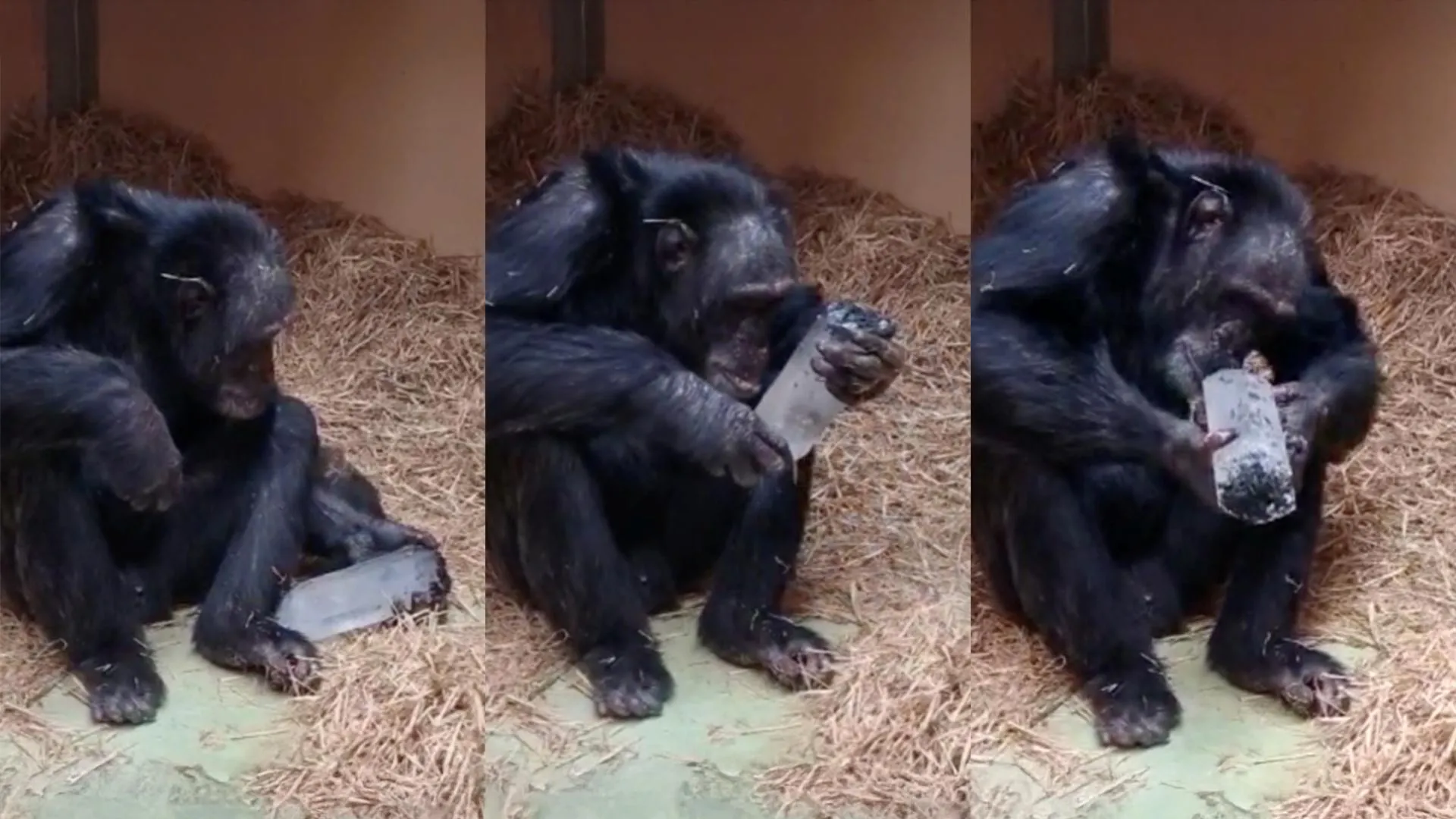
    In the first experiment, researchers placed a large crystal, referred to as a monolith, alongside a similarly sized ordinary rock. Initially, both objects attracted the chimpanzees’ attention, but the crystal soon emerged as the clear favorite, while the regular rock was largely overlooked.

    Once the crystal was removed from the display, the chimpanzees meticulously examined it, rotating and tilting it for different angles of view. Ivan, one of the chimps, eventually picked up the crystal and intentionally transported it back to his dormitory.

    Researchers found that the chimpanzees’ curiosity peaked immediately after encountering the crystals, gradually diminishing over time. This pattern mirrors the way novelty wears off in humans. Eventually, the researchers had to exchange bananas for yogurt to entice the chimpanzees back to the study.

    Chimpanzees Quickly Identify Crystals Among Pebbles

    The second experiment tested whether chimpanzees could recognize smaller crystals analogous to those gathered by ancient humans. Researchers mixed a small crystal into a pile of 20 pebbles, and remarkably, a chimpanzee picked it out within seconds.

    Even when pyrite and calcite crystals, which differ in shape from quartz, were included in the mix, the chimpanzees still discerned and selected the crystal type stones.

    “The chimpanzees began to investigate the transparency of the crystals with keen interest, lifting them to eye level and peering through them,” said García-Ruiz. The animals continued examining the crystals for several hours.

    Notably, a chimpanzee named Sandy exhibited particularly interesting behavior. She carried both pebbles and crystals in her mouth to a wooden stand where she organized them into separate groups.

    “She isolated three different types of crystals based on clarity, symmetry, and luster from the pebbles. This capacity to recognize crystals despite their variations surprised us,” García-Ruiz noted. Since chimpanzees usually do not carry objects in their mouths, the researchers speculate that Sandy may have been hiding the crystals, suggesting she considered them valuable.

    What Crystals Represented for Early Humans

    The research team emphasized that future studies should explore personality differences among chimpanzees, although they did not examine whether certain individuals show a greater interest in crystals.

    “There’s a Don Quixote and a Sancho; some are attracted to the clarity of crystals, while others might focus on their scent or edibility,” García-Ruiz highlighted.

    The researchers also pointed out that the chimpanzees in the study were accustomed to human environments, regularly encountering objects not found in the wild. They argue that similar experiments should eventually involve less culturally influenced apes, ideally in wild populations.

    By synthesizing findings from both experiments, the research team concluded that transparency and geometric shape are key features that make crystals appealing. These same traits may explain why our early ancestors chose to gather them.

    Unlike the typically curved and branched shapes of trees, mountains, rivers, clouds, and animals, crystals possess flat surfaces and straight edges, representing unique polyhedra in nature. Researchers propose that these unusual forms could have captured the attention of early humans as they sought to comprehend their surroundings.

    “Our research sheds light on the fascination with crystals and contributes to the understanding of the evolutionary roots of aesthetics and worldviews,” concluded García-Ruiz. “We have evidence that crystals have held a special place in our hearts for at least six million years.”

    Source: www.sciencedaily.com

    Share. Facebook Twitter Pinterest LinkedIn WhatsApp
    Previous ArticleApple’s Face ID Inventor Proposes AI-Powered Solutions for Brain Health Analysis
    Next Article Revolutionary Painted E-Tattoos: The Future of Wearable Biosensors

    Related Posts

    Science

    2,200-Year-Old Roman Shipwreck Reveals Ancient Waterproofing Technique

    Science

    Accelerating Drug Development Through Public Funding and Private Innovation

    Science

    2,900-Year-Old Artemis Sanctuary Discovered on Greek Mountaintop May Have Been Ancient Worship Destination

    Science

    NASA’s Webb Telescope Reveals How Supernova Dust Records Stellar Evolution

    Science

    Growing Lava Dome Oozes Like Toothpaste from Russia’s Hyperactive Snow-Covered Volcano, Seen from Space

    Science

    Delia Smith Joins Campaign Against £1.2 Billion Keswick Data Centre

    Science

    NASA+ Documentary Follows Europa Clipper’s Journey Into Deep Space

    Science

    Volcanic Eruption Widens Iwo Jima Coastline

    Add A Comment
    Leave A Reply Cancel Reply

    Stay In Touch
    • Facebook
    • Twitter
    • Instagram
    • Pinterest
    Top Picks
    Technology

    Trump Threatens to Ban U.S. Companies From Building AI Data Centers Overseas

    Data centers are expanding rapidly to support artificial intelligence services such as Claude and ChatGPT,…

    NASA’s Webb Telescope Unveils Concealed Planet in Iconic Star System

    Woman Carried a Stone Baby in Her Abdomen for Three Years: A Rare Medical Diagnosis

    How Healthier Global Diets Can Cut Agricultural Emissions by 85%

    Taylor Swift’s Madison Square Garden Cameras Go Dark: Unpacking the Controversy

    Most Popular
    Technology

    How Russian Mathematicians Taught AI Models to Communicate Without Words

    Technology

    D-Link Warns of Critical Zero-Day Vulnerability in DIR-822A Router

    Categories
    • AI (9)
    • Gadgets (6)
    • Science (3,556)
    • Space (3)
    • Technology (3,199)
    • Wheels (3)
    Our Picks
    Science

    Super El Niño Predictions: Increasing Likelihood of Humanitarian Crisis Ahead

    Science

    Early Universe Star Collisions May Explain the Formation of Massive “Star Monsters,” Study Suggests

    © 2026 Hitechub.
    • Home
    • About Us
    • Privacy Policy
    • Terms & Conditions

    Type above and press Enter to search. Press Esc to cancel.

    GDPR Cookie Banner

    We are using cookies to give you the best experience on our website.

    You can find out more about which cookies we are using or switch them off in .

    Ad Blocker Enabled!
    Ad Blocker Enabled!
    Our website is made possible by displaying online advertisements to our visitors. Please support us by disabling your Ad Blocker.