


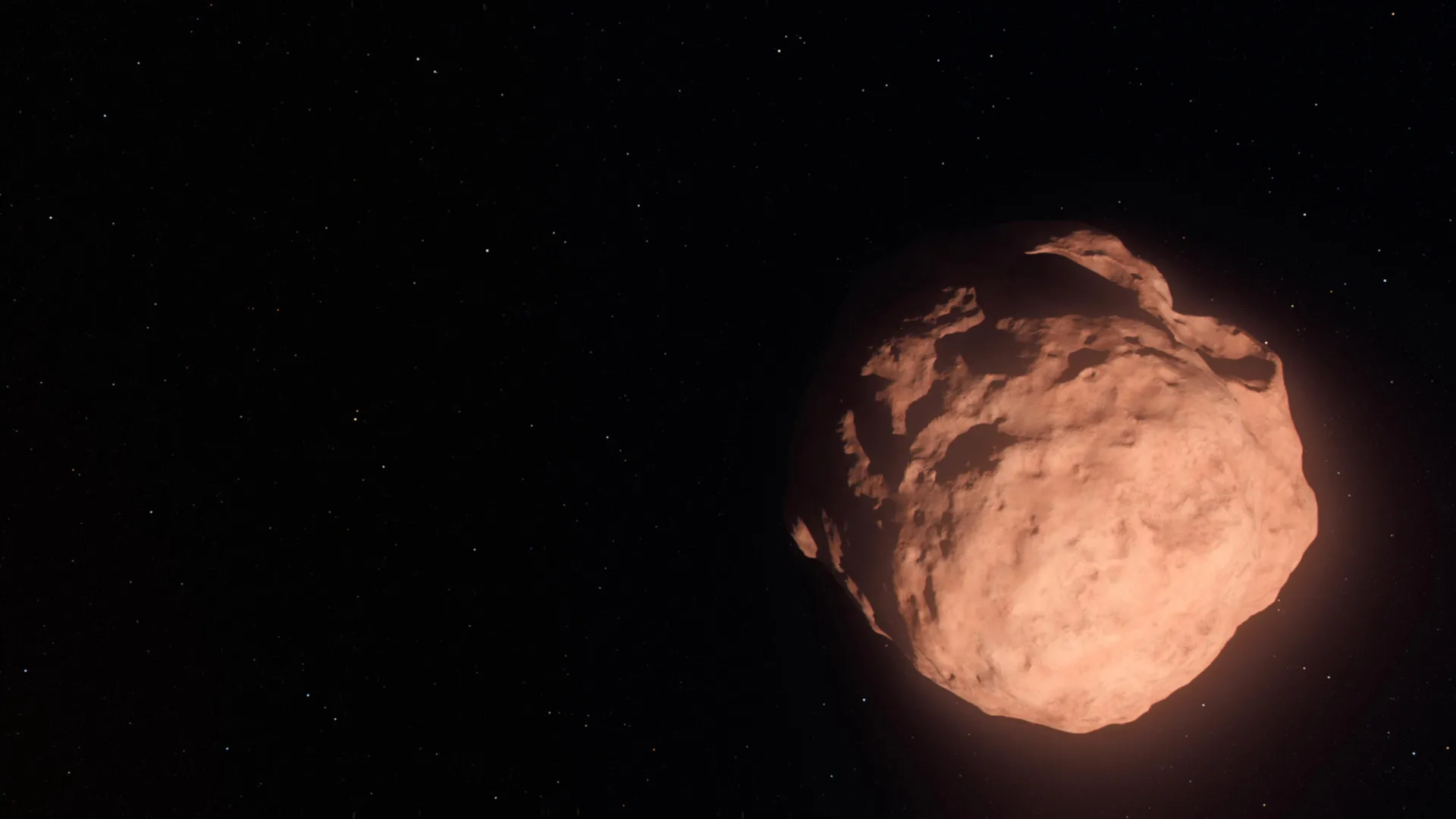
NASA’s Hubble Space Telescope and James Webb Space Telescope have revealed surprising clues about the early solar system by observing some of the smallest and faintest objects ever detected beyond Neptune. The discovery challenges existing ideas about planet formation: there are fewer small trans-Neptunian objects (TNOs) than some models predict, yet their colors resemble those of much larger objects, suggesting that these distant icy remnants have preserved evidence of their origins for billions of years.
Ancient components of the solar system
For the first time, astronomers combined observations from Hubble and Webb to study TNOs—small objects that orbit the Sun far beyond Neptune. The observations revealed 27 previously unknown objects and an unexpected pattern: small TNOs were less common than predicted by some theories, and their colors closely matched those of larger objects in the same distant region.
These frozen remnants offer a rare opportunity to study the material that eventually formed planets. Most are extremely difficult to detect and shine more than 100 million times fainter than objects visible to the naked eye. Two related studies published in Astronomical Journal investigated the newly identified objects to learn more about their sizes, compositions and ancient histories.
Scientists believe planet formation began when dust and pebbles orbiting the young Sun gradually accumulated into larger bodies. Over time, these materials formed nearly city-sized objects known as “planetesimals,” which eventually combined to produce the planets seen today.
That final stage of growth did not occur for many objects beyond Neptune. Instead of developing into full-sized planets, countless small bodies remained, preserving evidence of the solar system’s early formation.
To investigate these distant survivors, a research team led by a doctoral candidate from the University of Victoria in Canada, working under the direction of the National Research Council of Canada and Northern Arizona University in Flagstaff, conducted the deepest survey of TNOs ever carried out. Both space telescopes observed the same region of the sky at the same time: Hubble collected visible light, while Webb collected infrared light.
By combining the observations, astronomers can study the objects’ colors, estimate their sizes and determine how they orbit the Sun. Their colors are particularly valuable because they provide clues about surface chemistry, much like fingerprints that reveal an object’s identity and history.
Two groups of distant ice worlds
The researchers focused on two distinct populations of TNOs, known dynamically as “cold” and “hot” TNOs. These terms describe orbital behavior, not temperature.
Most cold TNOs remain near the region where they formed. They follow relatively circular paths around the Sun and stay close to the plane in which most planets in the solar system orbit.
Hot TNOs have experienced more turbulent histories. They originally formed between the current orbits of Uranus and Neptune, but were scattered outward as the giant planets shifted position early in the solar system’s development. Their current orbits are more elongated and carry them above and below the solar system’s main orbital plane.
Despite their very different histories, the two populations show unexpected similarities. Even the smallest objects appear to retain surface properties resembling those of larger TNOs.
A small world preserving ancient origins
Before the observations, scientists suspected that smaller TNOs would show clear evidence of repeated collisions over billions of years. Impacts could have damaged the objects, exposed new material and altered the composition or color of their surfaces.
Instead, the newly discovered objects displayed the same general color relationships seen in larger TNOs. This suggests that impact-related surface changes may have been much smaller than expected.
One possibility is that these objects experienced fewer impacts than astronomers previously assumed. Another is that their surfaces somehow retained their original compositions after collisions. Researchers have not yet determined which explanation is correct.
Anastasia Morgan, a PhD candidate at Northern Arizona University who led the study on color and composition, said, “You can even imagine scenarios where the surface composition changes upon impact and fragmentation, and the surface color of small TNOs is different compared to their larger siblings. So it’s very interesting to see that the tiniest objects somehow ‘remember’ and preserve the history of how they were made.”
“These dynamically ‘hot’ TNOs retain traces of their birthplace, even though they have since been scrambled in orbit,” said co-author David Trilling of Northern Arizona University.
The findings indicate that both hot and cold TNOs have maintained the color patterns associated with their formation, with surprisingly little apparent change since the beginning of the solar system. These ancient objects may therefore preserve important information about the environments in which they first formed.
Webb finds that the small worlds are smaller than expected
The James Webb Space Telescope provided another important piece of the puzzle. Its observations allowed scientists to estimate how many objects of different sizes were present and revealed unexpected similarities between the two populations.
Although hot and cold TNOs formed in different parts of the early solar system, their overall size distributions were surprisingly similar. This suggests that the processes involved in planetesimal production may have operated in much the same way across different environments.
“It’s very interesting that during planetesimal formation, the cold and hot populations end up having the same size distribution, even though they formed in different regions of the early solar system,” said Mariel Eduardo, a PhD candidate at the University of Victoria who led the study on size distribution.
The researchers also identified a surprising shortage of very small TNOs compared with predictions from some existing planet-formation models. Understanding why the number of detected objects declines could help scientists refine their explanations of how the solar system’s original components developed.
Webb’s extraordinary sensitivity enabled it to detect 27 extremely faint objects. One is so faint that finding it would be comparable to standing on Earth and spotting a swarm of tiny fireflies on the Moon.
The smallest object is only 3 miles (5 kilometers) in diameter, making it about five times smaller than anything detectable by even the most sensitive telescopes on Earth.
Hubble and Webb reveal new clues to planet formation
These discoveries depended on the complementary capabilities of NASA’s two space observatories. Hubble’s ability to detect visible light and Webb’s sensitivity to infrared light gave scientists a more complete view of distant objects than either telescope could provide alone.
Together, the telescopes have opened a new window into a largely unexplored population of ancient solar system remnants. Their similarities, preserved surface features and unexpected numbers provide important clues about how planets formed billions of years ago.
Source: www.sciencedaily.com