


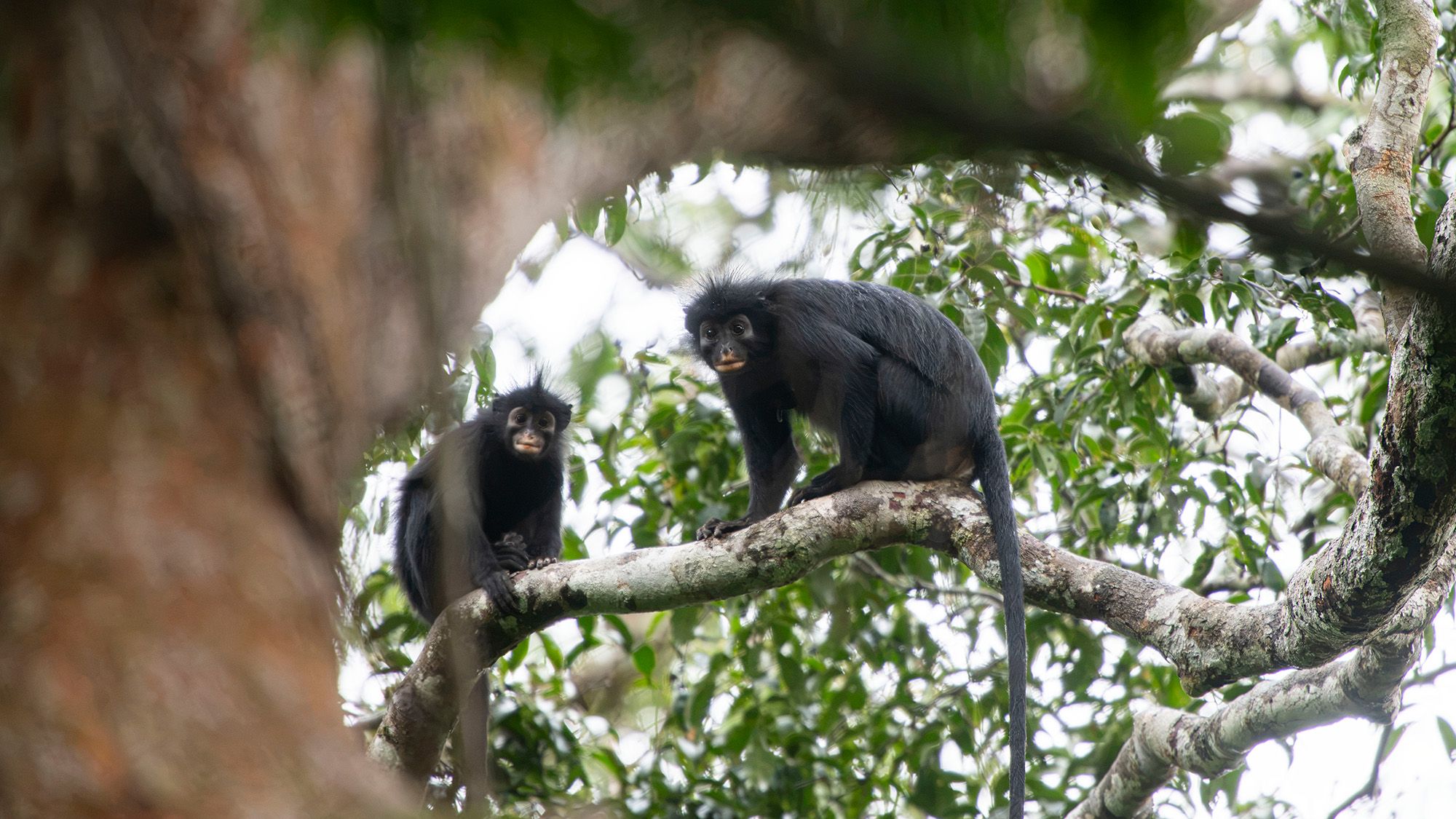
Exciting news has emerged from the Democratic Republic of Congo (DRC), where scientists have discovered a new species of monkey characterized by vibrant orange lips and a unique roar and snort. This remarkable primate inhabits secluded regions of the DRC.
This marks only the fifth new monkey species identified in Africa over the last 75 years, leading researchers to speculate that even more undiscovered species may exist in this area. The newly recognized monkey has been classified as colobus congoensis, popularly known as ‘Likweli’ in the local Kilanga language, named after its environmental home.
“This discovery is extraordinary because finding new primate species that have never been documented is quite rare, especially for relatively large ape species,” said Joshua Linder, an anthropologist at the Forest Collective, a nonprofit focused on rainforest conservation.
In 2008, conservationists ventured into a dense rainforest in Lomami National Park, capturing a blurred image of an unidentified monkey. A similar sighting in 2018 spurred further investigation by co-authors such as Junior Amboko, researchers from Lomami National Park, and anthropologists from Florida Atlantic University.
To confirm their findings, the researchers shared photographs with residents in 52 villages surrounding the park.
“The local communities are very knowledgeable about the flora and fauna of the forest,” Amboko shared with LiveScience. “In just eight villages, hunters recognized the monkeys and understood their economic value, but even they were largely unaware of this new species.”
The researchers conducted their study in Lomami National Park in the Congo Basin, DRC.
(Image credit: Daniel Rosengren, Frankfurt Zoological Society)
Local hunters refer to this new species as “Likweli,” although the meaning remains unclear. In some Mituku communities, it is called “kasaba nkoni,” interpreted as “branch shaker,” referencing the monkey’s agile movements.
Receive the world’s most captivating discoveries in your inbox.
From 2018 to 2022, researchers noted 114 sightings of C. congoensis across an estimated 660 square miles (1,700 square kilometers) area, naturally separated by the Lomami and Lualaba rivers. Their findings were published on July 15 in the journal PLOS ONE.
This monkey typically resides in groups of 1 to 20 individuals, showcasing a mostly shiny black coat with distinctive orange patches around its lips and nose. Its exposed gray cheekbones create an illusion of wearing a mask, further accentuated by white fur around the anal region.
“We consider the face and underside as unique features,” noted Kate Detwiler, co-author and anthropologist at Florida Atlantic University. “The distinctive orange-cream coloration of the facial skin contrasts beautifully with the white spots found on its back.”

DNA analysis confirmed C. congoensis as a previously unknown species.
(Image credit: Daniel Rosengren, Frankfurt Zoological Society)
Weighing approximately 15 pounds (7 kilograms), this monkey produces a deep, resonant roar coupled with a distinctive snort, helping to differentiate it from other colobus species.
Through DNA sequencing of samples taken from monkeys that were unfortunately killed by hunters for the illegal bushmeat trade, researchers verified that C. congoensis represented an entirely new species.
“DNA analysis revealed significant differences in key regions of the mitochondrial genome when compared to other colobus monkeys,” stated Professor Detwiler.

Researchers suggest this new species diverged around 5.78 million years ago.
(Image credit: Daniel Rosengren, Frankfurt Zoological Society)
These monkeys co-exist with Angora colobus (Angolensis colobus), but their closest relatives, Crocolobus monkeys (colobus satana), are located approximately 750 miles (1,200 kilometers) west across Cameroon, Gabon, and Bioko Island.
Linder, not involved in the study, stated, “It is also significant that the closest living relative of this new species is Crocolobus, found 1,200 kilometers away in West Africa,” offering insights into primate evolution.
Professor Detwiler estimates that the divergence between this new species and its relatives occurred between 5.78 and 3.44 million years ago, reshaping our understanding of African monkey evolution.
Due to their limited geographic distribution, rarity, and ongoing habitat loss, researchers recommend classifying C. congoensis as an endangered species on the IUCN Red List.
This finding supports the earlier identification of another monkey, Lesula (long-tailed macaque), reported in 2012 by a research team, which included Detwiler.
The Congo rainforest is the second-largest tropical forest globally, second only to the Amazon, with about 60% of it located in the DRC. “This region is a treasure trove of biodiversity,” Amboko commented, asserting the potential for even more undiscovered primate species. “If we can find two new large primate species, who knows how many more mammals, fish, reptiles, and plants await discovery?”
Test your knowledge about chimpanzees and great apes with our engaging Primate Quiz!
Source: www.livescience.com