


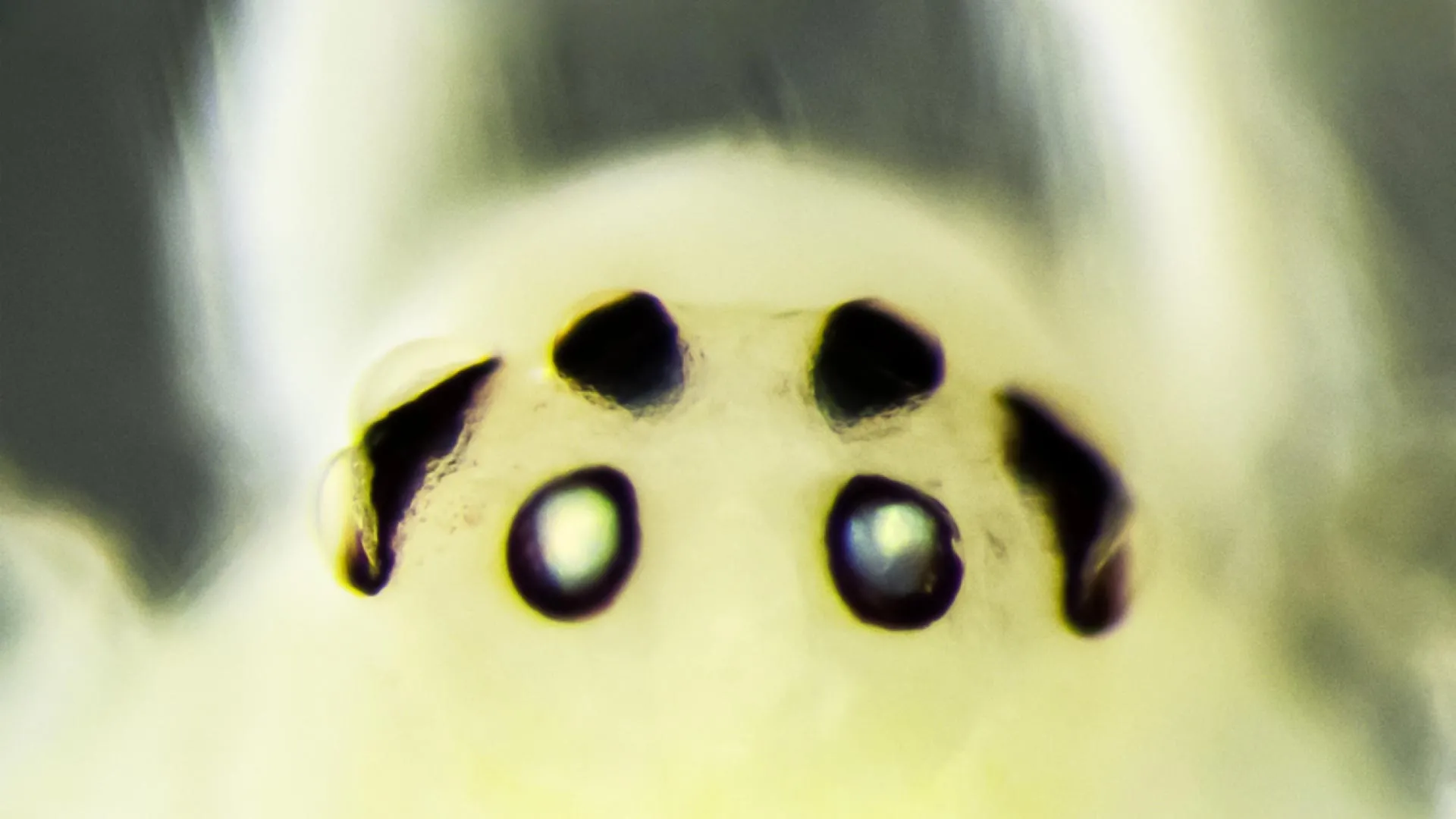
A tiny spider featuring a vibrant red smile on its back has astonished scientists by reemerging thousands of miles away from its famous relative’s original habitat. For over a century, the happy-faced spider was thought to exist solely in Hawaii, making it one of the most renowned and rare arachnids globally.
Recently, researchers from the Forest Research Institute and the Regional Museum of Natural History have discovered a new species in the mountains of Uttarakhand, India. They named it Teridion Himalayana, also known as the Himalayan Happy Face Spider, due to its striking resemblance to its Hawaiian counterpart.
Accidental Spider Discovery
“This discovery was serendipitous as our initial research focused on ants,” stated Devi Priyadarshini, a scientist at the Regional Museum of Natural History and co-author of the study.
“My co-author, Ashirwad Tripathy, and I were collecting spiders from high-altitude regions for identification. One sunny day, he shared a photograph taken from the underside of his car that resembled the Hawaiian spider I had seen during my master’s program. I was in shock. Thanks to their uncanny resemblance, we immediately realized we struck gold and requested all the morphs he found, leading to further discoveries in October 2023.”
Priyadarshini has long been passionate about studying high-altitude spiders due to the distinctive vegetation and landscape of these regions compared to lower elevations.
“This seemed like an exciting entry point for investigating other polymorphic species in the area,” she remarked.
Ashirwad emphasized that broader field studies might unveil further variation within the species.
Named After the Himalayas
The newly identified spider was discovered at an elevation exceeding 2,000 meters. The species name Himalayana honors the majestic mountain range where it was found.
“We chose ‘Himalayana’ as the species name to pay tribute to the Himalayas, which not only protect our nation but also preserve its rich biodiversity,” Ashirwad explained.
“As the first polymorph found in this region, we aimed to create an ode to these great mountains.”
DNA Confirms New Spider Species
Research findings published in the open-access journal Evolutionary Systematics document 32 distinct color forms, or ‘morphs’, collected from three locations in Uttarakhand: Makk, Tara, and Mandal.
Genetic analysis confirms that this new spider exhibits an 8.5% genetic divergence from the Hawaiian happy-faced spider Teridion Himalayana. This indicates a unique evolutionary lineage that developed independently in Asia.
The Mystery Behind the Spider’s Smile
These spiders are easily recognizable due to their colorful smile-like markings, yet the reasons behind their evolution remain a mystery.
“The emergence of polymorphism is both complex and unique,” Priyadarshini explained. “While these patterns undoubtedly enhance survival in the wild, the functional role of these markings throughout their life cycle still needs to be deciphered, suggesting deeper genetic mysteries lie ahead.”
Ashirwad added that spiders were found alongside other small creatures displaying similar color patterns, indicating that broader ecological or evolutionary factors might be influencing these traits.
An Interesting Connection with Ginger Plants
The researchers also uncovered another intriguing similarity between the Himalayan and Hawaiian species. Like their Hawaiian counterparts, the newly identified spider frequently inhabits ginger plants (Hedychium sp.).
Given that ginger is not native to Hawaii, this shared preference prompts new questions regarding the spiders’ evolutionary history.
“How did the spiders choose the exotic ginger species?” Priyadarshini questioned.
“If T. Himalayana is an older cousin of T. gralater, discovered 125 years later, it may sound audacious, but it will be our future research focus to establish any potential connections, if they exist at all.”
Source: www.sciencedaily.com