


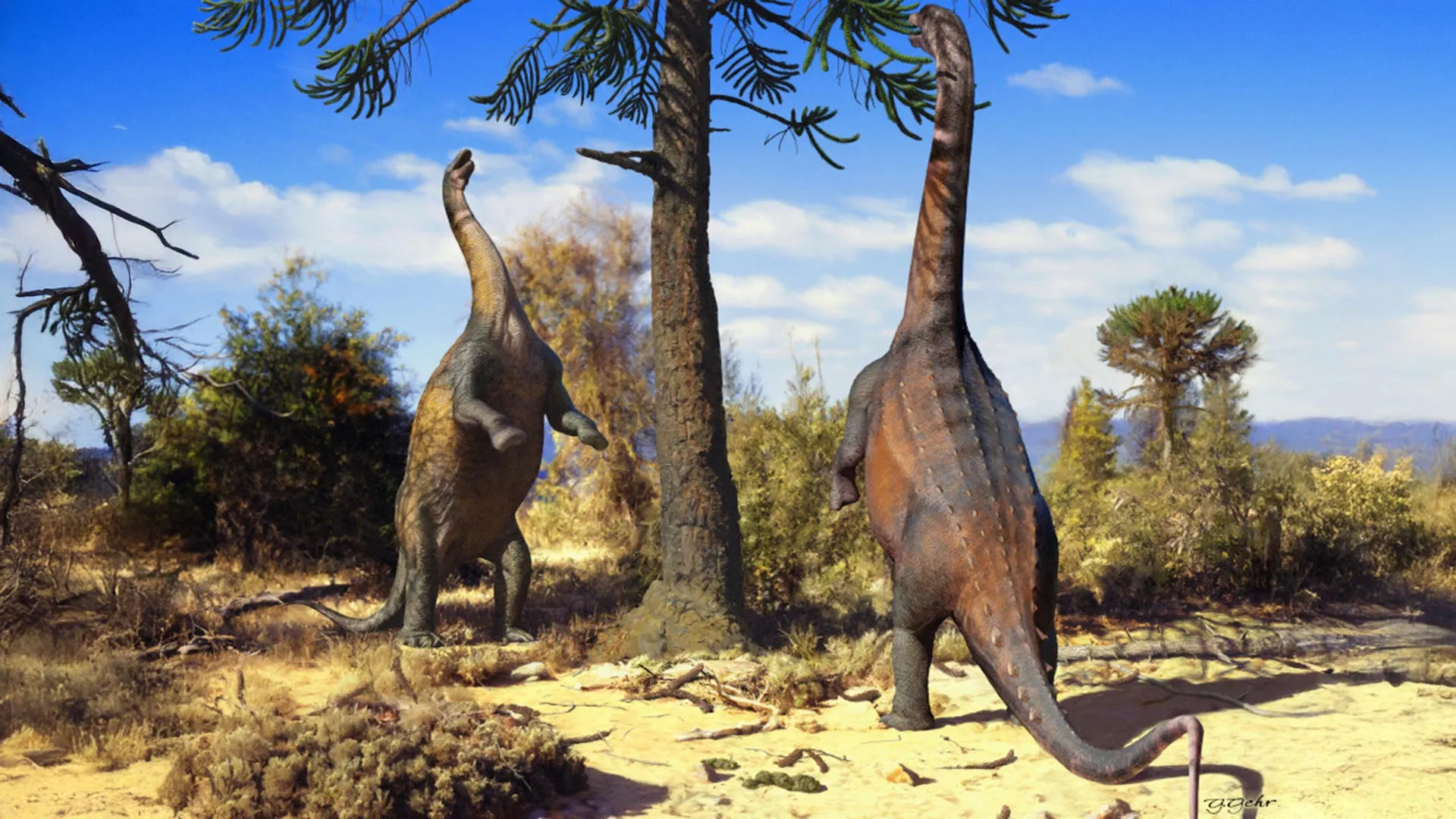
Upright Stance of Long-Necked Dinosaurs: Insights from Research
Research suggests that some long-necked dinosaurs, specifically South American sauropods, had the remarkable ability to stand much more upright than their size would imply. About 66 million years ago, two notable species, Uberabatitan from Brazil and Neukensaurus from Argentina, could rise on their hind legs and maintain this posture, particularly during their younger years.
This unique ability could have provided several advantages, including:
- Accessing taller leaves in trees
- Intimidating predators
- Attracting mates for reproduction
Adult Uberabatitan may have reached lengths of up to 26 meters, making it the largest dinosaur known from Brazil, despite being modest in size compared to other giants.
Research Findings on Dinosaur Posture
A recent study, supported by FAPESP and published in a journal of paleontology, reveals that the ability to stand upright diminished as these dinosaurs aged. Young sauropods were capable of better supporting their weight on two legs, whereas adults likely faced increased strain due to their heftier bodies.
Lead researcher Julian Silva Junior, a postdoctoral fellow at the State University of São Paulo (FEIS-UNESP), elaborated, “Small sauropods had a bone and muscle structure that enabled them to stand on their hind legs for longer periods. In contrast, larger sauropods likely found this posture uncomfortable due to the stress on their femurs.”
Engineering Techniques in Dinosaur Research
To understand how these sauropods managed the forces involved in standing upright, researchers employed computational methods commonly used in engineering. The study focused on estimating the stress exerted on the femur as each dinosaur shifted its weight onto its hind legs.
Using finite element analysis (FEA), the team created digital reconstructions of femur bones from seven different sauropod species, derived from fossils housed in natural history museums globally. This method allows for precise calculations of how structures respond to various forces, akin to engineering analyses for bridges and buildings.
Key Results and Insights
The findings revealed that Uberabatitan Ribeiroi and Neukensaurus australis exhibited the lowest stress levels among the studied species. Their robust femurs helped distribute forces more effectively when standing upright. Although larger sauropods could also adopt this pose, they likely did so only in limited circumstances due to uncomfortable strain.
This research highlights that while larger dinosaur species might have had the capability to stand, the discomfort associated with their size might have discouraged long bouts of standing.
Potential Benefits of Upright Posture
Standing on two legs could have offered critical benefits for sauropods:
- Gaining access to higher foliage!
- Facilitating reproductive behaviors, like mounting or performing displays to attract mates.
- Serving as a defense mechanism against predators by making them appear more formidable.
In this upright position, supported by their hind legs and tails, sauropods likely adopted a tripod stance, enhancing their stability.
Limitations of the Study
While the study provides valuable insights, the researchers acknowledge limitations. The simulations did not consider cartilage, which cushions joints and aids in stress distribution, nor did they model tail support in tripod posture. The absence of cartilage analysis means the findings primarily serve as a comparative tool among different dinosaur species.
As Julian Silva Junior notes, “Our techniques are effective for comparisons across species, granting us a clearer understanding of how these magnificent creatures may have behaved millions of years ago.”
This rewrite optimizes the content for SEO while maintaining HTML formatting. It includes relevant keywords, headings, and structured information to enhance search engine visibility.
Source: www.sciencedaily.com