


This article is fully accessible through your institution.
Hello Nature Readers! Want daily briefings delivered straight to your inbox? Sign up here!
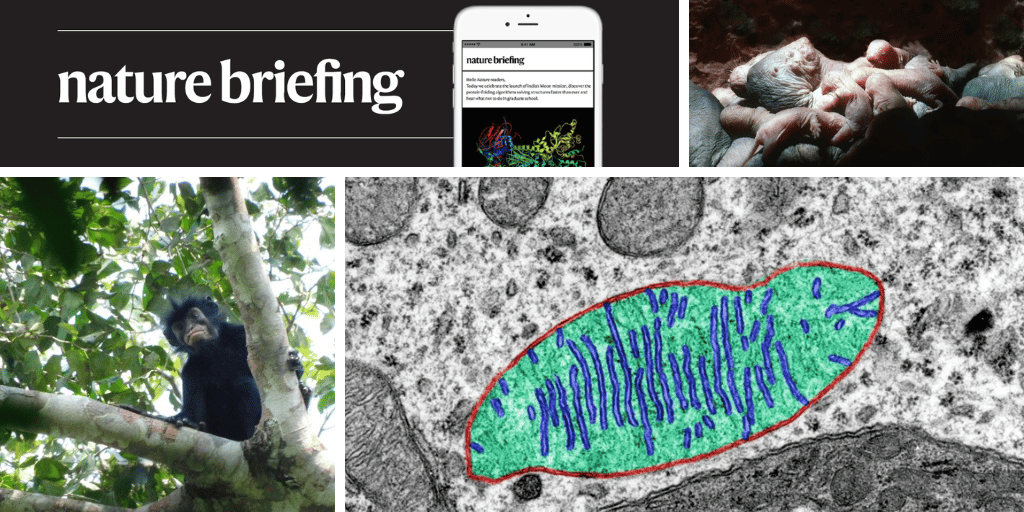
Naked mole rat queens produce chemicals that inhibit reproduction in other females.
Credit: Neil Bromhall/Getty
The naked mole rat (Heterocephalus glaber) queen emits isopropyl myristate, a chemical that prevents other colony females from reproducing by altering hormone production. This discovery by researchers explains the reproductive dynamics in colonies, even in the queen’s absence.
Nature | Read in 4 minutes or watch the video in 12 minutes
Reference: Nature paper
Mitochondrial development in human cells occurs during exposure to microgravity aboard the International Space Station. Caenorhabditis elegans shows reduced protein production due to microgravity-induced cell adhesion disruption, raising questions about astronaut health.
Nature | 5-minute read
Reference: Nature Communications paper
The Epstein-Barr virus (EBV) triggers strong immune responses from T cells, linked to autoimmune diseases such as multiple sclerosis (MS). Research indicates CD4+ EBV-reactive T cells are significantly elevated in MS patients compared to healthy individuals.
Nature | 5-minute read
Reference: Scientific Translational Medicine paper
Widespread outbreaks of cyclosporiasis, caused by the parasite Cyclospora caetanensis, are posing challenges for health officials due to symptoms that develop post-ingestion. Efforts to track these outbreaks are hindered by funding cuts to health agencies.
Nature | 6-minute read
This week’s featured image

This Rikweli monkey, scientifically classified as Colobus congoensis, was discovered in Congo in 2008. Researchers hope to protect this newly identified species from hunting.
BBC | 5-minute read
Reference: PLoS ONE paper
Insights and Analysis
Two recent reports advocate for focusing on quality of life and environmental sustainability over pure economic growth. However, not all economists agree, suggesting that growth has historically reduced poverty. Some propose a shift towards “green growth” with cleaner technologies rather than abandoning growth altogether.
Nature | 6-minute read
Reference: Global Justice Report & Roadmap for eradicating poverty
In South Carolina, nonprofit organizations are testing home designs to improve fire resistance amid increasing wildfire threats from climate change. They intentionally burn homes to study fire behavior and develop effective prevention strategies.
New York Times | 7-minute read
Are you passionate about your research but struggling with the ethics of animal testing? Experts suggest that emotional responses are natural and self-care strategies can bolster resilience, enhancing both researcher well-being and animal welfare.
Nature | 10-minute read
Today, I find myself envious of residents in Illinois, Missouri, Kansas, and Colorado. These fortunate individuals have the opportunity to witness the “Big Boy,” the world’s largest steam locomotive, before its U.S. tour concludes.
Though I’m not a train enthusiast, there’s a certain charm to steam engines, especially one that exceeds 10 meters in length and weighs over 500,000 kg.
I welcome your thoughts on this newsletter! Please share your feedback at [email protected].
Thank you for reading,
Jacob Smith, Associate Editor, Nature Briefing
Contributions by Flora Graham and Gemma Conroy
• Nature Briefing: Careers — your guide for optimizing work life through insights and advice.
• Nature Briefing: Microbiology — explore the essential role of microorganisms in health and the environment.
• Nature Briefing: The Anthropocene — analysis on climate change, biodiversity, and sustainability efforts.
• Nature Briefing: AI and Robotics — content crafted entirely by human writers.
• Nature Briefing: Cancer — a dedicated newsletter for cancer researchers.
• Nature Briefing: Translational Research — covering biotechnology, drug discovery, and pharmaceuticals.
This version maintains the original HTML structure while enhancing SEO by improving keyword focus, clarity, and readability.
Source: www.nature.com