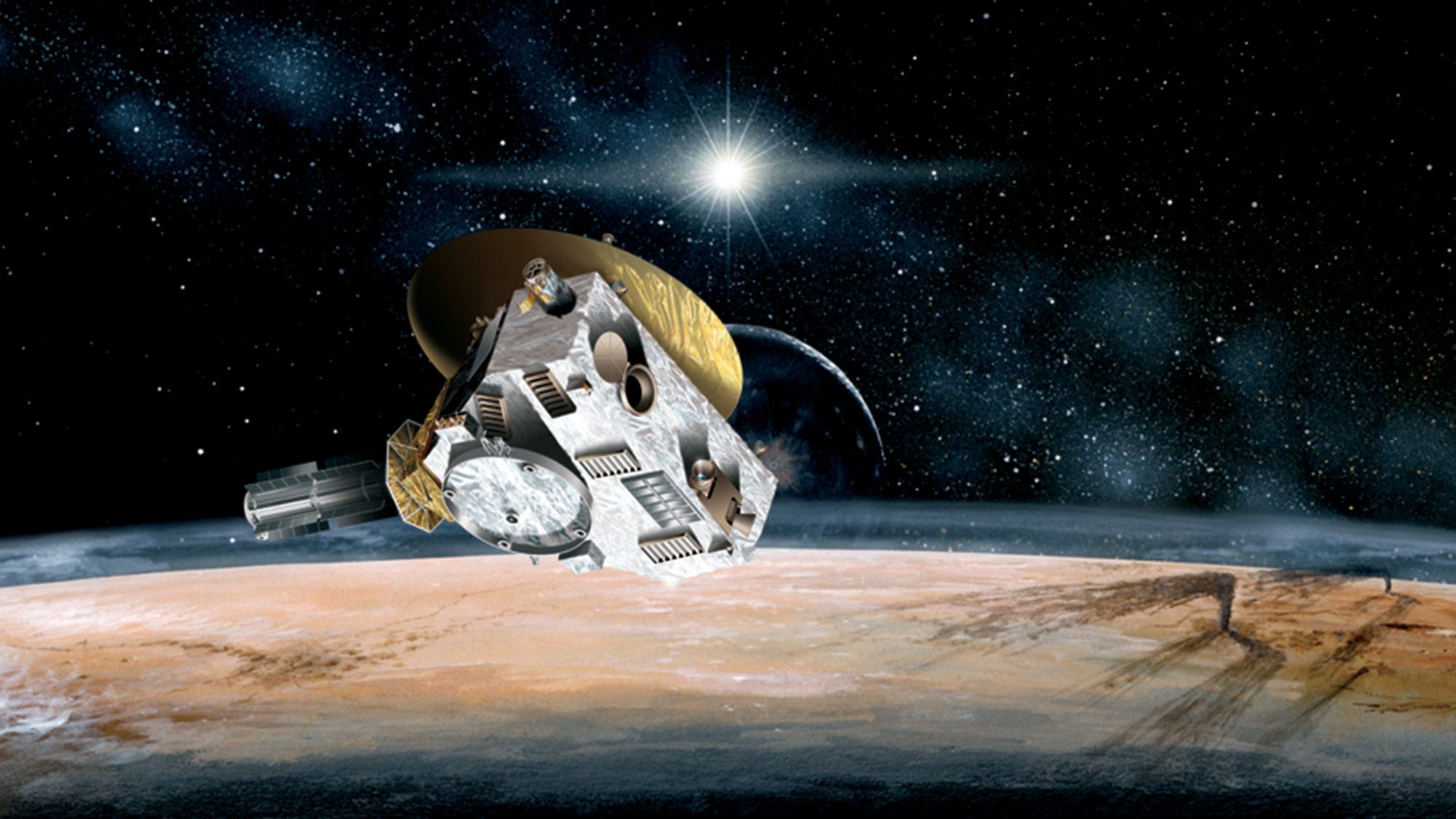
There’s nothing quite as bewildering as drifting into sleep while traveling, only to awaken billions of miles from Earth—welcome to Pluto.
Thankfully for NASA’s New Horizons spacecraft, recently awakened from nearly a year in hibernation at the outer reaches of our solar system, all systems are reported to be in “good condition.” This information comes from a NASA statement. As the spacecraft recovers from its 321-day slumber and begins to transmit scientific data anew, New Horizons is set to advance its mission of exploring the enigmatic boundary where solar territory ceases and interstellar space begins.
“All status reports during this hibernation period were ‘green,’ indicating that everything was functioning smoothly on New Horizons each week,” said Alice Bowman, New Horizons mission operations manager at the Johns Hopkins Applied Physics Laboratory in Maryland.
Latest videos from
Launched in 2006, New Horizons achieved the fastest space launch on record, traveling at approximately 36,400 miles per hour (58,500 km per hour). As it journeyed towards the edge of the solar system, it gained speed during its approach to Jupiter in 2007 and again as it passed Pluto in 2015. Presently, New Horizons is about 5.9 billion miles (9.5 billion kilometers) from Earth, positioned approximately 64 times further from the Earth than the Sun (64 astronomical units, or AU).
Aside from the twin Voyager probes launched in 1977, New Horizons is currently the farthest operational spacecraft in the universe. (Pioneer 10 and 11 traveled farther but ceased operations decades ago.)
Illustration of the Kuiper Belt object Arrokoth. This is the most distant solar system object ever to receive a flyby. New Horizons surpassed that in 2019.
(Image credit: NASA/Johns Hopkins University Applied Physics Laboratory/Southwest Research Institute/Steve Gribben)
Like the Voyager mission, New Horizons is headed towards the heliosphere—the furthest edge of the Sun’s influence, where the solar wind collides with the interstellar medium.
The Voyager probes demonstrated that this boundary is a measurable physical characteristic of the universe, presenting as a hot and thick plasma barrier. New Horizons will eventually traverse this boundary, equipped with more sophisticated instruments than Voyager, enabling it to gather the most comprehensive data on the region to date.
Get the world’s most fascinating discoveries delivered straight to your inbox.
However, our journey is far from over. The heliopause is estimated to commence at around 120 astronomical units from the Sun, almost double the distance New Horizons has traveled thus far. Meanwhile, the long and solitary voyage continues; the Kuiper Belt awaits. In the upcoming weeks, the spacecraft will begin its study of hydrogen at the outer edge of the heliosphere, sending back a wealth of data gathered during its year-long hibernation.
According to NASA, each message from New Horizons to Earth takes roughly 8 hours and 52 minutes to arrive, and this communication delay continues to increase.
In the Kuiper Belt, New Horizons might also have the opportunity to study intriguing icy bodies resembling peanut-shaped space rocks,Arrokoth, which was the most distant object in our solar system ever approached by a spacecraft. Whether New Horizons will break its own record again in the coming years remains to be seen.