


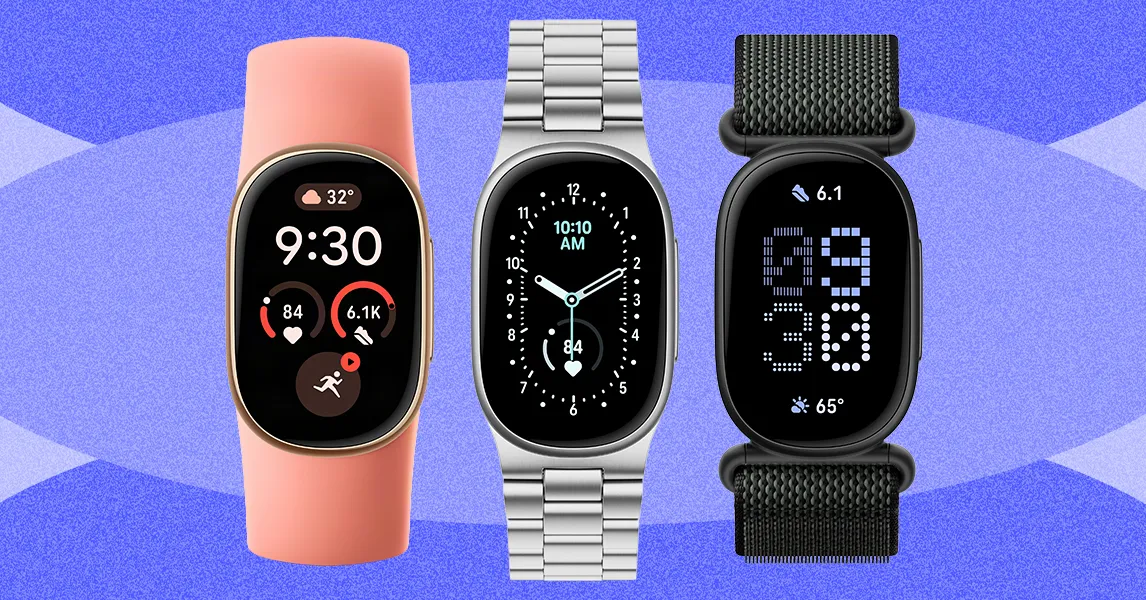
Google’s Fitbit Edge improves on the Charge 6 with a bright 1.34-inch display, richer workout data, Google Maps navigation, longer battery life and a repairable modular design. Its interchangeable bands offer options for training and formal wear, although the Performance Loop’s fastening mechanism can be finicky. The Edge also adds expanded health tracking, including nightly blood oxygen data, ECG features, AFib detection and blood sugar insights through a continuous glucose monitor.
Band options and fit
As with any smartwatch, comfort depends partly on the band. The Edge comes with Google’s Active Band, which works well for training but is not my favorite option. Google also offers HNBR, or high-performance synthetic elastomer, active sports bands; vented Performance Loop bands; silicone magnetic bands; and metal link bands.
Before long, I was alternating between the Metal Link and Performance Loop bands. The Metal Link looks suitable for a night out or a more formal setting, while the Performance Loop is better suited to everyday wear. Its micro-adjustable fit makes it easy to achieve a precise fit, although it is just as easy to make it too tight.
I also noticed that the band sometimes loosened during adjustment. The tracker remained attached on one side, so I did not have to worry about losing it, but the securing mechanism did not feel particularly secure. I eventually realized that the lock button was stuck and had to work with the mechanism to fix the problem.
Display, battery life and repairability
The Edge’s 1.34-inch display is its clearest advantage over the screenless Air. The difference is especially noticeable during training. On outdoor runs, I could view metrics and control music without slowing down. The display is also about twice as bright as the Charge’s maximum brightness, making it easier to read in direct sunlight.
Google Maps integration provides turn-by-turn directions on the wrist during runs or cycling, eliminating the need to take out a phone.
I prefer the more colorful interface of Wear OS, while the Fitbit dial feels somewhat plain by comparison. Fitbit’s software, however, provides up to seven days of battery life, which the Pixel Watch does not. Unlike the Pixel Watch, the Edge works with both iOS and Android.
The Edge is also Fitbit’s first repairable fitness tracker. Its modular construction includes a replaceable battery, making it comparable to the Pixel Watch in this respect. This may be related to battery regulations due to take effect in the European Union. From February 18, 2027, devices such as smartphones and smartwatches will be required to use removable and replaceable batteries.
2 steps forward, 1 step back
The Edge offers significant health and fitness upgrades over the Charge 6. Google has added more detailed workout metrics and hardware improvements intended to make it a more capable fitness tracker.
Several new features focus on long-term health tracking. Like the Pixel Watch 5 and Air, the Edge provides monthly blood pressure and insulin-resistance trends. Its SpO2 measurements now include nightly averages, ranges and changes over time.
The Edge also includes an updated ECG app, 24/7 heart-rate tracking, cardiopulmonary stress metrics and atrial fibrillation (AFib) detection. A continuous glucose monitor (CGM) provides blood-sugar insights alongside the nutrition log.
Source: www.wired.com