


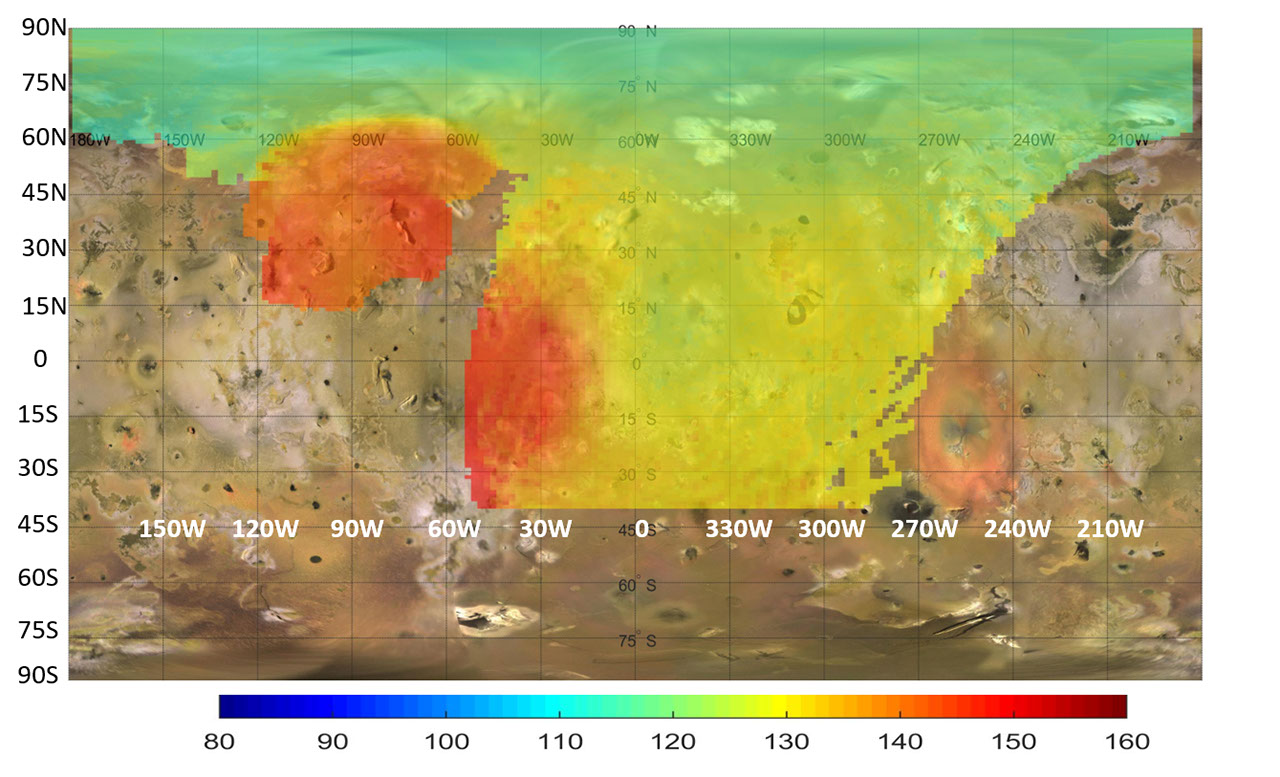
This detailed map illustrates the temperature data collected by the Microwave Radiometer (MWR) aboard NASA’s Juno spacecraft, showcasing heat emissions from beneath the surface of Jupiter’s moon Io. While infrared instruments measure surface temperatures, MWR’s low-frequency microwave channels (0.6 GHz and 1.25 GHz) penetrate approximately 6 to 20 feet (2 to 6 meters) into Io’s crust. The map’s vibrant colors represent distinct temperature gradients, with the hottest areas indicated in red.
The most significant red anomaly, located in the upper left (60 to 120 degrees west longitude), reveals subsurface temperatures ranging from 18 to 36 degrees Fahrenheit (10 to 20 degrees Celsius, or 10 to 20 Kelvin) warmer than the surrounding terrain. This major heat source corresponds with the Zal Montes Patera complex, an active volcanic region where Juno’s stellar reference unit detected ongoing lava flows. Additionally, another substantial underground heat source is identified near the equator, stretching from 0° to 50° west longitude. Together, these distinctive microwave anomalies point to considerable internal heating within the upper crust of Io.
In contrast to these intense hotspots, yellow and green areas represent more typical temperatures observed throughout the month. The yellow regions indicate intermediate temperatures rising near -190°F (-123°C or 150 Kelvin) towards the equator. Meanwhile, the green areas, primarily in higher northern latitudes, showcase the coldest subsurface temperatures, plunging down to around -298°F (-183°C or 90 Kelvin) near the poles.
NASA’s Jet Propulsion Laboratory (JPL), part of the California Institute of Technology in Pasadena, manages the Juno mission under principal investigator Scott Bolton from the Southwest Research Institute in San Antonio. Juno is an integral part of NASA’s New Frontiers program, managed by NASA’s Marshall Space Flight Center in Huntsville, Alabama, for the NASA Science Mission Directorate in Washington. The MWR was developed by JPL, while Lockheed Martin Space in Denver builds and operates the spacecraft.
For more information about the Juno mission, visit: Learn more about Juno.
Source: science.nasa.gov