


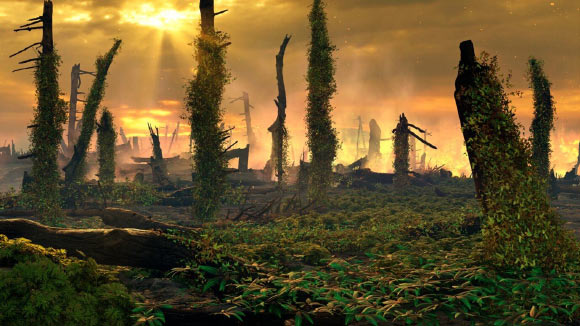
Research indicates that climate change, 201 million years ago, transformed Europe into a verdant fern savannah landscape, leading to recurrent wildfires. A recent study published in Natural Earth Science highlights these findings.
Lead author Dr. Bas van de Schootbrugge from Utrecht University states, “Ferns are resilient plants that have survived numerous crises over Earth’s history, showcasing their ability to adapt to extreme environments. They can be labeled as true disaster species.”
“Certain fern species can rapidly colonize disturbed areas, and wildfires can actually promote this proliferation.”
“While the above-ground parts of ferns burn, their underground root systems enable fast regrowth, often outcompeting other plant species.”
This phenomenon likely contributed significantly to the fern interspike period, estimated to last between 40,000 and 300,000 years.
The scientists studied fossil deposits from the end-Triassic mass extinction, extracting samples from drill cores in Germany, Luxembourg, Denmark, and the United Kingdom.
Creating a record of paleofires, the research relied on the quantity of fossilized charcoal and organic compounds known as polycyclic aromatic hydrocarbons (PAHs) that emerge from wildfire smoke.
Combined with evidence from pollen and spore records, these proxy indicators reveal spikes in wildfire activity that align with significant extinction events and the proliferation of pteridophytes.
However, interpreting charcoal records can be tricky, as larger charcoal pieces might degrade into smaller fragments over time.
PAHs from wildfires may not reach their original location, risking potential loss of these molecules.
“The novelty of our research stemmed from analyzing color changes in organic microfossils,” Dr. van de Schootbrugge explained.
“Using a simple, low-cost approach, we quantified the ‘darkness’ of fossil pollen and spores through the palynomorph darkness index.”
“Usually, organic microfossils, when buried, undergo color changes influenced by pressure and temperature.”
“As sediments deepen, temperatures rise, resulting in gradual darkening of organic matter. However, our study revealed a distinct pattern: the oldest, deepest samples displayed light-colored pollen and spores, which shifted to very dark brown during the extinction period, before reverting to bright yellow afterward.”
This unexpected finding occurred simultaneously across all four cores, despite their differing geological histories, suggesting it was not linked to sediment burial.
The authors conducted 15,000 measurements of pollen and spores from the periods before, during, and after the end-Triassic mass extinction.
Comparing tree pollen and fern spores helped eliminate group-specific biological effects.
“The consistency across all plant groups points to an external driving force,” Dr. van de Schootbrugge noted.
By correlating color changes in microfossils with other wildfire indicators, they established that this ‘dark zone’ indicated prolonged wildfire activity during the fern panicle interval.
“This darkening precisely coincided with the main extinction period and fern spike, marked by increased charcoal and PAH abundance.”
The rapid fern proliferation during this extinction phase was driven by factors like deforestation, soil erosion, greenhouse warming, and frequent wildfires.
“Dried ferns create dense mats that serve as excellent fire fuel,” Dr. van de Schootbrugge cautioned.
This led to widespread fern savannahs, with some species acting as ‘fire ladders’ while overshadowing other plant life.
“Ferns enabled conditions that fueled repeated large-scale wildfires, transforming the landscape dramatically,” he stated.
The essential takeaway is how the interplay of climate change, deforestation, and opportunistic species can create a perfect storm of ecological transformations.
_____
TP Horror et al. Documented extensive fern savannah wildfires during greenhouse warming at the end of the Triassic, in Natural Earth Science, published online July 21, 2026. doi: 10.1038/s41561-026-02048-4
Source: www.sci.news