


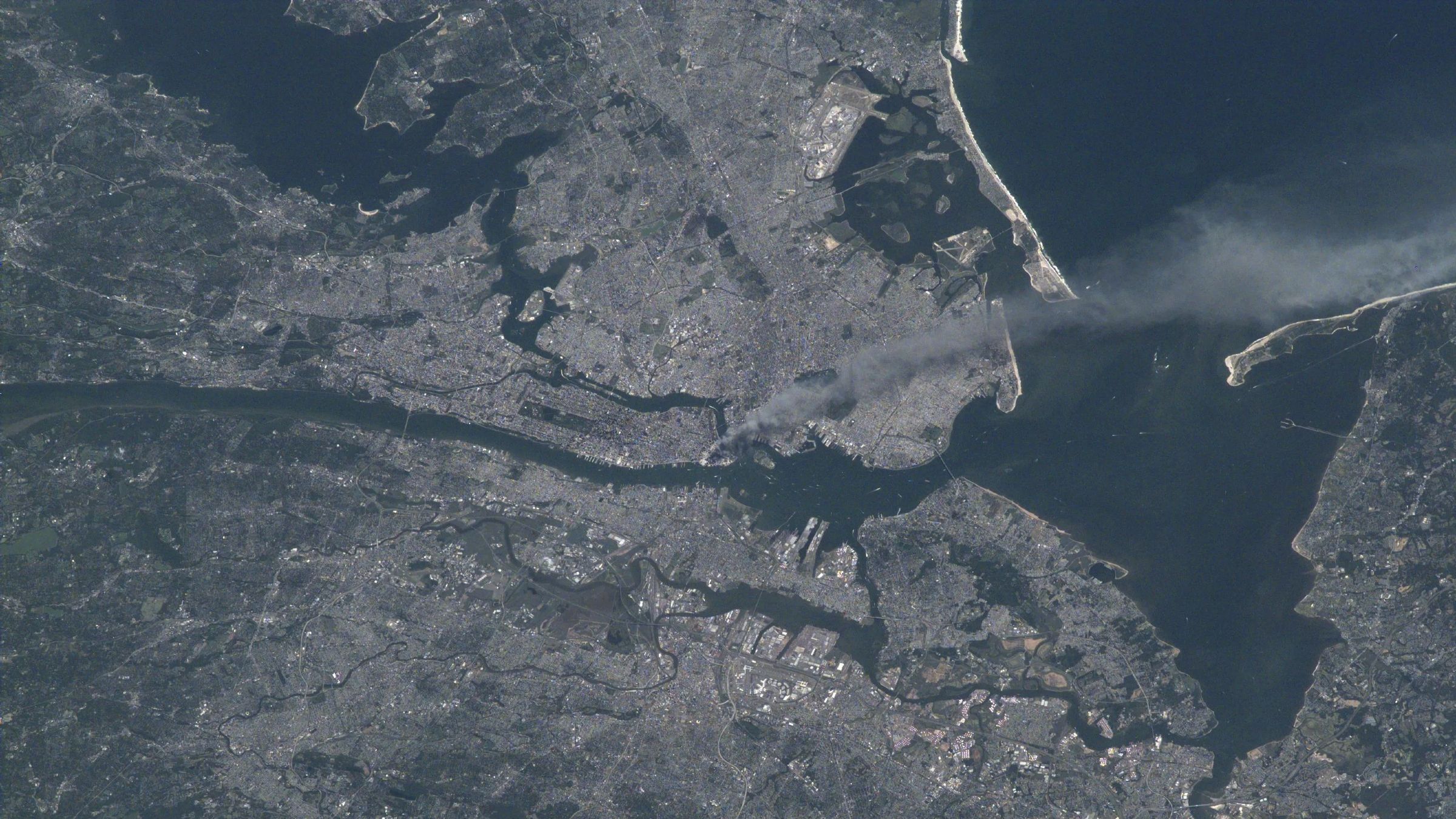
9/11 From Space: The Haunting NASA Image of Smoke Over New York
Simple facts
Where is it? New York City, New York [40.71113953, -74.01078602]
What is in the photo? A huge plume of smoke rising over Manhattan shortly after the September 11, 2001, terrorist attacks.
Who took the photo? NASA astronaut Frank Culbertson from the International Space Station.
When was the photo taken? September 11, 2001.
This haunting photograph of New York City after the September 11 attacks was captured from space by NASA astronaut Frank Culbertson. Taken from the International Space Station (ISS), the image shows a long trail of thick smoke stretching from Lower Manhattan after the collapse of the World Trade Center towers.
More than two decades later, the NASA photograph remains one of the most powerful images of 9/11. Seen from approximately 250 miles (400 kilometers) above Earth, the smoke plume offered a stark view of the destruction unfolding below.
On the morning of September 11, 2001, members of the terrorist organization Al Qaeda hijacked four commercial airliners. Two planes were flown into the Twin Towers, the 110-story skyscrapers that formed the centerpiece of the World Trade Center in Lower Manhattan. The towers collapsed after the impacts and ensuing fires.
A third hijacked plane struck the Pentagon, the headquarters of the U.S. Department of Defense, in Arlington, Virginia. Passengers on a fourth aircraft attempted to regain control of the plane, which crashed near Shanksville, Pennsylvania, before reaching its intended target. In total, 2,977 people were killed in the attacks, according to the 9/11 Memorial and Museum.
How Frank Culbertson photographed 9/11 from the ISS
Frank Culbertson was the only American astronaut in space during the attacks. He was serving as commander of Expedition 3 aboard the ISS when he learned what had happened in his hometown.
As the space station passed over the northeastern United States, Culbertson used a camera to photograph the smoke rising from Ground Zero. The image captured the enormous scale of the plume as it drifted across Manhattan and the surrounding region.
NASA astronaut Frank Culbertson later described the experience as deeply unsettling. From orbit, he could see the effects of the attacks but was unable to return to Earth or help those on the ground.
One unusual feature in the photograph is a flower-shaped cloud near the base of the smoke column. Culbertson suggested that this pattern may have formed around the time the second tower collapsed or shortly afterward.
NASA astronaut and ISS commander Frank Culbertson photographed the aftermath of 9/11 from space. This photograph, taken on September 17, 2001, shows Culbertson holding a camera in zero gravity.
(Image credit: NASA)
Astronaut’s personal account of the attacks
In letters written during the days after the attacks, Culbertson shared his perspective as the only American citizen away from Earth. “It’s terrifying to see smoke rising from a wound in your own country from such a great vantage point,” he wrote.
He also described the contrast between living aboard a spacecraft designed to improve life on Earth and watching people suffer below. “The dichotomy between being on a spacecraft dedicated to improving life on Earth and witnessing life being destroyed by such deliberate and horrific acts is unsettling,” Culbertson wrote.
The attacks were especially personal for the astronaut. He later learned that Charles “Chick” Burlingame, the pilot of the plane that crashed into the Pentagon, had been his classmate at flight school.
When the ISS passed over the Pentagon, Culbertson and the other astronauts could see a large opening in the side of the building caused by the impact. “Tears do not flow the same way in space,” he wrote while describing the experience to a friend.
Smoke from Ground Zero remained visible from space
Satellite imagery showed that smoke continued to rise from Ground Zero for at least 24 hours after the attacks. Images captured by the Landsat 7 satellite on September 12, 2001, documented the persistent plume over Lower Manhattan.

Landsat 7 satellite images captured on September 12, 2001, show smoke continuing to rise from Ground Zero at least a day after the attacks.
(Image credit: USGS/Landsat 7)
Air travel disappeared from the skies after 9/11
Culbertson later recalled another striking consequence of the attacks. Normally, contrails from commercial aircraft crisscross the United States. After all flights were grounded, those trails disappeared within approximately two orbits of the ISS.
The astronauts did notice one exception: a contrail moving east across the Midwest. Culbertson said it belonged to Air Force One as it returned to Washington, D.C., carrying President George W. Bush.
The photograph of smoke over New York remains an important record of 9/11 from space. It shows not only the scale of the disaster but also the unique perspective of the astronaut who witnessed the attacks from orbit.
Source: www.livescience.com