


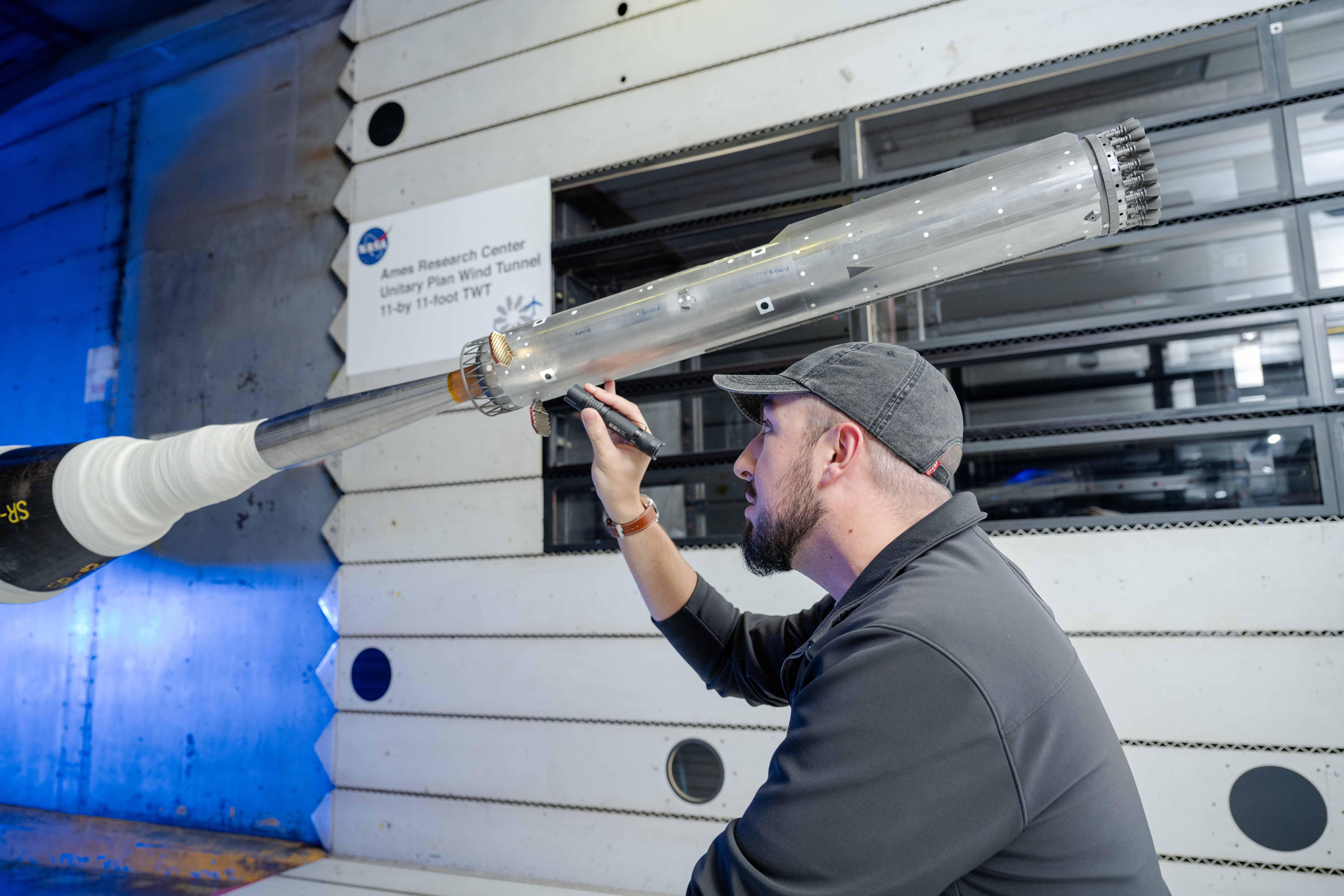
NASA and SpaceX are advancing preparations for the Artemis III mission with new wind tunnel tests of SpaceX’s Super Heavy Version 3 rocket booster. Conducted at NASA’s Ames Research Center in California’s Silicon Valley, the tests examined the extreme aerodynamic forces the booster may experience during atmospheric re-entry. The latest test campaign builds on earlier Super Heavy testing completed at NASA Ames in 2024.
NASA is partnering with SpaceX to develop the company’s Starship Human Landing System (HLS), which is designed to transport astronauts from lunar orbit to the Moon’s surface and safely return them. The upgraded Super Heavy booster is a key component of SpaceX’s Starship launch system. Starship and Super Heavy Version 3 are expected to support the Starship HLS for Artemis III in 2027, as well as a subsequent crewed lunar landing planned for 2028.
Although SpaceX is designing and building the Starship HLS lunar lander, NASA is working with commercial partners to provide access to specialized facilities, including NASA Ames wind tunnels, and technical expertise. NASA engineers helped prepare the Super Heavy Version 3 wind tunnel tests and analyze the resulting aerodynamic data.
“NASA has a lot of experience with unsteady aerodynamics,” said Manish Mehta, discipline lead engineer for the HLS Plume and Aero Environments team at NASA’s Marshall Space Flight Center in Huntsville, Alabama. “We used the agency’s broad experience base of conducting wind tunnel tests for the space shuttle, the SLS (Space Launch System) rocket, and Orion spacecraft to efficiently set up and analyze the wind tunnel testing for the Super Heavy Version 3. In fact, similar testing at the Ames Unitary Plan Wind Tunnel resulted in adding strakes to SLS for Artemis II, so what we learned for Artemis II is helping us get to Artemis III and beyond.”
SpaceX’s Starship launch vehicle consists of a 33-engine first-stage Super Heavy booster and a second-stage Starship spacecraft. Super Heavy Version 3 includes several major design and technology upgrades, including:
- New propulsion systems and upgraded Raptor 3 rocket engines
- The removal of the engine section skirt, individual engine shrouds, and integrated large-scale base heat shield
- Three grid fins on the Super Heavy booster instead of four, with each grid fin approximately 50% larger
- An integrated hot-stage system that replaces the previous single-use protective interstage
Because Super Heavy Version 3 features significant structural and propulsion changes, NASA and SpaceX engineers needed additional data on the steady and unsteady aerodynamic forces the booster could experience during atmospheric re-entry. The booster is designed to return to the launch site for refurbishment and reuse, making aerodynamic performance a critical part of the Starship launch system.
“When a rocket, or an airplane, flies through air at high speed, it’s subjected to steady aerodynamic forces and moments, and unsteady aerodynamic forces and moments,” explained Jayanta Panda, an unsteady aerodynamics subject matter expert at NASA Ames and a member of the Human Landing System Plume and Aero Environments team. “An example of a steady aerodynamic force would be when air smoothly flows over the surface of the rocket as it ascends. An unsteady aerodynamic force would be air ‘buffeting,’ or hitting, certain areas of the rocket at less predictable times and potentially causing vibrations.”
For the Super Heavy Version 3 campaign, NASA and SpaceX used a 1.2% scale model in NASA Ames’ transonic and supersonic wind tunnels. The transonic wind tunnel tests rocket and aircraft models at speeds ranging from Mach 0.2 to Mach 1.4. Mach 1 is the speed of sound, or approximately 761 miles per hour. The supersonic wind tunnel operates at higher speeds, ranging from Mach 1.55 to Mach 2.5.
Conducted in late 2025, the wind tunnel tests measured steady and unsteady airflow across the surfaces of the Super Heavy Version 3 model. The data will help engineers evaluate how the booster performs during atmospheric re-entry and refine its design and flight software.
“Resulting wind tunnel data on steady forces and moments helps predict how the rocket will react to forces in the atmosphere during re-entry so the flight software can effectively guide the rocket during flight,” Mehta said. “The unsteady pressure data helps engineers understand the environment around the rocket as it re-enters Earth’s atmosphere. Engineers use that information as one input into software that analyzes loads on the rocket.”
Through the Artemis program, NASA is preparing to return astronauts to the Moon for scientific discovery, economic opportunity, and the establishment of a sustainable human presence on the lunar surface. The program will also help build the foundation for future crewed missions to Mars for the benefit of all.
To learn more about NASA’s Artemis program, SpaceX’s Starship Human Landing System, and Super Heavy Version 3 testing, visit:
Source: www.nasa.gov