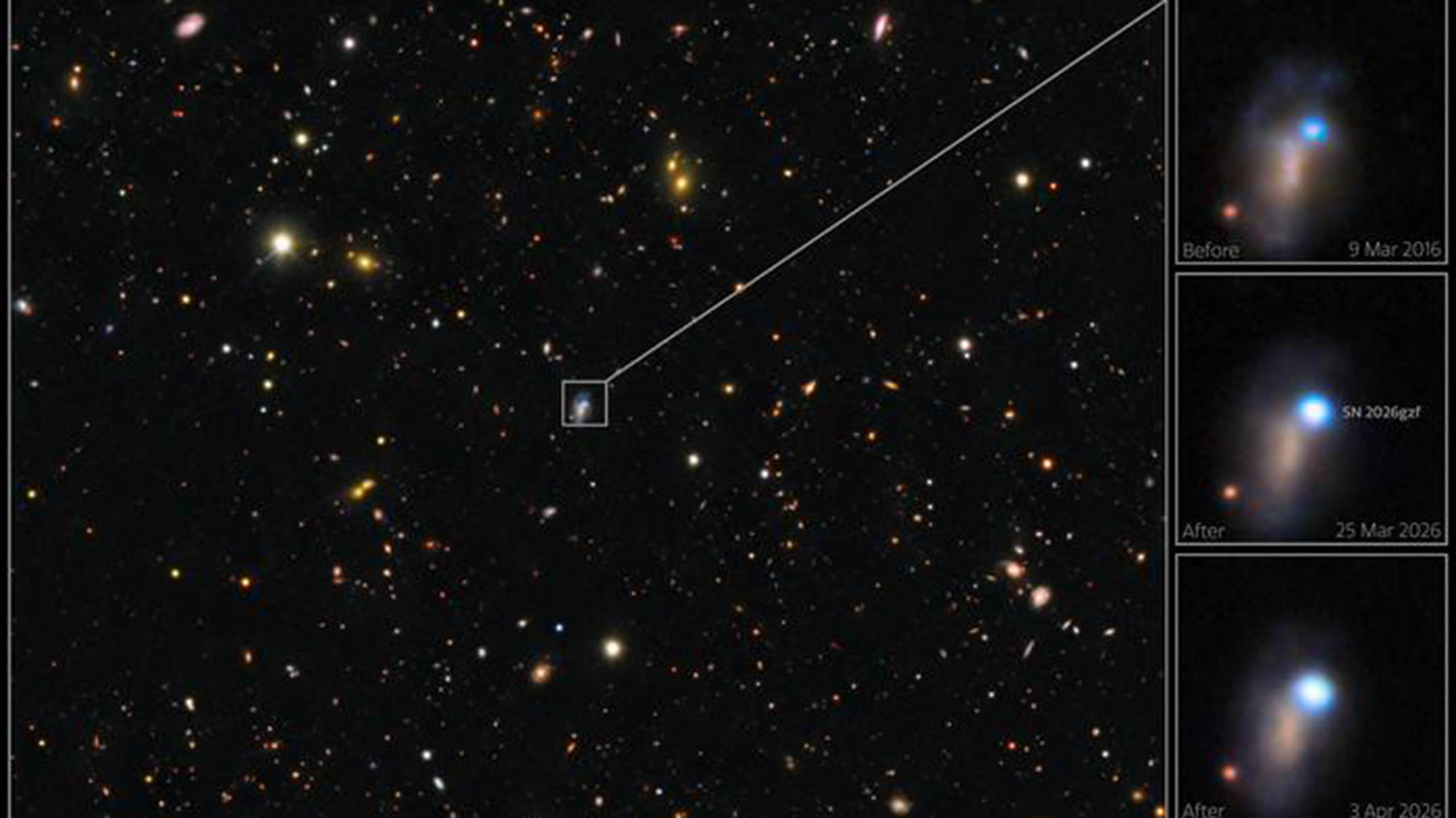
Astronomers have captured the earliest known moments of a supernova explosion in unprecedented detail, using a global network of space- and ground-based telescopes to track the blast as it unfolded.
The stellar explosion was first detected in March by China’s Einstein Probe space telescope, which recorded a sudden flash of X-rays. Within an hour, ground-based observatories began follow-up observations and identified the signal as a supernova — the powerful death explosion of a massive star.
More telescopes soon joined the campaign, including the wide-field Vera C. Rubin Observatory in Chile, which began its ambitious 10-year sky survey in late June. Together, the observatories monitored the supernova, located approximately 500 million light-years from Earth, and tracked how its light changed over time.
The researchers published their findings in twopapers published July 14 in The Astrophysical Journal Letters.
Latest Videos FromLive Science
The observations confirmed a rare phenomenon known as a “shock breakout.” This is the brief moment when the shock wave from a supernova bursts through the star’s surface and releases the explosion’s first visible and X-ray light.
A shock breakout can last anywhere from seconds to several hours, making it extremely difficult to observe. The newly studied event is only the second supernova in the past 20 years for which astronomers have directly detected the shock wave.
Scientists classified the explosion as a Type Ic broad-lined supernova, or Ic-BL supernova. These explosions produce unusually broad spectral lines, indicating that some of the stellar material is moving at a significant fraction of the speed of light. Ic-BL supernovas are often linked to gamma-ray bursts — some of the most energetic explosions in the universe.
However, this supernova produced no detected gamma-ray burst. Its shock breakout was also the faintest ever observed from an Ic-BL supernova.
“Follow-up observations using the most sensitive facilities found no evidence” of gamma-ray bursts, Brendan O’Connor, an astrophysicist at Carnegie Mellon University and co-author of one of the studies, said in a statement. He suggested that the jet may have been “choked” by the star’s surface or by material surrounding the star.
A global telescope network tracks the supernova
The Vera C. Rubin Observatory was monitoring the region when the supernova erupted. Rubin and Dark Energy Camera images of the explosion appear in the inset boxes.
(Image credit: NSF–DOE Vera C. Rubin Observatory/NOIRLab/SLAC/AURA)
The Rubin Observatory detected the explosion while observing a region called the COSMOS Deep Drilling Field. Its rapid imaging capabilities allowed astronomers to identify and study the event soon after it began.
The observatory will repeatedly scan the southern sky over the next decade, creating a time-lapse record of cosmic activity. Researchers expect the survey to reveal millions of supernovas, asteroids, comets and other transient events.
When Rubin identifies an unusual event, other observatories can quickly conduct follow-up studies. In this case, the Dark Energy Spectroscopic Instrument on the National Science Foundation’s Nicholas U. Mayall 4-meter Telescope at Kitt Peak National Observatory helped confirm the explosion as an Ic-BL supernova.
Astronomers also examined a decade of archival observations from the 570-megapixel Dark Energy Camera on the National Science Foundation’s Víctor M. Blanco 4-meter Telescope in Chile. The images revealed a faint “blue source” at the location of the later explosion, providing clues about the star system before the supernova occurred.
A team led by Jillian Rastinejad, an astronomer at the University of Maryland, College Park, used the Gemini Multi-Object Spectrographs on Gemini North in Hawaii and Gemini South in Chile, along with data from several other observatories, to analyze the explosion.
“Our observations allowed us to study the physics of three pieces of this explosion: the X-ray shock breakout, the accompanying supernova, and the interaction of the supernova with material previously cast out by the dying star,” Rastinejad explained. The combined data allowed the researchers to reconstruct the material surrounding the star and investigate its final stages of life.
The progenitor star was roughly 20 times more massive than the sun and belonged to a class of stars known as Wolf-Rayet stars. These massive stars lose most of their hydrogen early in their evolution. Before exploding, the star periodically shed large amounts of hydrogen and helium, ultimately leaving behind a core composed mainly of carbon and oxygen.
The expelled material formed shells around the star. As the supernova shock wave moved through these shells, the material became visible in telescope observations, including during the first X-ray shock breakout.
“This is the first time we’ve mapped out the pre-explosion environment of a star that has been stripped of hydrogen and helium,” said Gokul Srinivasaragavan, an astronomer who worked on the study.
Future detections of supernova shock breakouts could help scientists determine whether other stripped-envelope stars follow a similar pattern before collapse — and reveal how massive stars shape their surroundings in the final moments before they die.