


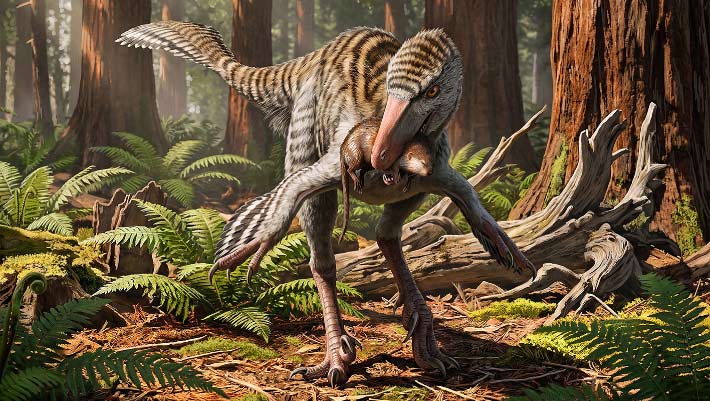
Paleontologists have identified Dinevenator robustus, a new genus and species of large, bird-like predatory dinosaur that lived in present-day New Mexico approximately 73 million years ago during the Late Cretaceous period.
The newly named dinosaur genus, Dinevenator, belongs to Troodontidae, a family of intelligent, bird-like theropod dinosaurs known for their slender bodies, sharp teeth, and relatively large brains.
Dinevenator is a monospecific genus, meaning it currently contains just one recognized species: Dinevenator robustus.
Researchers estimate that the dinosaur measured approximately 2.4 to 3 m (8 to 10 feet) long and weighed between 70 and 140 kg (150 to 300 pounds). These dimensions make Dinevenator robustus one of the largest troodontid dinosaurs known to science.
“This new work illustrates the dynamic nature of dinosaur studies as we continue to test what we think we know,” said Dr. Anthony Fiorillo, executive director of the New Mexico Museum of Natural History & Science.
“Furthermore, it demonstrates that New Mexico clearly has a prominent place in those global conversations.”
“This really helps us get a clearer picture of the diversity in this family of dinosaurs during the Late Cretaceous in North America, and it adds to our knowledge of dinosaurs that once roamed New Mexico,” said Dr. Steven Jasinski, paleontology curator at the New Mexico Museum of Natural History & Science and a paleontologist at Harrisburg University.
Dinevenator robustus is known from a single fossil: a nearly complete left frontal bone, which formed part of the dinosaur’s skull. The specimen is cataloged as SMP VP-1955.
The fossil was discovered in the summer of 2005 in the De-na-zin Member of the Kirtland Formation, located in the San Juan Basin of northwestern New Mexico, United States.
The specimen’s scientific classification has changed several times since it was first described in 2006. Initially, researchers identified it as a new species of the raptor-like dromaeosaurid dinosaur Saurornitholestes.
Subsequent studies challenged that classification. By 2014, paleontologists had reassigned the fossil to Troodontidae, although some researchers continued to question whether it represented a valid species.
A 2026 study proposed placing the dinosaur within Xenovenator, another troodontid genus from Mexico. However, Dr. Jasinski and his colleague Robert Sullivan concluded that the fossil displays enough differences from Xenovenator and other troodontids to justify establishing a separate genus.
The researchers’ phylogenetic analysis placed Dinevenator robustus within a group of large-bodied, thick-skulled troodontids. This lineage also includes Xenovenator espinosai from Mexico and Albertavenator curriei from Canada.
Contrary to earlier suggestions, the analysis indicates that Dinevenator robustus was not the closest relative of Xenovenator. Instead, it appears to be the earliest-diverging member of this robust-skulled troodontid group.
The discovery of Dinevenator robustus adds to the growing number of dinosaur species that appear to have been unique to the ancient ecosystems of the San Juan Basin. It also highlights the importance of New Mexico for understanding dinosaur evolution and biodiversity in the southern United States during the closing stages of the Cretaceous period.
“Recognition of a distinct, large, robust, thick-skulled troodontid adds to the unique nature of the ancient ecosystems of the San Juan Basin,” the authors concluded.
“Different dinosaur groups show closer relationships with species from various other geographic regions, implying a complex interplay between species and systems during the Late Cretaceous of North America.”
The research team’s study was published August 3 in the journal Fossil Studies.
_____
Steven E. Jasinski & Robert M. Sullivan. 2026. Dinevenator, a New Genus of Troodontid Dinosaur from the Late Cretaceous of New Mexico. Foss. Stud 4 (3): 21; doi: 10.3390/fossils4030021
Source: www.sci.news