


Did Archaeologists Discover the Site of the First Council of Nicaea?
Archaeologists excavating beneath Lake Iznik in Turkey say they may have identified the location of the First Council of Nicaea, a landmark Christian gathering held in 325 AD. However, historians and archaeologists not involved in the excavation caution that the evidence does not yet prove the council took place at the site.
Nicaea was an ancient Greek city located on the shores of Lake Iznik, also known historically as Lake Nicaea, in modern-day Turkey.
The First Council of Nicaea brought together hundreds of Christian bishops to resolve major theological disagreements. The council produced an early version of what is now known as the Nicene Creed, a central statement of Christian belief.
Roman Emperor Constantine I, who ruled from approximately 306 to 337 AD, legalized Christianity within the Roman Empire and is believed to have played an important role in organizing the council.
Latest videos from
Live Science
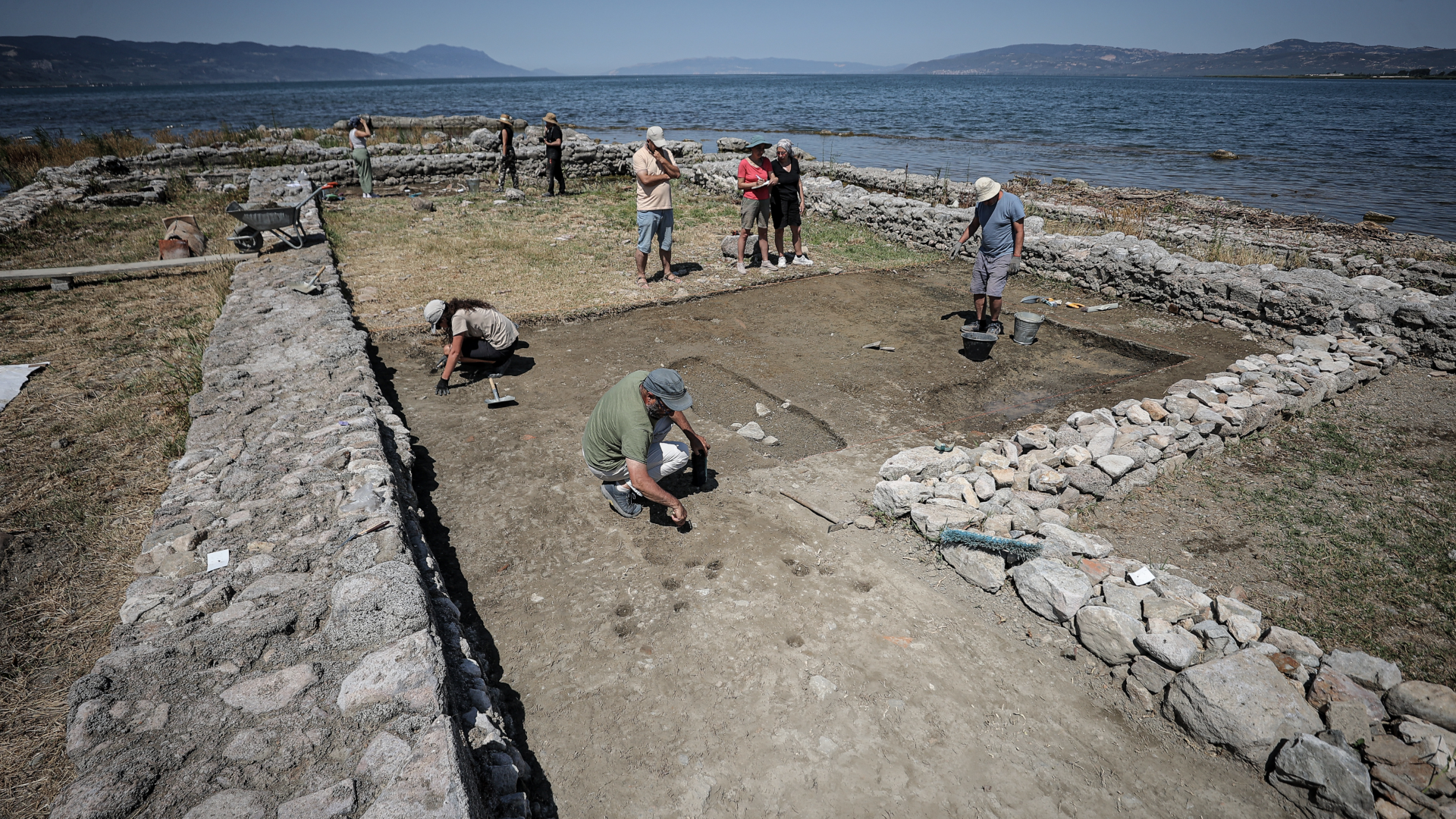
Archaeologists discovered a large church beneath Lake Iznik in 2014. Since 2015, excavations have revealed the remains of a smaller structure beneath the larger church. The team found a paved floor approximately 1 foot, or 30 centimeters, below the cathedral floor, suggesting that the smaller church may be older.
Mustafa Şahin, a professor of archaeology at Türkiye’s Bursa Uludağ University, is leading the underwater excavations.
One attendee of the Council of Nicaea, Eusebius of Caesarea, reportedly described the gathering as taking place in a “house of prayer,” possibly referring to a small church. Şahin believes the newly discovered structure may fit that description better than the larger basilica.
The excavation team has not yet established the exact dimensions of the smaller church. Based on historical records, however, Şahin has suggested that it may have been the Neophytos Church. The larger church built above it could have been the so-called Church of the Fathers, a name associated with the council.
Neophytus was a Christian who lived in Nicaea and was reportedly killed in 303 AD. Archaeologists believe the smaller church may have been destroyed by an earthquake around 368 AD, with the larger church constructed on the site around 380 AD.
So far, researchers have found no walls or decorative features belonging to the smaller church. Only its stone floor has been identified. Şahin said the structure may have been partly or largely built from wood, which could explain the limited remains.
An aerial view of church ruins near the site of ancient Nicaea.
(Image credit: Getty Images)
The Imperial Palace May Hold the Key
Experts not involved in the excavation have urged caution. They say it remains uncertain whether the bishops met in the underwater church. Even if the structure was used by some attendees, the council’s most important sessions may have taken place in Constantine’s imperial palace.
The imperial palace has never been located and could also be hidden beneath Lake Iznik.
Richard Kim, a professor of classics at the University of Illinois Chicago, noted that the smaller church has not yet been securely dated.
Kim also pointed to historical accounts by Eusebius of Caesarea, which state that the council opened in the imperial palace and continued for approximately three months. “We cannot be certain that the church was one of the council’s meeting places,” he told Live Science by email.
Charles Odahl, professor emeritus of history at Boise State University, also questioned whether the church served as a formal meeting place.
“The Council of Nicaea was held at the Imperial Palace on the shores of Lake Nicaea,” Odahl told Live Science. “Although this underwater church was nearby, it was not the location where the council met under the emperor.”
David Gwynn, a historian at Royal Holloway, University of London, said the evidence that the church dates to the early fourth century is promising and could support a connection to the First Council of Nicaea.
However, Gwynn cautioned against overstating the discovery. The church may provide important information about early Christianity and the development of Nicaea, but its precise relationship to the council remains unconfirmed.
The Council of Nicaea lasted more than a month and involved hundreds of bishops, along with as many as 2,000 clergy members, assistants and other staff. The ongoing excavation could shed new light on the city, its churches and the historical setting of one of Christianity’s most influential councils.
Excavation and analysis of the underwater site are continuing.
How much do you know about Jesus Christ and biblical archaeology? Test your knowledge with the Jesus Christ Quiz!
Source: www.livescience.com