


China’s Chang’e 7 mission is set to become one of the most ambitious lunar exploration campaigns yet. The mission will include a lunar orbiter, lander, rover, and spacecraft equipped with a mini-hopper, high-resolution cameras, and other advanced scientific instruments. Although the lander’s exact mass has not been disclosed, it is expected to be several times heavier than recent NASA-supported lunar spacecraft, including Firefly Aerospace’s Blue Ghost.
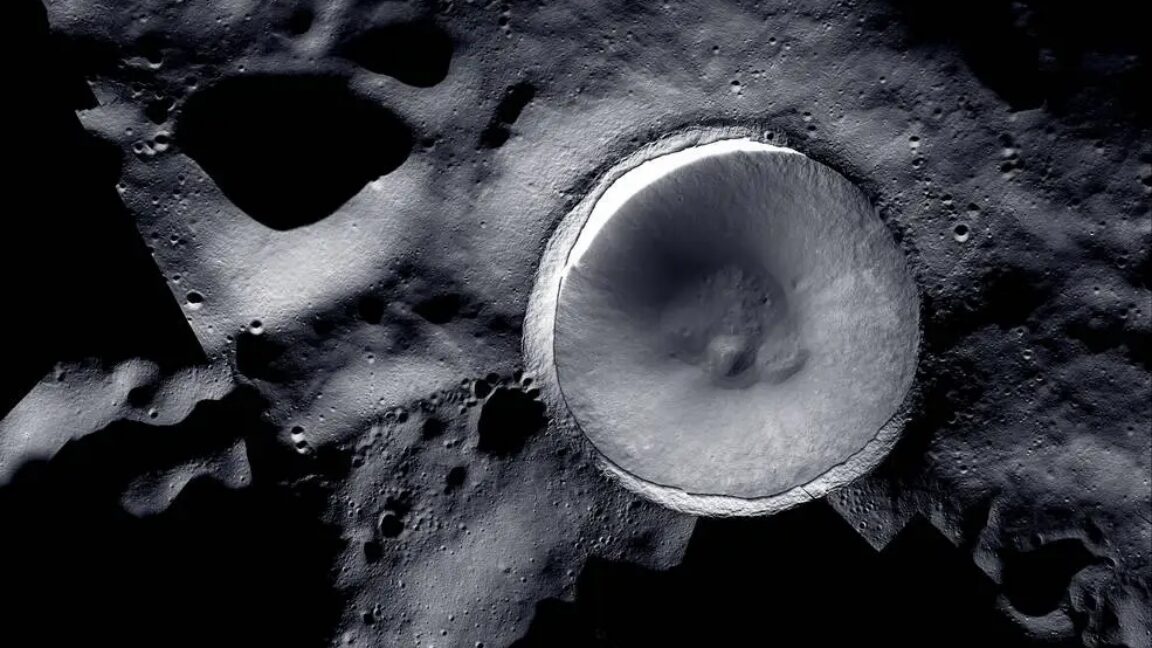
The mission’s destination is even more significant than its size. Chang’e 7 is scheduled to land near the Moon’s south pole, close to Shackleton Crater—one of the most scientifically important and strategically valuable regions on the lunar surface.
Shackleton Crater is surrounded by elevated terrain that may keep parts of its interior in permanent darkness. These permanently shadowed regions, often called “cold traps,” have remained extremely cold for billions of years. Scientists believe they may contain deposits of water ice and other volatile resources that could support future lunar exploration and settlement.
For both NASA and China, the lunar south pole is a major focus of long-term exploration plans. Water ice could provide drinking water, oxygen, and hydrogen-based rocket propellant, making this relatively small area of the Moon especially important for future lunar bases and resource utilization.
Why Chang’e 7 Matters for Lunar Exploration
Humans and robotic spacecraft have been exploring the Moon since 1959, when the Soviet Union’s Luna 1 became the first spacecraft to pass close to the lunar surface. Despite more than six decades of lunar missions, including numerous successes and failures, no spacecraft has yet completed a landing directly at the Moon’s south pole.
Chang’e 7 could change that. If successful, the Chinese mission will investigate one of the Moon’s most intriguing and previously unexplored environments. Its orbiter, lander, rover, and hopping spacecraft are expected to capture detailed images and collect valuable scientific data about the terrain, temperature, and distribution of water ice near Shackleton Crater.
The mission could deliver some of the clearest views ever obtained of the lunar south pole. More importantly, its findings may help determine how much water is present in the region and whether those resources could support future human missions and permanent lunar infrastructure.
Source: arstechnica.com