


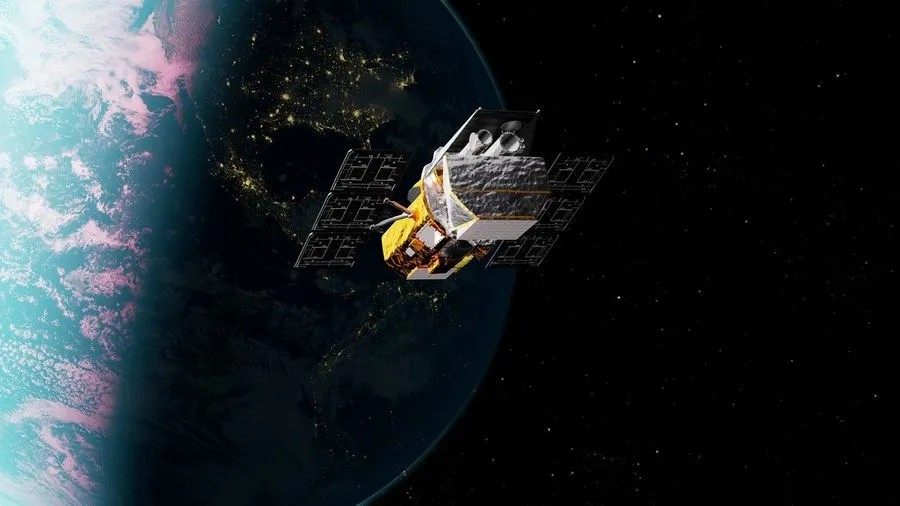
NASA and Katalyst Space announced Wednesday that the LINK spacecraft will not attempt to capture government satellites or move Neil Gehrels Swift Observatory into a higher orbit to extend its science mission. Ongoing spacecraft attitude-control issues have prevented those planned operations. However, LINK will continue rendezvous and close-proximity operations with NASA’s Swift Observatory to demonstrate critical technologies for future in-orbit satellite servicing and space exploration missions.
“NASA should be prepared to act quickly and take smart risks when the potential benefits are worth it, and that’s exactly what we did with this mission,” said NASA Administrator Jared Isaacman. “While this is not the outcome we were aiming for, it was still a worthwhile mission. The team moved with extraordinary speed to give Swift the opportunity to perform more science and improve the capabilities America will need for future satellite services. We learned everything we could from the LINK rendezvous attempt and will apply those lessons to our next mission.”
NASA and Katalyst Space are working closely to evaluate the next steps for the LINK rendezvous mission and collect valuable data for future robotic satellite servicing, spacecraft maintenance, and in-orbit operations.
“We knew this was a high-risk, high-return mission—the first of its kind developed on an unprecedented timeline driven by solar activity,” said Sean Domagal-Goldman, director of the Astrophysics Division at NASA Headquarters in Washington. “We all expected more scientific results from Swift, but we knew the mission would provide valuable information regardless. We have already learned a great deal from this series of results.”
NASA predicts that, without intervention, Swift could re-enter Earth’s atmosphere later this year. As part of its plans for the spacecraft’s end of life, NASA will continue exploring new ways to respond quickly to changing conditions in space and use current missions to address operational and scientific gaps.
“The construction, testing, and operation of this mission are already strengthening the U.S. space industry pipeline and expanding space-services capabilities in entirely new ways,” Domagal-Goldman said. “NASA is committed to supporting commercial partners that work alongside the agency on challenging missions and push the boundaries of what is possible. We are extremely proud of this team for reaching the launch pad in record time, solving complex problems in orbit, and advancing innovative capabilities during a record year for NASA astrophysics launches.”
NASA’s Swift Observatory launched in 2004 to study gamma-ray bursts—the most powerful explosions in the universe—as well as other astronomical objects and phenomena. The spacecraft was designed for a two-year primary mission but completed more than 21 years of scientific observations. Increased solar activity caused Swift’s low Earth orbit to decline rapidly, creating an opportunity for NASA to advance U.S. spacecraft-servicing technology. NASA awarded Katalyst Space a contract in September 2025 to begin developing a robotic servicing mission for Swift within a year.
LINK launched July 3 aboard a Northrop Grumman Pegasus XL rocket from Kwajalein Atoll in the South Pacific. The mission team established communications with LINK, completed initial on-orbit checkouts, and continued spacecraft commissioning. In late July, the mission team reported attitude-control issues that affected the spacecraft’s planned rendezvous operations.
For additional mission details, visit the Katalyst Space LINK mission page and follow NASA’s Swift blog for continued updates on the rendezvous, close-proximity operations, and future satellite-servicing demonstrations.
-end-
Alyse Fisher
NASA Headquarters, Washington
202-358-2546
[email protected]
Source: www.nasa.gov