


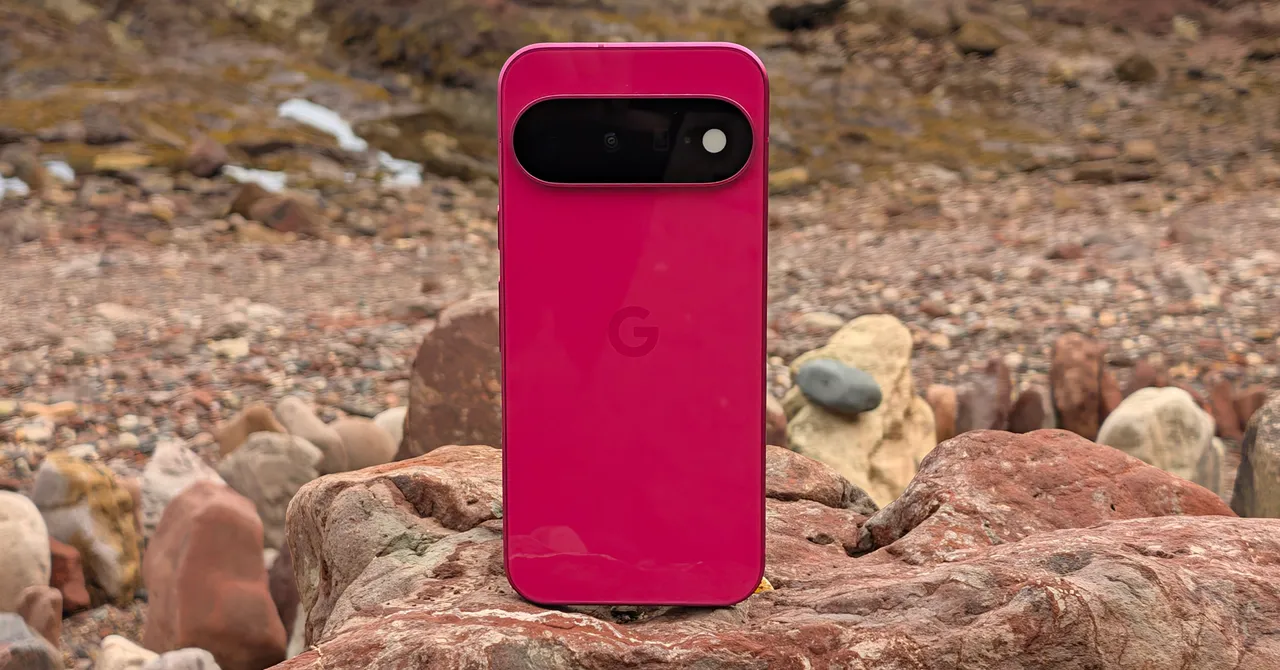
The Google Pixel 11 is available in four colors: Hibiscus, a vibrant hot pink; Pistachio, a warm green; Frost, classic white; and Obsidian, black. Unfortunately, Google discontinued Indigo, which was a favorite among last year’s Pixel colors. Similar to Apple’s lineup, Google appears to reserve its brighter, more playful finishes for the standard Pixel 11, while the Pro model uses more understated color options.
With its 6.3-inch display, the Pixel 11 is a comfortable choice among today’s smaller smartphones. After using last year’s Pixel 10 Pro XL, I appreciated how easily the Pixel 11 fits in one hand. Although the phone is slightly thick, its design feels comfortable, and its shape is nearly identical to the Pixel 11 Pro, meaning some cases may be interchangeable. We strongly recommend using a protective Pixel 11 case, as the paint began peeling after the phone was dropped on the beach.
The Pixel 11 features the same 6.3-inch OLED display as last year’s model, with a resolution of 1080 x 2424 pixels and a 60Hz or 120Hz refresh rate. It is disappointing that Google did not add a variable refresh rate ranging from 1Hz to 120Hz, which could help improve battery life. The display is also set to 60Hz by default, so you must open the display settings to enable the smoother 120Hz mode. With a peak brightness of 3,000 nits, the screen is bright enough for comfortable outdoor viewing. Compared side by side with the Pixel 11 Pro, however, it is slightly dimmer and less sharp, with noticeably larger bezels. Most users will need to look closely to spot the difference.
The Pixel 11’s fingerprint sensor performs as well as those on competing smartphones, but Google’s face unlock feature still struggles in dark environments. That could frustrate users switching from an iPhone. In the US, the Pixel 11 is eSIM-only, so buyers will not get a physical SIM card slot. Physical SIM cards remain convenient when moving between phones, especially while traveling internationally, but phone makers and wireless carriers have made eSIM activation much easier. Setting up an international eSIM may require contacting your carrier, yet the process is generally straightforward. As eSIM technology has become standard across US smartphones and networks, its absence is unlikely to be a major issue for most buyers.
Pixel 11 performance and battery life
Google’s new Tensor G6 processor is reportedly 20% more power efficient, delivers 25% faster web browsing, and improves app loading speeds by 15%. The Pixel 11 includes 12GB of RAM and either 256GB or 512GB of storage. In everyday use, the phone feels fast and responsive. Apps open smoothly, web pages scroll without delays, and the camera launches slightly faster than before. Compared with the Pixel 10 Pro XL, notifications and video clips from a Nest video doorbell loaded about one to two seconds faster on the Pixel 11.
The Pixel 11 can run demanding mobile games such as Storm Waves, but performance is inconsistent. While the game remained playable, action became choppy, and combat produced frequent frame drops even with balanced graphics and performance settings enabled. After approximately one hour of gaming, the phone felt warm and battery life dropped from 40% to 26%. Less demanding titles such as Mini Metro and Alto’s Odyssey ran smoothly. However, serious mobile gamers may want to consider a more gaming-focused smartphone.
Source: www.wired.com