


How Psilocybin Reshapes Brain Connectivity, Consciousness and Therapeutic Change
Psychedelic experiences can profoundly alter how people perceive internal sensations, external environments and their sense of self. Many individuals describe these experiences as among the most meaningful events of their lives7. Research also suggests that psychedelics may produce lasting therapeutic benefits, including reductions in depression, anxiety and addiction, as well as improvements in social connection and overall well-being3,4,9–14.
Although the psychological effects of psychedelics are increasingly well documented, scientists are still working to understand how changes in brain activity produce meaningful and potentially therapeutic experiences. New research using functional magnetic resonance imaging (fMRI), electroencephalography (EEG) and machine learning provides further insight into how psilocybin reorganizes brain networks during different sensory and psychological contexts.
How the Brain Builds Perception and Selfhood
The brain creates perception and a sense of self by combining information from the outside world with internal models of the environment15. Communication between sensory and associative brain regions depends on structural and functional connectivity16.
Psilocybin, the primary psychoactive compound in “magic mushrooms,” affects this communication by stimulating serotonin 5-HT2A receptors. Preclinical studies suggest that psilocybin can promote structural and functional plasticity, including rapid growth of dendritic spines in the medial prefrontal cortex that may persist for weeks17,18. These cellular changes may contribute to longer-lasting behavioral effects and broader changes in brain connectivity19–22.
Studies of effective connectivity also indicate that psilocybin may reconfigure communication between associative brain networks23–27. Subjectively, this reorganization is often experienced as a heightened sense of immersion, in which ordinary distinctions between space, time and self become less rigid and more interconnected28,29.
These psychedelic brain states have often been described as entropic, desynchronized or less constrained5,6,30,31. However, the new findings suggest that apparent disorder in time-averaged brain activity may conceal a more structured form of organization that becomes visible when researchers analyze brain dynamics over time.
The Default Mode Network and Psychedelic Brain Connectivity
A major focus of psychedelic neuroscience is the default mode network (DMN). This large-scale brain network integrates information related to memory, imagination, self-reference, time and social context32–37.
Under psilocybin, the connectivity patterns that normally keep brain networks separate appear to relax. This allows new interactions between sensory and associative regions to emerge38,39. Because these networks help regulate emotion, cognition and perception, their reorganization may contribute to changes in mood, self-awareness and consciousness40.
Previous research has found that psilocybin can produce a persistent reduction in connectivity between the anterior hippocampus and the DMN in healthy adults. Rodent studies have also reported acute reductions in DMN-like connectivity6,41. Although these findings have mainly been observed in non-clinical populations, researchers have proposed that they may be relevant to the therapeutic effects of psychedelic treatment.
However, an important question remains: how do changes in brain connectivity translate into meaningful subjective experiences and lasting psychological change?
Why Context Matters During a Psychedelic Experience
Psychedelic effects are highly sensitive to mindset and setting, often referred to as “set and setting”8. A person’s expectations, emotional state, physical surroundings, music and social environment can all influence the quality and outcome of the experience. This principle is now incorporated into many clinical guidelines for psychedelic-assisted therapy42.
To investigate how context influences the psychedelic state, researchers designed a large, multimodal study that examined brain activity during several naturalistic conditions. The study avoided relying solely on structured cognitive tasks, which can make it difficult to distinguish the effects of the task from the effects of the psychedelic state itself.
The researchers collected the largest single-site acute-phase psychedelic neuroimaging dataset of its kind. The study included:
- 62 healthy adults with no previous psychedelic experience
- Multimodal fMRI and 64-channel EEG recordings
- Eyes-open and eyes-closed conditions
- Rest, meditation, music and movie-viewing contexts
- Extensive behavioral and subjective experience measures
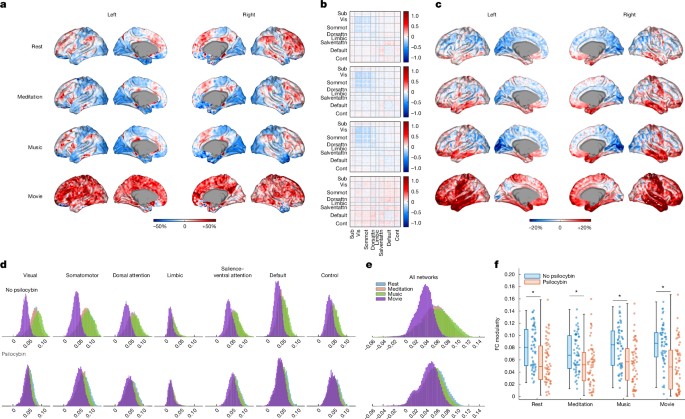
The results showed that psilocybin redistributed brain integration. Global functional connectivity increased in associative regions but decreased in sensory regions during eyes-closed conditions. At the same time, brain activity recorded with both fMRI and EEG became more similar across eyes-open and eyes-closed states.
Using machine learning, the researchers also identified a context-aligned pattern of brain activity that conventional analyses did not detect. This pattern was strongest in participants who reported positive self-dissolving and boundary-dissolving experiences.
Psilocybin Redistributes Global Brain Connectivity
The researchers quantified global functional connectivity (GFC), a measure of how strongly each point on the cortical surface correlates with every other point. This approach made it possible to determine whether psilocybin increased or decreased the integration of different brain regions with the wider network.
During eyes-closed rest, meditation and music conditions, psilocybin reduced GFC in sensory regions. The strongest decreases occurred in the occipital cortex, with reductions of up to 39%. Midline ventral parietal regions also showed lower connectivity across several conditions.
In contrast, GFC increased in associative brain regions, with increases of up to 72%. This pattern suggests that psilocybin reduces the integration of sensory regions with the rest of the cortex while increasing the participation of higher-order associative regions.
During the eyes-open movie condition, however, GFC increased in both sensory and associative regions. This may reflect greater global synchrony while participants engaged with an external visual narrative. The changes were not explained by head movement.
Changes in BOLD Signal Variability
Psilocybin also reorganized the spatial distribution of blood oxygen level-dependent (BOLD) signal variability across the cortex.
During the eyes-open movie condition, variability increased in the orbitofrontal cortex, occipitotemporal regions, inferior temporal lobes and parts of the right primary somatosensory cortex. During eyes-closed conditions, variability decreased in early visual regions, especially while participants listened to music.
The spatial maps of signal variability broadly matched the maps of GFC changes. This relationship is consistent with previous research linking psychedelic states to increased entropy and signal diversity.
Eyes-Closed and Eyes-Open Brain States Become More Similar
At baseline, the overall distribution of GFC values differed substantially between eyes-open and eyes-closed conditions. Under psilocybin, these distributions largely converged.
The effect was statistically significant across sensory, limbic and associative resting-state networks. It was especially strong in the visual network, where the difference between eyes-open and eyes-closed GFC values decreased by approximately 85% after psilocybin.
These findings suggest that psilocybin weakens the usual distinction between internally focused and externally focused brain states. Eyes-closed experiences may become more externally engaged, while sensory information may become less constrained by ordinary patterns of brain organization.
Psilocybin Reduces Functional Brain Modularity
Functional modularity describes how strongly brain activity is divided into distinct, relatively segregated networks. Across rest, meditation, music and movie conditions, psilocybin reduced modularity.
The decrease was particularly pronounced during movie viewing. Similar reductions in modularity have been reported in clinical populations, where lower modularity after psychedelic treatment has been associated with longer-term symptom improvement49.
Further analysis showed that the reduction in modularity was primarily driven by decreased connectivity within established networks. Significant reductions were observed across all major networks during eyes-closed rest, meditation and music. During the movie condition, the strongest changes were observed in the DMN and dorsal attention network.
These results support earlier studies reporting reduced segregation between resting-state networks under psychedelics46,50–52. However, the researchers emphasize that lower time-averaged modularity does not necessarily mean the brain becomes disorganized. Instead, dynamic analyses revealed that brain activity can become more structured in relation to the surrounding context.
Machine Learning Reveals Context-Aligned Brain Trajectories
To study the temporal organization of brain activity, researchers used a machine learning technique called contrastive embeddings for behavioral and neural analysis, or CEBRA. CEBRA converts high-dimensional brain data into a low-dimensional representation that preserves important patterns in the original data.
The researchers mapped frame-by-frame BOLD activity from 332 brain regions into a three-dimensional embedding space. They then used a support vector machine classifier to determine how accurately the resulting brain trajectories could identify whether a participant was resting, meditating, listening to music or watching a movie.
Under psilocybin, brain activity developed a more distinct organization for each context. Stronger subjective effects were associated with tighter clustering of brain activity within each condition. As a result, the classifier could more accurately distinguish between different contexts.
Importantly, the effect depended on when the subjective experience occurred. One participant reported that the main effects of psilocybin began after the MRI session. Their brain embeddings closely resembled their baseline scans, suggesting that the neural reorganization tracked the timing and intensity of the psychedelic experience.
Context Alignment Is Linked to Subjective Experience
Classification accuracy was most strongly associated with positively felt self-dissolving and boundary-dissolving experiences. These included feelings of unity, bliss, spirituality and reduced separation between the self and the surrounding world.
Associations with sensory and hallucinatory effects were weaker. Negative experiences, including anxiety and impaired control or cognition, showed little or no positive relationship with context alignment.
The same context-aligned brain organization was also associated with changes in mindset reported one day after psilocybin administration. By comparison, conventional measures of functional modularity did not predict either the intensity of the mystical experience or next-day mindset change.
This finding suggests that the psychologically meaningful organization of the psychedelic state may be contained within the brain’s temporal dynamics rather than in static, time-averaged connectivity measures.
The Default Mode and Visual Networks Help Anchor Context Alignment
A network perturbation analysis examined which brain systems contributed most to context-aligned activity. The researchers replaced the psilocybin-induced dynamics of individual networks with their baseline dynamics and measured the resulting decline in classification accuracy.
The DMN and visual network made the largest contributions. Replacing the altered dynamics of either network with baseline activity reduced classification accuracy by approximately 6–8 percentage points.
These two systems occupy opposite ends of a major cortical gradient that ranges from internally directed processing to externally oriented sensory processing. Their joint alteration may therefore help explain how psilocybin weakens the normal separation between inner experience and the external environment.
The findings also demonstrate that the psychedelic state is not simply random or noisy. If psilocybin only increased neural noise, brain trajectories would become diffuse and more difficult to classify. Instead, participants with stronger subjective effects showed tighter clustering and higher classification accuracy.
A Second Machine Learning Method Confirms the Findings
The researchers also used a temporal attention-enhanced variational graph recurrent neural network, known as TAVRNN. This method modeled changing patterns of connectivity between individual brain regions over time.
TAVRNN identified two simultaneous effects under psilocybin. Regions within individual networks became more tightly clustered, suggesting greater local cohesion. At the same time, the overall organization of networks became more integrated across the brain.
This combination of increased within-network cohesion and broader brain-wide reorganization was related to the strength of subjective effects. The results were consistent across different contexts and provided independent support for the context-alignment findings identified with CEBRA.
The Phenomenology of Psilocybin Experiences
Participants reported highly intense and meaningful experiences after receiving a standard 19-milligram dose of psilocybin. Approximately half ranked the experience among the most meaningful events of their lives, and most participants rated its intensity at 9 or higher on a 10-point scale.
Qualitative reports included descriptions of:
- Deep peace and profound personal significance
- Merging with the MRI machine and surrounding environment
- Loss of ordinary identity and location
- A sense of unity with the environment
- Feeling part of a larger interconnected system
Participants reported wide individual variability across measures of altered consciousness. Positive self-dissolving and boundary-dissolving effects, including bliss and unity, were generally rated more highly than cognitive insights or spiritual experiences. Negative effects, especially anxiety, were relatively uncommon or mild.
One month after psilocybin administration, the group showed improvements in death acceptance, personal meaning and nature relatedness. Individual responses varied, highlighting the importance of personal context and psychological differences.
Positive Psychedelic Experiences Predict Mindset Change
The researchers examined whether the acute psychedelic experience was related to changes in mindset reported one day later. Mindset was assessed across areas including connection to self, connection to others, connection to nature, patience, harmony and inner peace.
Associative aspects of the psychedelic experience showed the strongest relationships with next-day psychological change. Insightfulness had the strongest correlation, followed by mystical, positive, blissful and spiritual experiences.
Sensory and hallucinatory effects showed weaker associations, while negative experiences such as anxiety and impaired control were not meaningfully related to mindset improvement.
These findings suggest that the emotional and associative qualities of the psychedelic experience may be more important for subsequent psychological change than sensory distortions alone. They also provide context for ongoing scientific debate about the role of subjective psychedelic experiences in therapeutic outcomes.
Context Changes Hippocampus–DMN Communication
Dynamic causal modeling was used to estimate effective connectivity between the anterior hippocampus and key DMN regions, including the medial prefrontal cortex, posterior cingulate cortex and inferior parietal cortex.
The largest changes occurred during the eyes-open movie condition. Rest, meditation and music produced more modest changes in effective connectivity. This pattern indicates that the context in which psilocybin is experienced can influence communication between the hippocampus and the DMN.
The stronger changes during movie viewing may reflect the demands of externally directed attention and the integration of visual, emotional and narrative information. These results provide further evidence that psychedelic brain connectivity is context-dependent rather than uniform across conditions.
Meditation and Music Influence the Psychedelic State
Half of the participants completed an eight-week mindfulness-based cognitive therapy program before the imaging session. The brief meditation training did not produce significant group-level differences in acute subjective effects or connectivity measures.
This result differs from previous reports of synergy between meditation and psychedelics, which have generally involved experienced practitioners participating in intensive retreat-based training. Short-term structured training may not be sufficient to produce measurable changes during an acute psychedelic session.
Music had a stronger effect. Participants rated the immersive music as more emotionally resonant and engaging under psilocybin during both MRI and EEG recordings. Independent ratings collected on the administration day showed a similar increase in aesthetic music experience.
The TAVRNN analysis also showed the greatest global network organization during the music condition, supporting the importance of music as a contextual element in psychedelic research and therapy.
EEG Shows Context-Sensitive Changes in Brain Power and Complexity
EEG recordings confirmed the fMRI findings and demonstrated that psilocybin changes brain dynamics across multiple timescales and measurement methods.
During eyes-closed conditions, psilocybin reduced theta, alpha and beta power, while producing modest increases in gamma activity, particularly in frontal regions. During the movie condition, these effects were less pronounced and became more localized to early visual regions.
Psilocybin also reduced the normal difference between eyes-open and eyes-closed alpha power by approximately 48%. Alpha activity is commonly associated with the suppression of visual input during eyes-closed states. Its reduction may indicate weaker sensory filtering under psilocybin.
Lempel–Ziv complexity, a measure of signal diversity, was highest during eyes-closed conditions. This supports the idea that internally generated perceptions under psychedelics may be associated with more complex and diverse brain signals.
The convergence of fMRI and EEG results suggests that the observed effects cannot be explained solely by vascular changes caused by psychedelics. Instead, psilocybin appears to produce context-sensitive changes in both brain connectivity and electrical activity.
Embeddedness: A Possible Brain–Mind State
The researchers describe the subjective experience associated with context-aligned brain activity as embeddedness. Embeddedness refers to the feeling of being continuous with, rather than separate from, the surrounding environment.
This concept differs from connectedness. Connectedness implies a relationship between separate entities, whereas embeddedness describes a reduced sense of separation between the self and the world.
Under psilocybin, communication between systems involved in internal self-reference and external sensory processing becomes more flexible. This may allow brain activity to align more closely with the current context while reducing rigid boundaries between internal and external experience.
The strength of context alignment was associated with self-dissolution, unity, blissful experiences and next-day mindset improvements. These relationships suggest that embeddedness may be relevant to the therapeutic potential of psychedelics, particularly for psychological distress involving isolation, rigid self-focus or existential anxiety.
In this framework, psilocybin may not simply add unusual content to consciousness. Instead, it may temporarily relax the neural mechanisms that maintain separation between the self, the body, other people and the wider environment.
Why Static Connectivity Measures May Be Incomplete
Traditional psychedelic neuroimaging studies often focus on average connectivity, network segregation or modularity. These measures are valuable, but they can overlook the way brain activity evolves over time.
The current findings show that reduced within-network connectivity can coexist with tighter clustering of dynamic brain trajectories. In other words, a brain may appear less organized when viewed through static averages while becoming more structured when analyzed as a continuously changing system.
Machine learning embeddings revealed that the psychedelic state contained a latent organization aligned with context. This organization became stronger as subjective effects intensified, particularly during positive self-dissolving and boundary-dissolving experiences.
These results challenge the idea that psychedelic states are simply desynchronized or chaotic. Instead, they suggest that time-averaged measures may mask a dynamic form of order that emerges as the brain becomes more flexible and responsive to context.
What These Findings Mean for Psychedelic Therapy
The study provides a potential systems-level explanation for why therapeutic context matters during psychedelic treatment. Psilocybin appears to redistribute integration across the brain, reduce rigid network boundaries and increase the alignment between neural activity and the surrounding environment.
The resulting state may support immersive, meaningful experiences that are associated with changes in mindset, personal meaning, nature relatedness and death acceptance. However, these findings do not prove that psilocybin is universally beneficial or that subjective intensity alone determines therapeutic success.
Responses to psychedelics vary widely, and treatment outcomes depend on factors including preparation, psychological support, dosage, environment, medical history and integration after the experience. Psilocybin should only be used in legal, medically appropriate and professionally supervised settings.
Conclusion
New multimodal brain imaging research shows that psilocybin does more than reduce the separation between large-scale brain networks. It reorganizes brain activity in a structured, context-sensitive way.
Across fMRI and EEG, psilocybin redistributed connectivity between sensory and associative regions, reduced functional modularity, weakened the distinction between eyes-open and eyes-closed states and altered communication between the hippocampus and DMN.
Machine learning revealed that brain activity became increasingly aligned with context as subjective effects intensified. This alignment was strongest during positive experiences involving self-dissolution, unity and reduced boundaries between the individual and the environment.
The proposed concept of embeddedness may help explain how psychedelic experiences connect changes in brain dynamics with meaningful psychological transformation. More research is needed to determine whether these signatures generalize across different populations, psychedelic compounds, therapeutic settings and clinical conditions. Nevertheless, the findings offer a promising framework for understanding how psychedelic brain states may translate into lasting changes in perception, identity and well-being.
Source: www.nature.com