


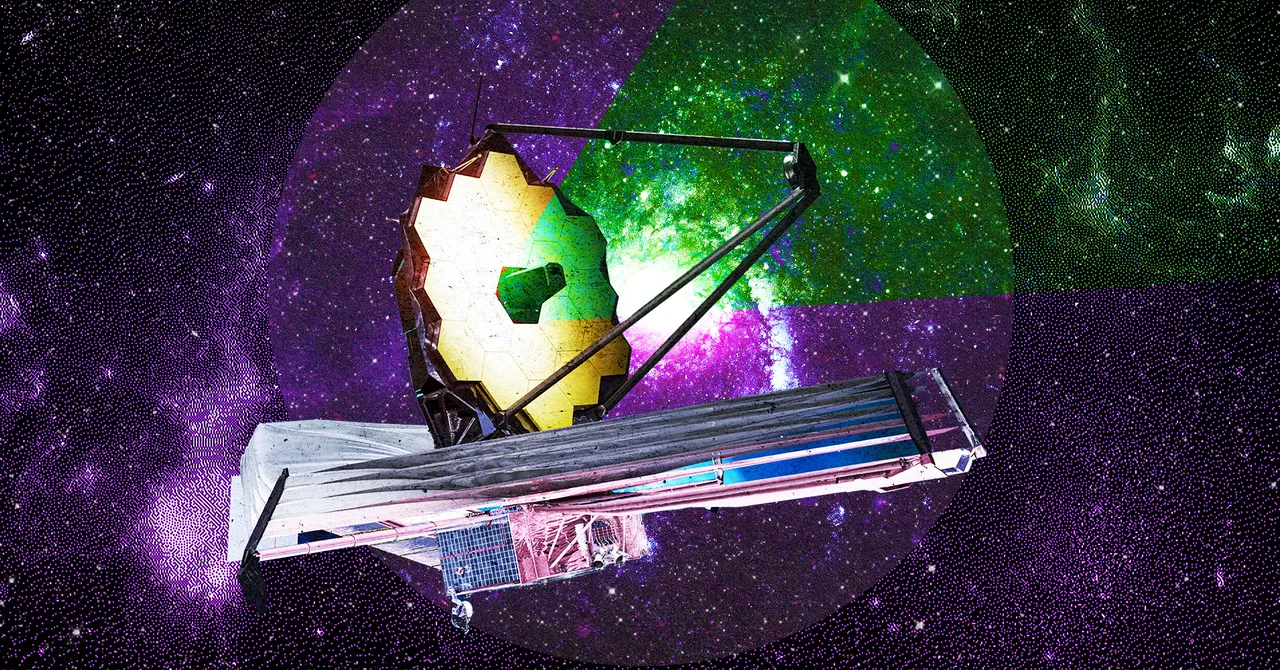
“If you think about what the James Webb Space Telescope does, it’s optimized to study the very distant universe—but it observes only a small portion of the sky,” says astrophysicist Rachel Mandelbaum of Carnegie Mellon University. “The Nancy Grace Roman Space Telescope, by contrast, will be able to survey enormous areas of the sky at once.”
Roman’s wide field of view will allow the space telescope to examine billions of stars while searching for exoplanets. Like earlier space missions, Roman will find many planets by observing them as they pass in front of their host stars. This transit method is highly effective for detecting large planets with short orbital periods. To find other types of worlds, however, Roman will use another powerful technique known as gravitational microlensing.
When two stars align, with one positioned behind the other, the foreground star’s gravity bends, distorts and magnifies light from the more distant star. If the foreground star has a planet, Roman can detect the planet when its gravity produces an additional magnification in the background starlight.
“This method can detect planets that are farther from their stars than other techniques can,” says Matthew Penny, an exoplanet researcher at Louisiana State University. “A planet does not need to complete an entire orbit before it can be detected.”
Because Roman will be highly sensitive to gravitational microlensing, it could discover planets with less mass than Mercury. The mission may also detect free-floating, or “rogue,” planets—worlds that were expelled from their planetary systems or formed independently in interstellar space.
By studying these unexplored populations of exoplanets, scientists can better understand the conditions that create planetary systems like our own and determine how common potentially habitable, Earth-like planets may be.
“We don’t really know at this point, but our solar system could potentially be very unique,” Penny says. “It may contain a series of fortunate coincidences that made life possible.”
Exploring the distant regions of planetary systems will provide an important missing piece of that puzzle. For instance, if a massive planet forms far from its host star, Penny says, smaller planets could form closer to the habitable zone—the region where temperatures may allow liquid water to exist.
“Unless we have a complete census of the full range of possible planets, we won’t know how common Earth-like worlds are or how frequently planetary systems resembling our own develop,” Penny says.
The Dark Universe
Alongside its search for new worlds, the Nancy Grace Roman Space Telescope will observe more than a billion galaxies. Scientists will pay particular attention to galaxies that existed approximately 2 billion to 6 billion years after the Big Bang, a critical period in the history of cosmic evolution.
“One of the questions we’re trying to answer is how cosmic structure formed and grew,” Mandelbaum says. “In the universe’s earliest stages, matter was distributed almost uniformly. However, small fluctuations created regions that were slightly denser or less dense than their surroundings.”
Over time, the denser regions attracted increasing amounts of matter and grew into enormous concentrations of dark matter known as halos. Gas was pulled into the centers of these dark matter halos, where it collapsed and ignited new stars. Those stars eventually gathered into the galaxies that fill the universe today.
Source: www.wired.com