


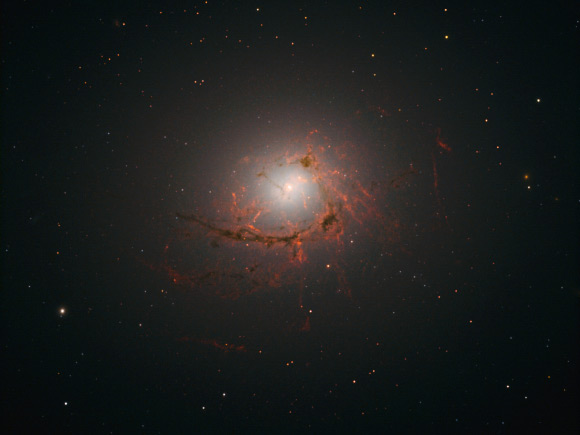
Exciting new images of the giant elliptical galaxy NGC 4696 captured by the NASA/ESA/CSA James Webb Space Telescope unveil gas filaments delivering material into a rotating disk surrounding an 800 light-year-wide supermassive black hole. This discovery helps solve a long-standing mystery regarding the continuous growth of these colossal galaxies.
This Hubble image showcases the elliptical galaxy NGC 4696. Image credit: NASA / ESA / Hubble / A. Fabian.
At the heart of nearly every large galaxy in the universe lies a supermassive black hole, with masses millions or even billions of times that of the Sun.
When these black holes actively consume surrounding material, they function as cosmic engines, emitting powerful jets of energy that can strip entire galaxies, hinder the formation of new stars, and impact the growth of galaxies over time. This type of black hole is known as an active galactic nucleus (AGN).
However, if the AGN jet heats the surrounding gas, it could theoretically restrict the black hole’s fuel supply. So, how is this black hole sustained?
A prominent hypothesis suggests that the gas cools and forms elongated streamers, called filaments, which gravitationally collapse toward the galaxy’s center in a self-regulatory manner.
“Webb’s observations have unlocked thousands of new insights and measurements, and we have much data to analyze,” said Megan Donahue, a professor at Michigan State University.
“We’re collaborating to address fundamental astrophysical questions on how black holes obtain their fuel and their interactions with host galaxies.”
Professor Donahue and her team directed the Webb Telescope towards NGC 4696, an elliptical galaxy situated approximately 116 million light-years away in the constellation Centaurus.
As the largest galaxy in the Centauri cluster, measuring about 30,000 light-years in diameter, NGC 4696 consists of hundreds of galaxies.
Utilizing nearly eight hours of observation time with Webb’s NIRSpec instrument, astronomers developed a comprehensive map detailing the gas movement near the black hole’s influence, with resolution fine enough to identify features covering about 30 light-years.
These observations illustrated that the S-shaped vortex is indeed a rotating disk of gas enveloping a supermassive black hole approximately 800 light-years in diameter, with material orbiting at speeds up to 600 kilometers per second.
Significantly, this disk appears to be directly linked to one of the large incoming filaments extending throughout the galaxy.
The data indicated that gas flows along the filament and into the disk, nourishing the supermassive black hole.
This groundbreaking research will enhance scientists’ understanding of the complete feeding cycle of supermassive black holes.
Jets emitted by the black hole infuse energy into the surrounding gas, which eventually cools and becomes unstable, resulting in the formation of filaments a few hundred light-years wide and potentially thousands of light-years long.
The magnetic forces decelerate the rotation of the gas as it descends, guiding it inward. It accumulates into a rotating disk encasing the black hole, providing the necessary sustenance. The black hole ejects jets, and the cycle recommences.
To validate this theory, researchers executed a cutting-edge computer simulation of the system.
The simulated gas exhibited behaviors that closely aligned with the observations made by Webb, lending robust independent confirmation to the proposed model.
“Our simulations indicate that the magnetic field should assist in channeling cold gas to feed the universe’s most massive black holes, and it is remarkable to witness this phenomenon in the Webb images,” stated Dr. Mark Voight from Michigan State University.
The results of this groundbreaking study will be published in scientific findings in the Astrophysics Journal Letter.
_____
Julie Hlavacek-Lalonde et al. 2026. JWST reveals how supermassive black holes are nourished: kiloparsec-scale multiphase filaments sustain a subkiloparsec perinuclear disk. APJL in press. arXiv: 2606.06620
Source: www.sci.news