


Could universes evolve like living organisms? A theory called cosmological evolution proposes that black holes may create new universes—and recent James Webb Space Telescope observations have renewed interest in the idea.
:focal(521x516:522x517)/https://tf-cmsv2-smithsonianmag-media.s3.amazonaws.com/filer_public/11/48/11487635-0fac-4b64-baa7-f7f3cb941e79/image_1.png)
NASA
In his 1996 book Darwin’s Dangerous Idea, philosopher Daniel Dennett described evolution as one of humanity’s most powerful intellectual discoveries. He even ranked Charles Darwin’s theory above the work of Isaac Newton, Albert Einstein and other scientific giants.
Many physicists might challenge that ranking. Evolution explains the development of peacock feathers, human beings and other forms of life, but can the same principle explain the behavior of galaxies, black holes and the universe itself?
Dennett argued that Darwin’s theory functions as a “universal acid.” Wherever nature produces complexity, evolutionary thinking can reshape how scientists understand it. Although Darwin’s idea began as an explanation for biological change, Dennett wrote, it could also offer insights into cosmology, psychology and other fields.
Evolutionary principles have already influenced neuroscience. The well-known phrase “neurons that fire together wire together” describes how frequently used neural pathways become stronger over time, while less-used connections weaken. The process resembles natural selection, in which advantageous traits become more common across generations.
The question is whether evolution can operate on the largest possible scale. Supporters of a niche theory known as “cosmological evolution” believe it might. They propose that the universe could develop according to principles similar to those that shape living organisms.
Traditional cosmology generally treats the universe as a complex structure produced by physical processes and chance events. Cosmological evolution offers a different picture: Universes may reproduce by creating new universes, with each generation inheriting slightly different physical properties from its predecessor.
Over many generations, natural selection could favor universes that are especially effective at producing additional universes. In this view, the cosmos is not simply a static object. It behaves more like a growing, reproducing system.
“The universe is not a rock,” the Irish writer Julian Gough suggests. “It is an egg.”
Gough, an Irish poet, novelist and musician best known for writing the short story that plays at the end of the video game “Minecraft,” has become a prominent public advocate for cosmological evolution. Through his Substack publication, The Egg and the Rock, he writes about cosmic evolution, emerging scientific evidence and observations from the James Webb Space Telescope.
More than a decade ago, Gough began asking why the universe has become increasingly complex. The cosmos began as an extremely hot, dense state and eventually produced stars, galaxies, planets and biological life. “That’s a very strange thing for hot gas to do,” he says.
Gough wondered whether the universe had somehow evolved into its current form. “It seemed to me an evolutionary explanation was the natural one,” he says. Systems that organize themselves and become more complex often have an evolutionary history. He questioned why the universe itself should be excluded from that pattern.
Gough assumed other scientists had explored the idea. His search led him to Lee Smolin, a founding member of the Perimeter Institute for Theoretical Physics.
Smolin’s theory drew on earlier ideas from physicists Bryce DeWitt and John Wheeler. They proposed that the singularities inside black holes might lead to new expanding universes with physical laws that differ slightly from those of their parent universes.
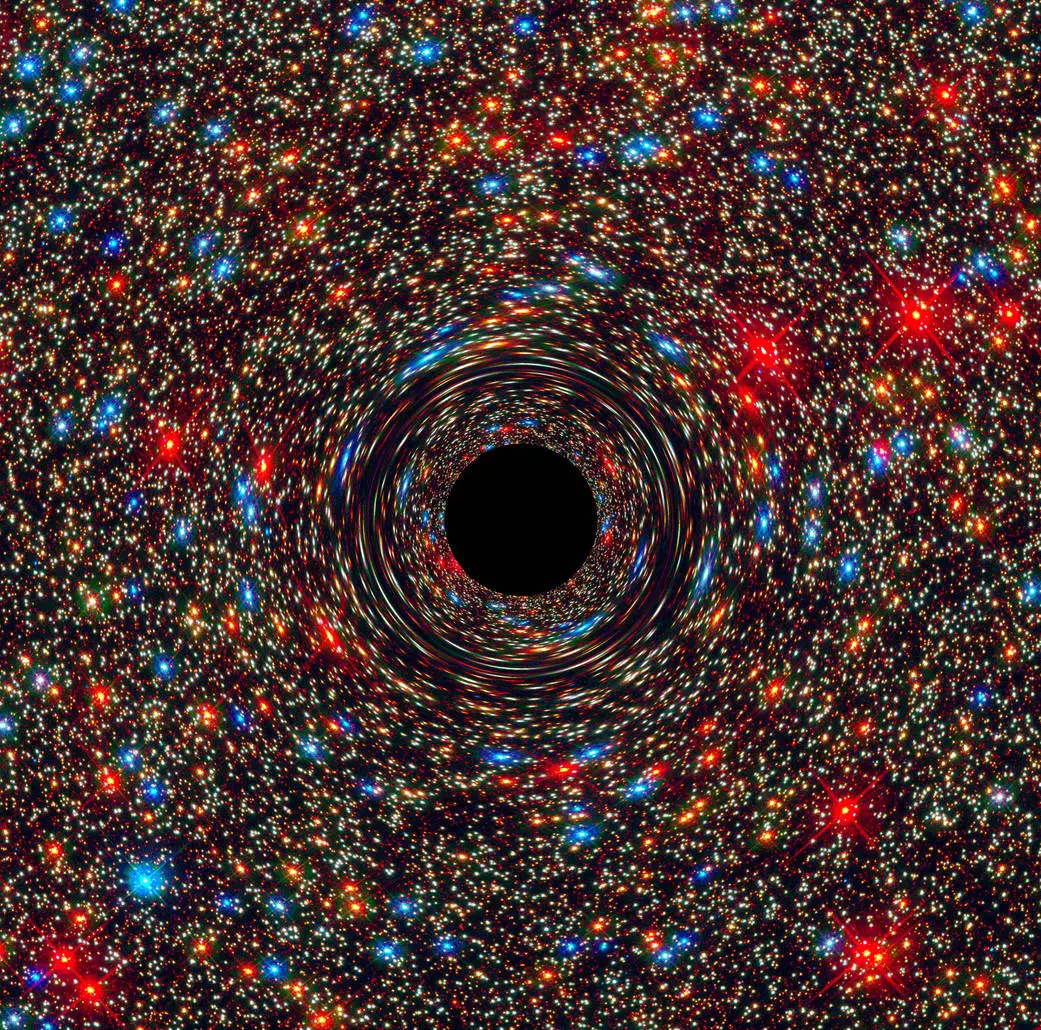
Under this hypothesis, every universe—including our own—could have begun as a Big Bang inside a black hole in another universe.
Smolin recognized that black holes could provide a mechanism for cosmic reproduction. If new universes inherited their parent universe’s physical laws with small variations, then universes could evolve over time, much like organisms inherit modified versions of their parents’ genes.
Cosmic natural selection would favor universes capable of producing the greatest number of black holes. Universes that create more black holes would generate more offspring, while less productive universes would become less common over many generations. If the theory is correct, our universe may be unusually efficient at producing black holes.
Smolin published these ideas in his 1992 paper “Did the Universe Evolve?” and later explored them in his 1997 book The Life of the Cosmos.
Gough read Smolin’s work with enthusiasm. At first, he assumed the theory must have been rejected because it had not become part of mainstream cosmology. Further research led him to a different conclusion: The theory had not been disproved so much as largely overlooked.
Smolin’s proposal did not disappear completely. Some philosophers and futurists expanded it to include the development of stars, life and advanced technology. In their view, civilizations capable of harnessing enormous amounts of energy might eventually create artificial black holes, potentially increasing the number of universes produced by technologically advanced cosmic systems.
Academic cosmologists, however, have generally treated the theory cautiously. Kevin Kelly, founding executive editor of Wired magazine and a former editor of Whole Earth Review, says the idea may initially sound like “kind of a crackpot thing.” Still, he began considering it decades ago and believes it could provide a mechanism for producing increasing complexity on cosmic scales.
The theory may also have suffered from a communication problem. Physicists have often explained cosmological evolution without drawing deeply on evolutionary biology, while evolutionary biologists have rarely encountered the proposal. Gough argues that this gap has made it difficult to evaluate the theory’s Darwinian logic.
Another obstacle was the lack of testable predictions. When Smolin first proposed cosmological evolution, astronomers had limited access to the universe’s earliest structures. That changed with the development of the James Webb Space Telescope, which was designed to observe faint infrared light from the first billion years of cosmic history.
Gough began studying astronomy, cosmology, astrophysics and evolutionary biology in an effort to develop predictions before Webb began returning data. His approach was straightforward: If universes reproduce through black holes, what consequences should that reproductive process produce?
Gough reasoned that the earliest universes would have favored the simplest and most efficient way to create black holes: “direct collapse.” Most black holes form when massive stars collapse, but some scientists have proposed that primordial gas could have collapsed directly into enormous black holes in the early universe.
Evolutionary systems often retain features inherited from their ancestors. For example, gill-like folds appear in human embryos and later develop into structures in the jaw, inner ear and throat. Gough therefore predicted that direct-collapse black holes—the possible remnants of an early cosmic stage—would appear very early in the history of our universe.
If his prediction was correct, the James Webb Space Telescope would find that supermassive black holes formed soon after the Big Bang and helped drive the rapid development of stars and galaxies. Gough expected the process to begin within approximately the first 100 million years of cosmic history.
On July 8, 2022—four days before Webb released its first observations—Gough published his predictions on Substack. Because he did not have a conventional academic background, he worried that a failed prediction could damage his credibility. “I was really terrified,” he says. “This could be fantastically humiliating.”
Webb’s early observations instead revealed galaxies that appeared to form earlier, faster and more orderly than many standard cosmological models had predicted. In November 2022, NASA reported evidence of galaxies assembling roughly 100 million years after the Big Bang.
Follow-up observations also identified a galaxy from approximately 470 million years after the Big Bang containing an unusually massive black hole—nearly as massive as all the stars surrounding it. These discoveries have intensified scientific debate about how quickly the earliest black holes and galaxies could have formed.
A 2025 paper in the Astrophysical Journal described these observations as part of a broader challenge involving the unexpected abundance of massive galaxies and other large structures during the first few hundred million years of cosmic history.
“You have these headlines saying physics is completely baffled by these early and self-organizing things,” says Johannes Jäger, an evolutionary systems biologist and philosopher at the Complexity Science Hub in Vienna. Jäger notes that Gough’s predictions appeared to anticipate some of Webb’s surprising observations, although the connection requires rigorous scientific testing.
/https://tf-cmsv2-smithsonianmag-media.s3.amazonaws.com/filer_public/80/13/8013c2ee-28c3-4dec-9245-f380e4c84582/image.png)
NASA
Since publishing his predictions, Gough has received funding from programs including Emergent Ventures and O’Shaughnessy Ventures. He has also received support from Christopher Fields, a biophysicist affiliated with Tufts University’s Allen Discovery Center, and Tufts biological theorist Michael Levin.
“I think it’s a fresh approach that should be looked at,” Levin says. “He’s convinced me that it’s worth exploring this idea.”
Stephon Alexander, a cosmologist and theoretical physicist at Brown University, calls cosmological evolution “a beautiful idea” and “a nice mechanism.” However, he emphasizes that conventional cosmological models may also explain the early appearance of massive black holes and galaxies.
The central challenge, Alexander says, is connecting cosmological evolution to established physics. Researchers would need to determine whether the theory is compatible with current models—or whether it makes predictions that could prove it wrong.
The theory must also explain how a black hole, where matter appears to collapse toward an extremely dense singularity, could produce a new universe that expands outward like ours. Some recent studies have explored whether our universe might itself exist inside a black hole.
In a 2025 study, computer scientist Lior Shamir analyzed 263 spiral galaxies observed by Webb. He found that 158 appeared to rotate clockwise from Earth, compared with 105 rotating counterclockwise. A universe with no directional preference would be expected to show a more even distribution.
Shamir suggested that the imbalance could be evidence that our universe formed inside a spinning black hole, which may have influenced the rotation of galaxies within it. However, the study also acknowledges that the rotation of the Milky Way could affect the observations, so the result remains unsettled.
Cosmological evolution would also need to explain how black holes could transmit the laws of physics to new universes while allowing those laws to change slightly. “The only game in town to understand that is quantum gravity,” Alexander says. Yet scientists still lack a complete theory of quantum gravity.
Testing multiverse theories is inherently difficult because scientists can observe only the single universe in which they live. As German cosmologist Jenny Wagner told the Irish Times, studying a multiverse from inside one universe is “like studying medicine on a single patient.”
Even the standard model of cosmology contains significant mysteries. Dark matter is used to explain gravitational effects that visible matter cannot account for, while dark energy is thought to drive the accelerating expansion of the universe. Although both concepts successfully describe observations, their underlying nature remains unknown.
“The standard model of cosmology works well—but only by introducing new ingredients we have never observed directly,” wrote Enrique Gaztañaga, a cosmologist at England’s University of Portsmouth and co-author of a study proposing that our universe emerged inside a black hole.
Wagner has described the current situation as a possible “dead end” and called for more open dialogue between mainstream cosmology and unconventional theories such as cosmological evolution.
Gough acknowledges that direct evidence for cosmic reproduction may be extremely difficult to obtain. Still, he believes Webb’s observations of unexpectedly early galaxies and massive black holes provide “excellent circumstantial evidence” for his predictions.
Observations so far show that the early universe was more complex and developed more rapidly than many researchers expected. But scientists still do not know whether black holes can create new universes or pass physical laws to them.
For cosmological evolution to become a scientifically accepted theory, researchers would need evidence that a black hole can “birth a new space-time or universe,” Alexander says. Such a discovery would provide a powerful sign that the universe may evolve through cosmic generations.
For now, cosmological evolution remains speculative. Its appeal lies in the possibility that the same evolutionary principles that explain life on Earth could also help explain the universe’s increasing complexity.
Evolution “is always the best explanation,” Gough says, echoing Dennett’s idea of evolution as a universal acid. “Why wouldn’t it apply to universes when it applies to everything else?”
Source: www.smithsonianmag.com