Lady K’abel: The Maya Warrior Queen Remembered in a 692 CE Limestone Stela
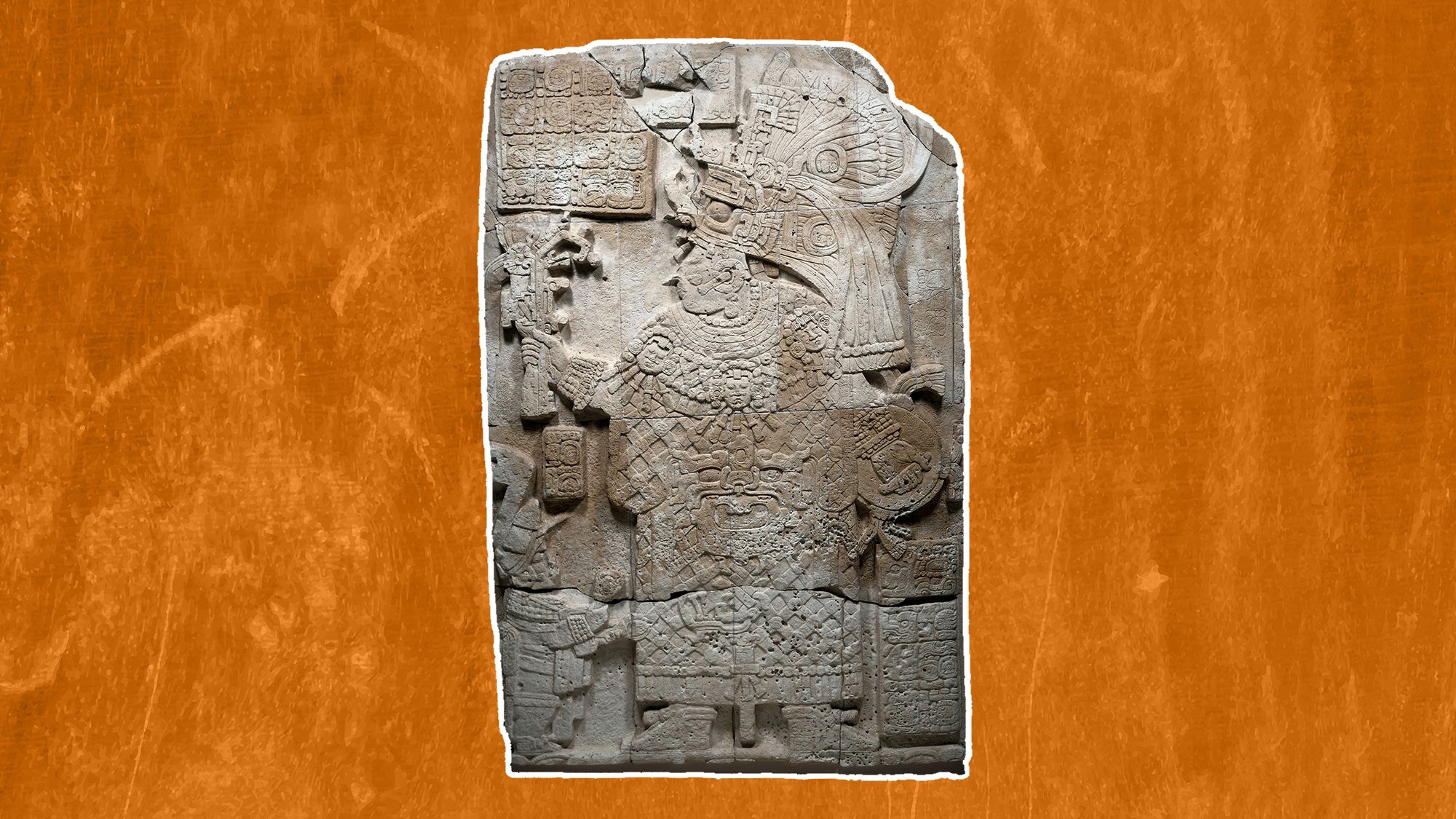
A limestone carving depicting the ancient Maya queen Lady K’abel.
(Image credit: Cleveland Museum of Art, purchased from the J.H. Wade Foundation 1967.29)
Quick facts
Name: Front of a limestone monument depicting Lady K’abel
Material: Carved limestone
Discovery location: El Perú-Waka’, Petén, Guatemala
Date created: Approximately 692 CE
A Maya monument honoring Lady K’abel
This monumental limestone sculpture portrays the Maya queen Lady K’abel, whose name is often translated as “Lady Water Lily Hand.” The inscription also identifies her as Ix K’aloomte’, or “Lady Supreme Warrior,” a title that highlights her military and political authority.
The carved stone monument is part of the collection of the Cleveland Museum of Art. Museum conservators reconstructed it from more than 40 carved limestone fragments. The reconstructed front section is about 9 feet (2.74 meters) tall and weighs approximately 2,500 pounds (1,134 kilograms).
The monument was created around 692 CE, likely to mark the end of a katun—a 20-year period in the ancient Maya calendar. It was discovered at the Maya city of El Perú-Waka’ in the Petén region of northern Guatemala, where Lady K’abel ruled during the Late Classic period.
Who was Lady K’abel?
Lady K’abel stood beside a related portrait of her husband, King K’inich Bahlam II. She belonged to the powerful Caanul, or Snake, dynasty and governed El Perú-Waka’ as a military leader. The inscription’s title, Ix K’aloomte’, presents her as a supreme war commander rather than simply a royal consort.
Some researchers believe Lady K’abel may have led military campaigns from the city of Calakmul against the rival Maya center of Tikal. Her portrait communicates this authority through an elaborate costume that combines royal, military and divine imagery. The monument’s inscriptions describe her as being “covered in rich ornaments,” emphasizing her status and connection to the supernatural world.
Latest videos fromLive Science
Symbols of power, rebirth and divine authority
Lady K’abel wears an elaborate headdress decorated with green quetzal feathers and a netted garment embellished with jade beads. A fish-like creature appears at her waist, while she holds a scepter and a circular shield—objects that reinforce her role as a powerful military ruler.
The queen’s costume also links her to Maya gods, including the maize god or a lunar deity. By appearing in divine attire, Lady K’abel may have been portrayed as a figure of creation, renewal and rebirth. These themes were especially important during the transition from one katun to the next.
Lady K’abel’s tomb confirms her identity
The Cleveland Museum of Art acquired the limestone monument in 1967, but archaeologists did not discover Lady K’abel’s tomb until 2012. Researchers found the burial unexpectedly while excavating near the base of a previously unknown staircase at El Perú-Waka’, close to where the monument had been uncovered.
The excavation, led by archaeologists including Olivia Navarro-Farr, revealed a rich collection of jade, obsidian and shell objects. Among the discoveries was a bivalve shell placed near the pelvis of the deceased. The shell matched the one shown on Lady K’abel’s body in the limestone portrait.
Archaeologists also found a small alabaster vessel inscribed with hieroglyphs naming Lady K’abel as its owner. Together, the hieroglyphic inscription, the matching shell and the location of the burial provided compelling evidence that the tomb belonged to the Maya warrior queen depicted on the monument.
Get the world’s most fascinating archaeological discoveries delivered straight to your inbox.
“It’s not unusual to find royal tombs,” Navarro-Farr said. “However, there is rarely a complete confluence of evidence that allows for such historical identification.”
For more fascinating archaeological discoveries, explore our archive of amazing artifacts.