


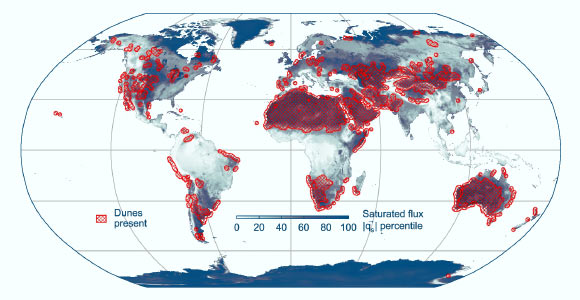
Monash University scientist Dr. Andrew Gunn has created the first comprehensive global map of wind-blown sand dunes on Earth.
Global distribution of wind-blown sand dunes on Earth. Image credit: Andrew Gunn, doi: 10.1038/s41467-026-75466-y.
“Sand dunes can serve as natural archives of climate and geological history,” said Dr. Gunn, author of the study, published in the journal Nature Communications.
“A consistent global map of sand dunes gives us a deeper understanding of how wind-shaped landscapes evolve on Earth today. It also provides a valuable benchmark for interpreting the geological record and studying similar landforms on planets such as Mars.”
For the study, Dr. Gunn combined satellite imagery with elevation data to manually map dune distribution across 0.1-degree grid squares worldwide. The analysis identified wind-blown sand dunes across approximately 7.8% of Earth’s land surface, spanning every continent.
The research found that dune formation cannot be explained by aridity or wind strength alone. Instead, sand dunes are most common in areas where sediment is actively accumulating faster than it is being removed by erosion.
Africa provides a clear example of this process. Although parts of the Sahara Desert are extremely dry and experience strong winds, some areas contain few or no sand dunes because wind transports sand away faster than new sediment can accumulate.
Dr. Gunn also examined how the shape of crescent-shaped barchan dunes—often used to determine wind direction on Earth, Mars and in ancient rock formations—can be influenced by the type and properties of the sediment.
This new global sand-dune dataset could improve predictions of desertification linked to climate change and help scientists interpret wind-shaped landscapes on other planets.
“As global climate patterns change, this map provides a baseline for tracking how wind systems and drylands are changing in real time,” Dr. Gunn said.
“The dataset not only helps us understand Earth’s past, but also gives climate modelers an important tool for predicting how desertification and wind erosion could affect communities in the coming decades.”
_____
A. Gunn. 2026. Distribution of wind-blown sand dunes on Earth. Nature Communications 17, 8468; doi: 10.1038/s41467-026-75466-y
Source: www.sci.news