


Hello Nature readers. Would you like to receive this science briefing free in your inbox every day? Sign up here.
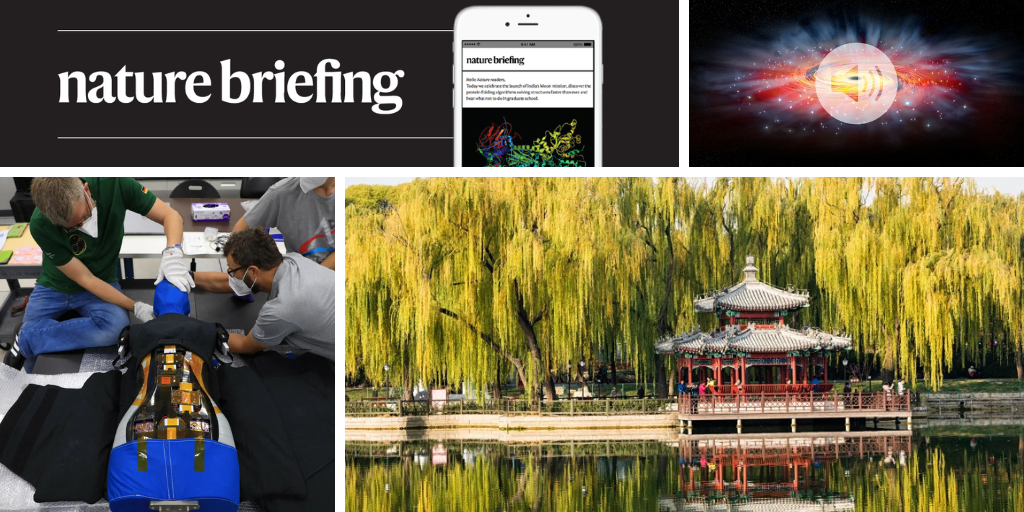
Researchers fitted a prototype radiation protection vest to Zohar, a mannequin that flew aboard NASA’s Artemis I mission in 2022.
Credit: NASA/DLR
Radiation protection vest could shield astronauts in deep space
A lightweight radiation protection vest worn by a female-shaped mannequin during NASA’s uncrewed Artemis I mission could help protect astronauts from dangerous radiation during deep-space travel. The AstroRad vest is made from a durable plastic containing hydrogen-rich particles, which can block radiation more efficiently than the heavy shielding used to protect an entire spacecraft.
Measurements taken as the spacecraft passed through the highly radioactive inner Van Allen radiation belt suggested that the vest could block 40–60% of radiation from solar storms. That level of protection could spare astronauts from radiation exposure equivalent to six months or more in deep space.
Reference: Science Advances paper
Urban trees can contribute to ozone pollution
Some tree species planted in cities are selected because they grow quickly and can tolerate a changing climate. However, certain urban trees also release high levels of volatile organic compounds (VOCs), which can contribute to air pollution and ground-level ozone.
VOCs react with nitrogen oxides (NOx) in sunlight to form ozone, a pollutant that can worsen breathing problems. A study in Beijing found that vegetation accounted for approximately 10% of total VOC emissions during 2021. Although automobiles and industry remain major sources of these emissions, choosing lower-emitting tree species could help reduce urban ozone pollution.
Nature | 6 min read
Reference: Science Advances paper
Personalized mRNA vaccine reduces melanoma recurrence risk
A personalized mRNA vaccine for melanoma reduced the risk of cancer recurrence in a phase III clinical trial, according to the company that developed it. The vaccine is the first mRNA-based cancer treatment to report success in a late-stage trial.
mRNA researcher Seth Cheatham described the findings as “incredibly exciting”. Sam Burrell, chief executive of the medical research charity LifeArc, said the results could have implications beyond cancer. Personalized vaccines could increase confidence in tailored treatments for rare diseases caused by individual genetic mutations.
Nature | 5 min read
This week’s infographic

Source: Grant Witness/NSF Data
NSF research grant awards expected to decline
The US National Science Foundation (NSF) plans to reduce the number of new research grants awarded during the current fiscal year. The decline follows a reduction that began last year, according to Nature reporting.
Grant Witness and NSF data indicate that the number of new grants could be about 46% lower than the annual average between 2021 and 2024. The NSF also plans to direct approximately $1 billion of its $8.8 billion budget towards initiatives known as “Grand Research Challenges”, which focus on areas including advanced materials and artificial intelligence.
Nature | 6 min read
Source: Grant Witness/NSF Data
Features and perspectives
How personal experience shapes rare-disease research
Molecular biologist Francesca Granata studies porphyria, a rare disease that can cause burning and intensely itchy skin. She began researching the condition after being diagnosed herself in 2008.
Granata and other scientists who study their own rare diseases told Nature that personal experience can deepen empathy for patients and motivate researchers to develop better treatments. Although studying one’s own condition can introduce bias, contributing to a stronger understanding of a disease can also bring a powerful sense of purpose and satisfaction.
Nature | 12 min read
Biocrusts help protect fragile desert soils
In high deserts and other arid regions, broad areas of ground can be covered by biocrusts: slow-growing communities of bacteria, algae, fungi, lichens and mosses. These living soil crusts help build and stabilize the ground.
Biocrusts protect soil from ultraviolet radiation, improve nutrient availability and retain water. They can also reduce erosion, support native plants and prevent dust from becoming airborne. Rising temperatures may limit their growth, so researchers are conducting field experiments to understand how biocrusts can be restored and used to strengthen arid landscapes.
Reference: Restoration Ecology paper
A small mistake leads to a larger mystery
In the latest short story from the Nature Futures series, a banker notices a seemingly minor error in his ledger.
Nature | 6 min read
New star could reveal how fast the Milky Way’s black hole spins
The recently discovered star S301 could help physicists investigate a long-standing question about Sagittarius A*, the supermassive black hole at the centre of the Milky Way: how quickly is it rotating?
S301 appears to orbit the black hole. If Sagittarius A* is spinning, that rotation should subtly alter the star’s orbit. By tracking changes in the orbit over time, researchers could determine the black hole’s spin rate and direction.
Nature Podcast | 29 min listen
Subscribe to the Nature Podcast on Apple Podcasts,
Spotify,
YouTube Music
or RSS.
Today, a reef penguin swims along a river in El Gallineral Park in Santander, Colombia. Can you find the penguin?
The answer will be in Monday’s email. Many thanks to Briefing photo editor and penguin wrangler Tom Horton.
This newsletter is constantly evolving. Let us know what you think by emailing [email protected].
Thank you for reading,
Flora Graham, Nature Briefing Editor-in-Chief
Contributed by Jacob Smith
• Nature Briefing: Careers — practical insights, advice and award-winning journalism to help you optimize your work life.
• Nature Briefing: Microbiology — the microorganisms that shape health, the environment and our food systems.
• Nature Briefing: The Anthropocene — climate change, biodiversity, sustainability and geoengineering.
• Nature Briefing: AI and Robotics — 100% written by humans, of course.
• Nature Briefing: Cancer — a weekly newsletter written for cancer researchers.
• Nature Briefing: Translational Research — biotechnology, drug discovery and pharmaceuticals.
Source: www.nature.com