


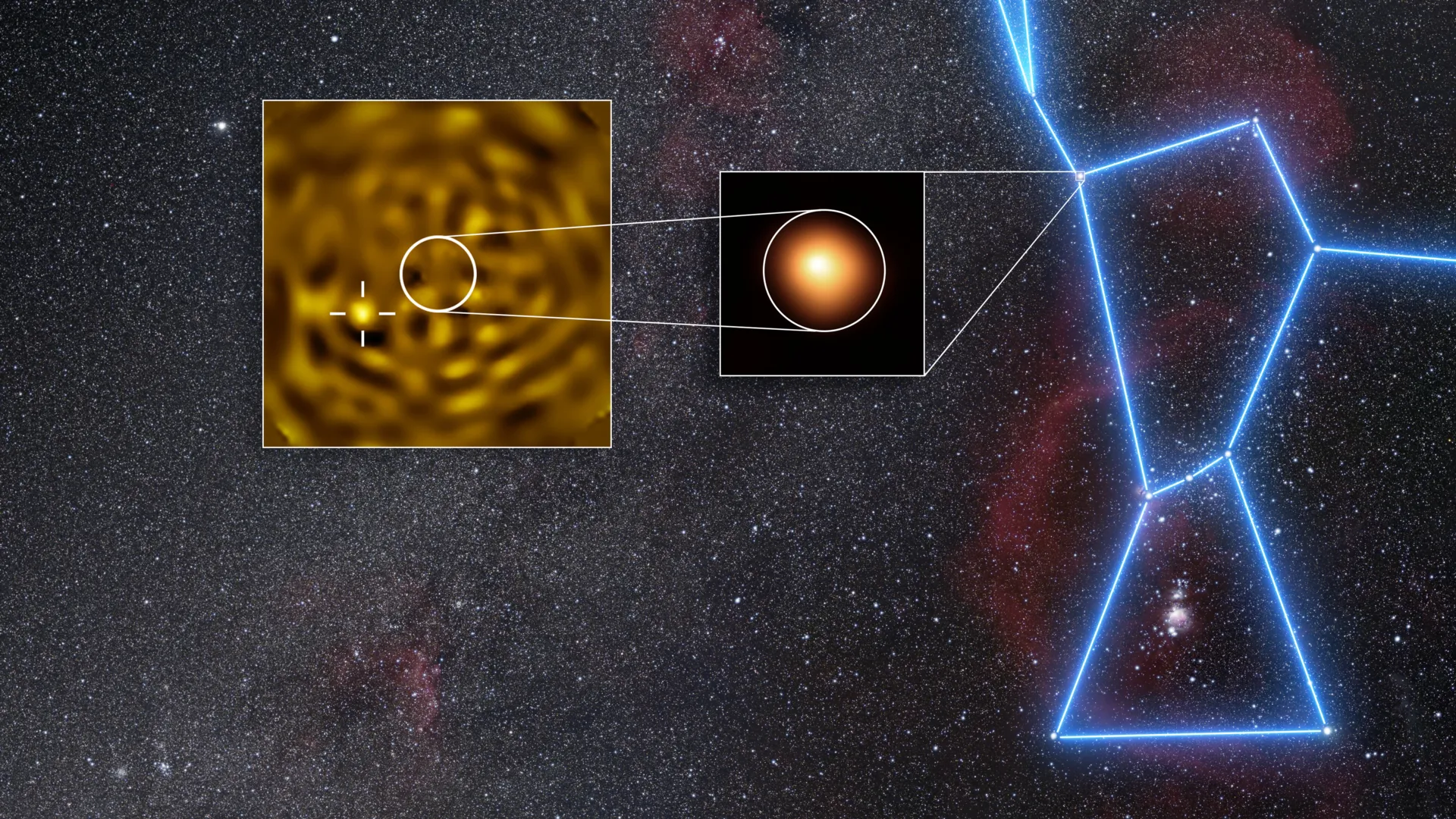
Astronomers have found the strongest evidence yet that Betelgeuse, one of the brightest and most recognizable stars in the night sky, has a stellar companion. A team led by French astronomer Miguel Montargès used the European Southern Observatory’s Very Large Telescope (ESO’s VLT) to capture the clearest images to date of a suspected companion star known as Betelgeuse B.
“This is the conclusion of a century of research,” Montargès said.
“We have shown that Betelgeuse is not a single star, but is accompanied by a faint companion,” said Montargès, an astronomer at the Paris Observatory–PSL in France and lead author of the study published in Astronomy & Astrophysics.
Betelgeuse is a reddish supergiant star in the constellation Orion. Easily visible with the naked eye, it is also known for regularly changing brightness. Although people have observed Betelgeuse for thousands of years, the famous star continues to surprise astronomers.
The century-long search for Betelgeuse B
“When I saw the processed image, I jumped out of my chair,” Montargès recalled.
The possibility that Betelgeuse has a companion star was first proposed about a century ago as a possible explanation for some of its brightness variations. However, despite decades of observations, astronomers had never been able to clearly detect the suspected companion.
That changed after two studies published in 2024 made detailed predictions about the companion’s likely location. Researchers determined that Betelgeuse B would reach its greatest apparent separation from Betelgeuse in December 2024, creating an ideal opportunity for direct observation.
Montargès and his colleagues observed Betelgeuse with ESO’s VLT in December 2024. They then spent several months processing and analyzing the observations in detail.
“Honestly, we did not think we had enough sensitivity to detect Betelgeuse B as predicted,” Montargès explained. “It is larger than expected, which made it possible to see.”
Scientists had originally estimated that Betelgeuse’s companion would have a mass similar to that of the Sun. The new observations instead indicate that Betelgeuse B may be significantly larger, with an estimated mass of two to three times that of the Sun.
“The fact that we can still discover a nearby companion star that is larger and brighter than the Sun around such a well-studied star is remarkable,” Montargès said. “This is one of the great moments in science: seeing something new and unexpected.”
Clearest image yet of Betelgeuse’s companion
Researchers directly imaged Betelgeuse B, meaning they detected light emitted by the suspected companion itself. The observation was made using the SPHERE instrument on ESO’s VLT in Chile’s Atacama Desert.
Earlier observations had already suggested that Betelgeuse may have a companion, including a possible direct detection by the Gemini North Telescope in Hawaii. However, the latest VLT observations provide the strongest evidence so far and the sharpest image yet of Betelgeuse B.
“It is noteworthy that SPHERE and its advanced image-processing techniques, originally developed to detect exoplanets, are also highly effective at identifying companion stars around massive, evolved stars such as Betelgeuse,” said co-author Anthony Boccaletti, an astronomer at the Paris Observatory.
The discovery is not yet considered completely confirmed. Astronomers hope to conduct additional observations to track the suspected companion’s orbit and determine its future position relative to Betelgeuse.
“We would need to observe it on the other side of the star within a year to confirm that the companion is truly there, but there is little room for doubt,” Montargès added.
Betelgeuse’s famous dimming event
Betelgeuse attracted worldwide attention several years ago when its brightness dropped dramatically. The unusual dimming led to speculation that the red supergiant might be preparing to explode, since massive evolved stars are expected to eventually end their lives as supernovae.
However, the dimming was not caused by an imminent explosion. Montargès and his team used ESO’s VLT to study the event and determined that a cloud of dust had blocked some of Betelgeuse’s light from view.
The possible discovery of Betelgeuse B now adds another important factor for astronomers studying the evolution and behavior of this famous red supergiant.
Could Betelgeuse B influence a future supernova?
Researchers will now investigate whether Betelgeuse B could affect the evolution of Betelgeuse and other red supergiant stars, including the conditions surrounding their eventual supernova explosions.
“Whether this companion star influences the evolution of red supergiants remains an open question,” Montargès concluded.
The research was published in a paper titled “VLT/SPHERE images of Betelgeuse’s potential companion” in Astronomy & Astrophysics.
The research team includes M. Montargès (Institute of Astrophysics, Paris Observatory, PSL University, Sorbonne University, University of Paris Cité, CY Cergy Paris University, CNRS, France; LIRA), A. Boccaletti (LIRA), O. Flasseur (Université Claude Bernard Lyon 1, Centre de Recherche Astrophysique de Lyon UMR5574, ENS de Lyon, CNRS, France), A. de Koter (University of Amsterdam, Anton Pannekoek Institute for Astronomy, Netherlands), J. Milli (University Grenoble-Alpes, CNRS, IPAG, France), P. Kervella (France–Chile Astronomical Institute, IRL 3386, CNRS, University of Chile, Chile; LIRA), S. Ridgway (National Optical-Infrared Astronomy Research Laboratory, USA), E. Bordier (I. Physikalisches Institut der Universität zu Köln, Germany), E. Lagadec (University of the Côte d’Azur, Côte d’Azur Observatory, CNRS, Lagrange Institute, France), A. K. Dupree (Harvard University and Smithsonian Center for Astrophysics, USA), F. Backs (Institute of Astronomy, University of Leuven, Belgium), T. Calderwood (American Association of Variable Star Observers, USA), and P. Morgan (AAVSO).
Source: www.sciencedaily.com