


EvoHarness-RL Teaches AI Agents to Manage Long-Term Tasks More Efficiently
Enterprise AI agents need more than a large context window to complete complex, long-running workflows. Consider an agent migrating thousands of customer records from a legacy CRM to a cloud database. A task that takes hours requires continuous access to runtime information, including server logs, API responses, task status, and recovery procedures.
This runtime layer, often called an AI agent harness, gives the model feedback from its environment and helps it manage the workflow. The harness tracks completed and pending subgoals, prevents duplicate data transfers, and provides tools for recovering from unexpected failures. For example, if a database rejects a batch because of API rate limits, the harness can help the agent pause, adjust its strategy, and resume the migration safely.
Today, developers typically control how an AI agent uses tools by writing detailed rules and procedures. A developer might instruct an agent to search a company wiki before drafting an email or to check a database schema before running a query. While these instructions can improve reliability, they also make agents dependent on rigid scripts rather than independent decision-making.
Researchers from Meta AI and the University of Illinois Urbana-Champaign have introduced EvoHarness-RL, a framework designed to make AI agent harnesses more adaptive. The approach adds a trainable abstraction layer that teaches agents when to read, update, and integrate information from their environments during complex tasks.
For long-term workflows, an AI agent must continuously interpret changing conditions. It needs to update its understanding of the environment, track active subgoals, recover from failed actions, and reuse useful knowledge from previous tasks. The harness manages this execution state, but traditional systems often rely on manually engineered logic to decide what information the agent should use and when.
Self-evolving agent frameworks such as Harness-1 address part of this challenge by collecting previous task trajectories and converting them into structured procedural memory. This memory can include reusable skills, workflows, and code libraries. However, long-term skill curation is often separated from real-time state tracking within an active task. As a result, these systems may remember past procedures without effectively managing the immediate conditions of the current workflow.
Xuying Ning, a co-author of the EvoHarness-RL paper, told VentureBeat that manually written logic and inflexible memory systems can consume significant engineering resources.
“The optimal harness often varies by model,” Ning explained. “Different models can have different prompts, memory designs, permissions, and sandbox configurations. Coding all this logic by hand can lead to another long cycle of tuning and debugging every time you upgrade a model.”
Simple memory accumulation can also hurt an agent’s reasoning. “Additional dedicated memory assumes that more context is always useful, but that’s not necessarily true,” Ning said. “When performing long tasks, memory may contain old conclusions, failed attempts, or information that is no longer relevant.”
For this reason, reliable AI agents need dynamic memory systems that can update, compress, and replace information. Without those capabilities, an agent may repeat failed strategies, rely on outdated conclusions, or waste tokens searching through irrelevant context.
EvoHarness-RL Creates a Unified Workspace for AI Agents
EvoHarness-RL addresses the limitations of hard-coded prompts by training agents to use their harnesses more strategically. Instead of blindly following a fixed sequence of instructions, an agent learns to organize unstructured execution data into a structured workspace and decide when external state is worth consulting.
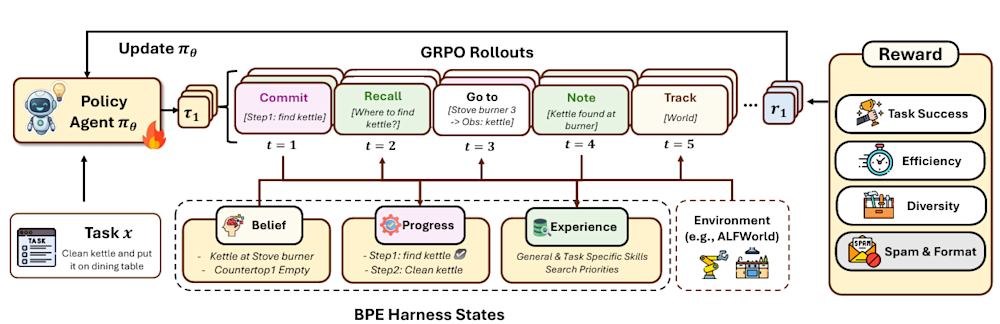
The framework consolidates key harness functions into a single interface called Beliefs, Progress, and Experience, or BPE. This workspace organizes the information an AI agent needs into three areas:
-
Beliefs: The agent’s current understanding of the environment, including system conditions, available resources, and relevant facts.
-
Progress: The status of completed, active, and pending subgoals, including dependencies between workflow steps.
-
Experience: Lessons, strategies, feedback, and insights that can be reused across tasks.
Rather than exposing the agent to a collection of complicated, domain-specific APIs, EvoHarness-RL provides four compact meta-actions: Track, Commit, Recall, and Note. These actions allow the agent to monitor the live environment, record progress updates, retrieve relevant past strategies, and save newly discovered information for future use.
The three BPE states can support a wide range of enterprise use cases. In software engineering, beliefs can represent an agent’s understanding of a code repository, including component relationships, configuration changes, and the current state of the development environment. Progress can show which implementation and testing steps are complete, which remain open, and which tasks depend on one another. Experience can store lessons from code reviews, user feedback, and previous debugging sessions.
The same structure can help financial services agents perform compliance audits. Beliefs may describe applicable regulations and available evidence. Progress can track completed checks, unresolved exceptions, and escalation requirements. Experience can help the agent identify recurring discrepancies and recognize when human review is necessary.
“These conditions combined prevent agents from losing track of their work or repeating the same failed approach,” Ning said.
How EvoHarness-RL Trains AI Agents
The researchers use a two-stage training process to teach agents both the mechanics and the strategy of external workspace management.
In the first stage, known as supervised harness fine-tuning, the base model learns to extract useful facts from unstructured interaction logs. It then organizes those facts into the BPE workspace, separating current environmental beliefs, workflow progress, and reusable experience.
The second stage uses cost-aware reinforcement learning. Consulting memory systems, updating trackers, and querying external tools all consume time and token computation. An agent that checks its harness after every action may become unnecessarily slow and expensive.
Cost-aware reinforcement learning therefore teaches the model to decide whether accessing external state is worth the computational cost. The result is a shift from fixed tool-use instructions to learned runtime behavior. The agent can consult the harness when uncertainty or task complexity justifies it, while relying on internalized knowledge for routine steps.
EvoHarness-RL Performance on ALFWorld
To evaluate the framework, the researchers tested EvoHarness-RL on ALFWorld, a text-based benchmark featuring multi-step tasks that require sequential reasoning, planning, and state tracking.
For training, the team used Qwen3-8B as the base model. They compared the resulting system with three large frontier models—Claude Opus 4.5, GPT-4.1, and GPT-5—as well as static agent frameworks such as ReAct, ExpeL, and ReasoningBank. The evaluation also included trainable approaches including standard GRPO, SkillOS, and SkillRL.
The Qwen3-8B model equipped with EvoHarness-RL achieved an average success rate of 96.9%. That result represents a 49.0-percentage-point improvement over the baseline ReAct model.
The trained 8B model also exceeded the reported results for SkillRL, which achieved 89.9%, and SkillOS, which achieved 80.2%. It nearly matched Claude Opus 4.5, which recorded a 96.4% success rate in the comparison.
These results suggest that better harness management can substantially improve the performance of smaller, more cost-efficient language models. The gains were not limited to models trained with EvoHarness-RL. Researchers also found that adding a BPE prompt-time harness improved the performance of frozen frontier models. GPT-4.1’s success rate increased by 22.1 percentage points, while GPT-5 improved by 25.7 points.
Harness Annealing Reduces AI Agent Costs
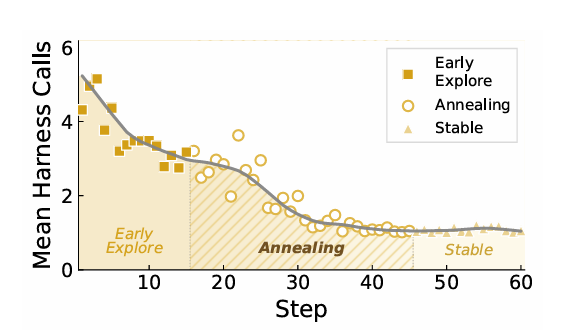
The researchers observed a behavioral pattern they called harness annealing. During the early stages of reinforcement learning, the agent frequently queried the experience and progress modules. This helped it learn how to manage unfamiliar tasks and use the available tools.
As the model became more proficient, it reduced its reliance on external tools and embedded successful patterns into its parameters. For enterprise applications, this could translate into lower latency, fewer tool calls, and reduced inference costs.
For example, an AI agent migrating standard database records may eventually complete familiar transfers without repeatedly checking its task tracker. However, if it encounters an unusual legacy API endpoint or a complex validation error, it can increase its use of the belief and experience modules. It might capture current server logs, review relevant historical tickets, and use those insights to resolve the exception safely.
Harness Evolution Helps Agents Handle Unexpected Problems
In addition to harness annealing, the researchers observed what they describe as harness evolution. This behavior allows an agent to adapt its use of the BPE workspace to the complexity of the situation.
The agent may bypass the harness during simple, familiar operations. When it enters an unfamiliar environment or encounters an unexpected obstacle, it can expand its use of beliefs, progress tracking, and experience retrieval.
This adaptive behavior is particularly important for enterprise workflows. A customer data migration may proceed quickly when records follow a standard format. If a legacy endpoint behaves differently or a validation rule rejects a batch, the agent can inspect live system feedback and retrieve relevant prior solutions instead of relying on guesswork.
How Enterprises Can Deploy EvoHarness-RL
Introducing a new AI agent framework can create integration challenges for enterprise engineering teams. EvoHarness-RL is designed to address this issue through environment adapters. These adapters allow organizations to keep domain-specific tools and workflows while sharing the trainable harness layer.
“I think there is great potential in integrating BPE into existing orchestration systems,” Ning said. “Teams don’t necessarily need to replace their current tools or agent frameworks; BPE can serve as an additional state management layer that continually organizes what agents currently believe, how far they’ve progressed, and what they’ve learned.”
For teams focused on inference costs, deployment can use a hybrid architecture. Frontier models may generate high-quality training or integration data, while smaller open-weight models handle routine state management during day-to-day operations.
“One possible compromise is to use frontier models to generate high-quality integrated data and then fine-tune competent open-weight models to handle day-to-day condition management,” Ning said. She added that these integrations could run asynchronously so they do not slow down the agent’s primary execution loop.
Organizations should still determine whether a trainable BPE harness is appropriate for their use case. Short, predictable tasks may not require a sophisticated runtime layer. “For short, stable tasks, ReAct or standard RAG may already be sufficient,” Ning said. “BPE becomes even more valuable when agents work for hours, days, or even weeks.”
Long-running workflows require agents to summarize decisions, maintain an accurate view of task progress, recover from failure, and learn from human feedback. In these environments, structured state management can help prevent the agent from losing context or repeating unsuccessful actions.
Ultimately, EvoHarness-RL does not eliminate the need for workflow engineering. Instead, it changes the role of engineers—from manually scripting every agent behavior to designing systems that can learn how to manage their own runtime state more effectively.
Source: venturebeat.com