


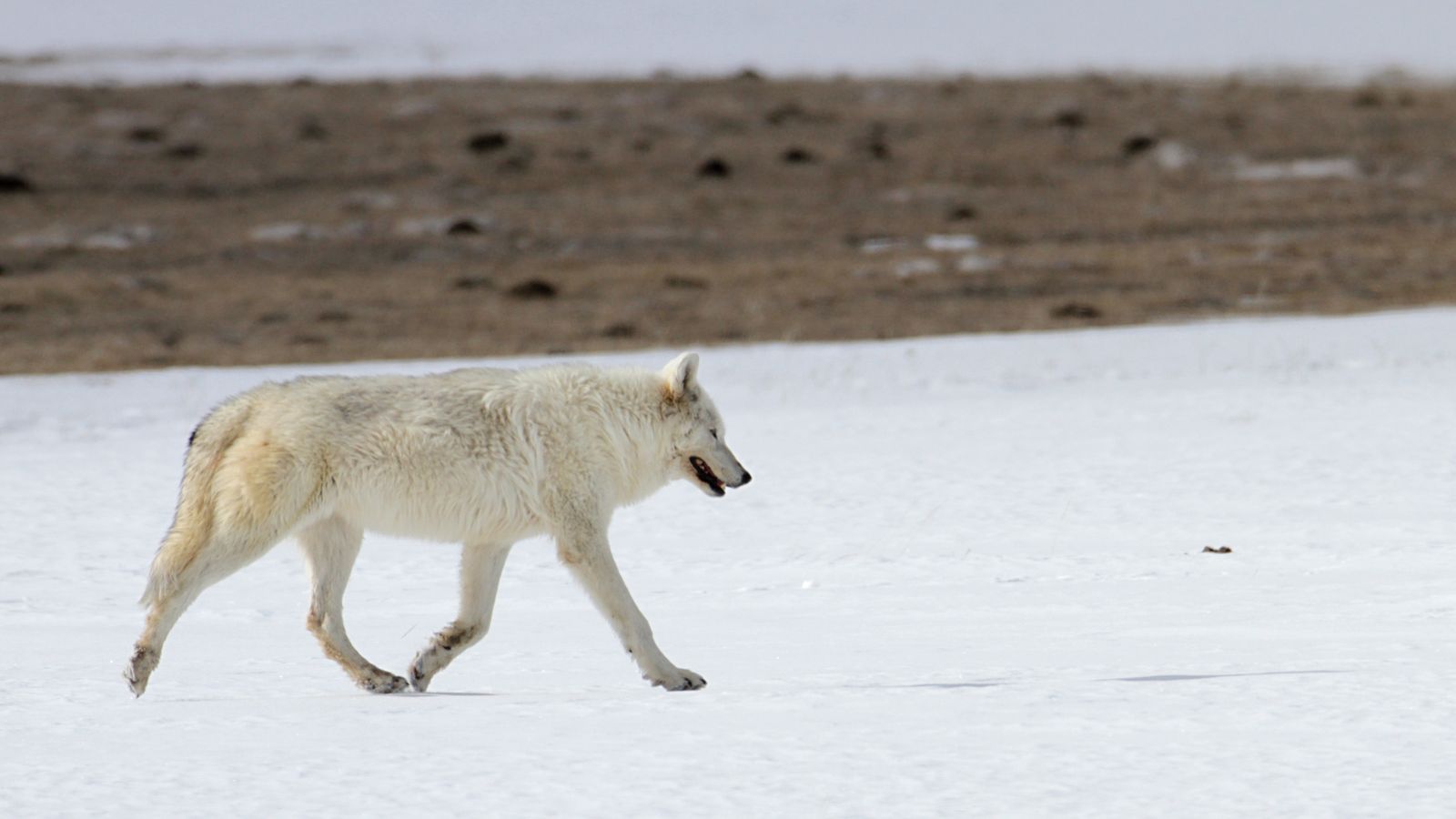
How Yellowstone’s Gray Wolves Transformed the Park’s Ecosystem
A century after Yellowstone’s resident wolves were eliminated, biologists reintroduced gray wolves in 1995. Their return restored a top predator and reshaped the park’s wildlife, science and conservation debate.
Jim Peaco / NPS
Gray wolves are social predators that depend on cooperation to survive. They live in close-knit family packs, working together to hunt elk, deer, bison and other hoofed mammals that can weigh several times more than an individual wolf.
The popular image of a solitary “lone wolf” does not capture the animal’s social nature. Writer Erica Berry, author of the book Wolfish: Wolf, Self and the Stories We Tell About Fear, says wolves offer a different lesson about independence and community.
“What humans share with wolves,” Berry explains, “is not this idea of our independence and solitude, but actually the ways that we collaborate.” Even a wolf traveling alone, she adds, comes from a pack and is usually searching for another one.
/https://tf-cmsv2-smithsonianmag-media.s3.amazonaws.com/filer_public/40/c3/40c3d24d-cd70-43a5-9a1b-5f83f5ab7bd1/53470570715_873e9028fb_o.jpg)
Ashton Hooker / NPS
For thousands of years, wolves were among the most widely distributed land mammals on Earth. They once occupied much of North America and played an important role in Indigenous cultures and oral histories.
James Holt, an environmentalist and member of the Nez Perce Tribe in Idaho, says Indigenous communities have observed and learned from wolves since long before written records. Those relationships helped shape cultural traditions and understandings of the natural world.
Despite their ecological and cultural importance, wolves became targets of widespread persecution in the United States. The first documented wolf bounty in colonial America was established in Massachusetts in 1630. As settlers expanded across the continent, conflicts grew between wolves, livestock owners and government agencies.
Wolves generally avoid people, but their presence became a source of fear and suspicion. Historian Jon T. Coleman wrote in Vicious: Wolves and Men in America that early settlers often heard wolves howling without seeing them, creating what he described as a mysterious or “ghostly presence.”
/https://tf-cmsv2-smithsonianmag-media.s3.amazonaws.com/filer_public/ff/21/ff2127de-79ce-48d5-b5e0-aeea7e558ee6/18040d.jpg)
Jim Peaco, NPS / Yellowstone National Park
During the 19th century, westward expansion reduced many of the wolves’ natural prey animals. At the same time, livestock became more accessible. Ranchers, hunters and government officials responded with trapping, shooting and poisoning campaigns.
Those efforts nearly eliminated gray wolves from the lower 48 states. In many areas, killing wolves was supported by public policy, and historical photographs show people posing with the pelts of animals they had killed.
Yellowstone National Park became one of the most important places in both the history of wolf eradication and the species’ eventual recovery. Gray wolves lived in the region when Yellowstone was established in 1872, and fossils show that wolves inhabited the Mountain West for thousands of years.
Park officials, however, soon began treating wolves as a threat to elk and other prey. In 1915, Yellowstone’s superintendent described growing wolf numbers as “a decided menace.” The National Park Service then participated in a campaign to remove predators from the park.
“Wolves were public enemy number one,” said Doug Smith, a biologist who worked on Yellowstone’s wolf program for nearly three decades.
/https://tf-cmsv2-smithsonianmag-media.s3.amazonaws.com/filer_public/3f/cc/3fcc8152-d4c6-455c-ad0b-3b5ed50a73dd/14768.jpg)
NPS / Yellowstone National Park
According to the National Park Service, at least 136 wolves were killed in Yellowstone between 1914 and 1926. The campaign was part of a larger predator-control effort on public lands that also targeted cougars, coyotes and other carnivores.
Poison was one of the most effective tools. Officials used strychnine, a toxic alkaloid that can cause convulsions, respiratory failure and severe pain. Poisoned carcasses of livestock, elk and bison were left where wolves would find them while scavenging.
Wolves could learn to avoid hunters and traps, but poison was much more difficult to detect. Yellowstone’s last known resident wolves were killed in 1926. Although isolated wolves may have been seen for several years afterward, the park no longer had a functioning wolf population.
Nearly 70 years later, conservation policy began moving in the opposite direction. The Endangered Species Act of the 1970s protected gray wolves and created a legal foundation for their recovery. In 1987, the U.S. Fish and Wildlife Service published a recovery plan for wolves in the Northern Rockies.
After years of public meetings, scientific planning and political debate, Interior Secretary Bruce Babbitt approved a proposal in 1994 to reintroduce gray wolves to Yellowstone National Park and central Idaho.
In January 1995, wildlife managers transported 14 gray wolves from western Canada to Yellowstone. The animals were held in acclimation pens for approximately ten weeks before being released into the park.
The following year, biologists brought 17 additional Canadian wolves to Yellowstone. The reintroduction was designed to restore a top carnivore to an ecosystem that had been without wolves for generations.
/https://tf-cmsv2-smithsonianmag-media.s3.amazonaws.com/filer_public/34/f3/34f391a4-31df-4f37-928d-439ba848ac98/15575.jpg)
Barry O’Neill, NPS / Yellowstone National Park
/https://tf-cmsv2-smithsonianmag-media.s3.amazonaws.com/filer_public/fc/14/fc1402c7-7867-4743-8f11-64cafa9000e1/15118.jpg)
Jim Peaco, NPS / Yellowstone National Park
The timing favored the newly released predators. Yellowstone had one of the largest elk populations ever recorded, with more than 25,000 elk in the northern herd during the early years of the reintroduction. The wolves quickly formed packs, reproduced and spread throughout the park.
Wolves are highly resilient animals. They breed successfully, disperse across large landscapes and adapt to changing conditions. Arthur Middleton, an ecologist and wildlife-management scholar, describes them as one of the most resilient large carnivores in the world.
The wolves of Yellowstone | 60 Minutes Archive
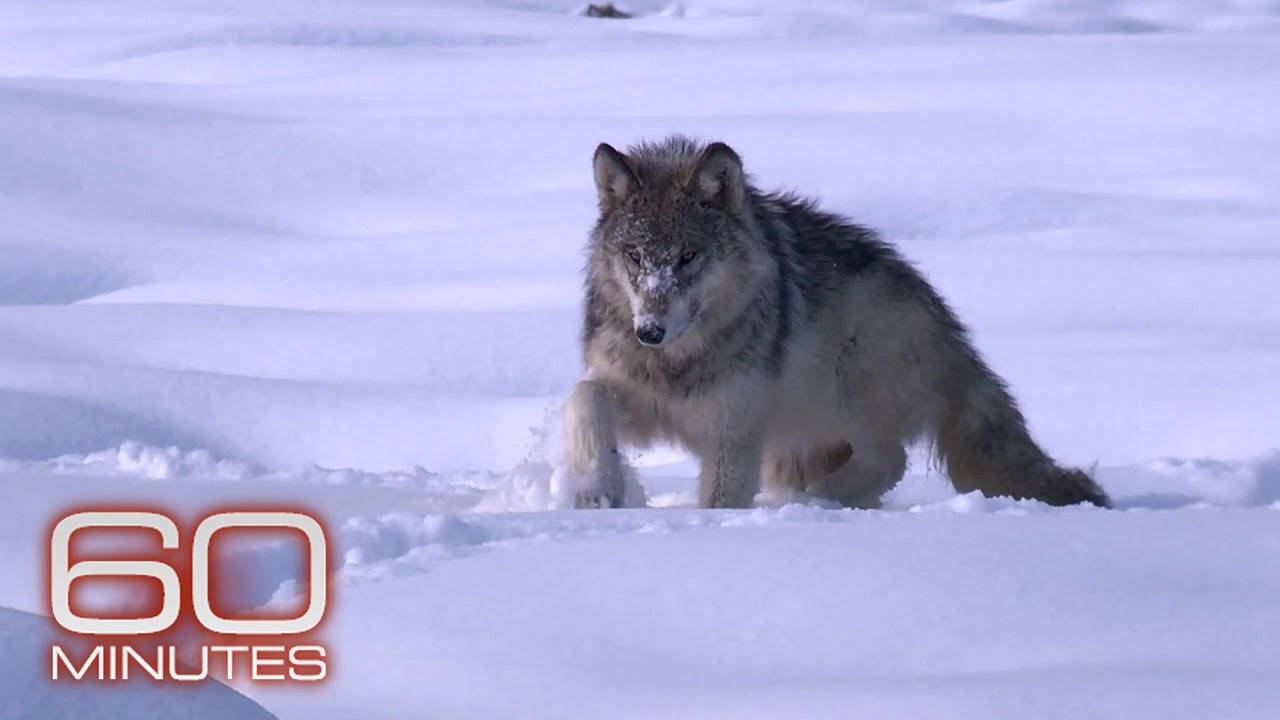
Today, Yellowstone is widely regarded as one of the best places in the United States to observe wild gray wolves. The park covers more than 2.2 million acres across Wyoming, Montana and Idaho, providing protected habitat for wolves, elk, bison, bears and many other species.
Wolf watching has become a major attraction. Visitors often spend hours in Lamar Valley, Hayden Valley and other wildlife areas hoping to see a pack moving across the landscape. Because it is illegal to kill wolves inside Yellowstone, the park functions as what biologists call a “wolf fortress.”
Over the past three decades, Yellowstone biologists have documented the animals’ behavior, reproduction, movements and deaths in unprecedented detail. The park may have the largest long-term scientific data set on wild wolves anywhere in the world.
In winter, biologists use helicopters to locate wolves and capture some of them for radio-collaring. The collars allow researchers to follow individual animals and study pack behavior. Yellowstone aims to keep roughly one-quarter of the wolf population collared.
/https://tf-cmsv2-smithsonianmag-media.s3.amazonaws.com/filer_public/ff/d1/ffd14305-d471-4687-bb88-8a7b2e50a67b/16055515297_c8c13c05b3_o.jpg)
Jim Peaco / NPS
/https://tf-cmsv2-smithsonianmag-media.s3.amazonaws.com/filer_public/ec/f7/ecf78065-72a1-4986-ab4b-4a567744d85a/53726569610_182e8bdb20_o.jpg)
Jacob W. Frank / NPS
Researchers are also testing less invasive ways to monitor wolves. Remote cameras and audio recorders may eventually help scientists identify and count wolves by analyzing their howls and other vocalizations.
Yellowstone has averaged approximately 100 wolves living in about ten packs over the past 12 years. The official count was closer to 80 wolves last year, but biologists consider the population healthy and stable.
Most Yellowstone packs are extended families led by a breeding male and female. The pair typically produces pups each year, while older offspring may remain with the pack for one or two years to help hunt, defend territory and care for younger siblings.
About 75 percent of Yellowstone packs follow this family structure. In some years, however, multiple females within a pack give birth, creating a more complex social group.
/https://tf-cmsv2-smithsonianmag-media.s3.amazonaws.com/filer_public/c5/7a/c57a8633-d6a2-4c26-9ee3-ce5992f65ac0/16189.jpg)
NPS / Yellowstone National Park
Fun facts: Gray wolves can have different coat colors
- Wolf guard hairs can be gray, black, white, brown or a mixture of several colors. Regardless of the outer coat, gray wolves have a gray undercoat.
- Yellowstone research suggests that black-coated wolves may have greater resistance to some diseases, while gray-coated wolves may have higher reproductive success. Packs with different-colored breeding pairs can help preserve genetic diversity.
Life in Yellowstone remains dangerous for wolves. In the protected park, many deaths result from territorial conflicts between neighboring packs. Wolves defend their territories, food sources and den sites, sometimes fighting to the death.
Disease also affects the population. Outbreaks of canine distemper caused declines in the late 1990s and early 2000s, but the packs recovered.
Large prey can be dangerous, too. Bison are especially difficult to hunt because they are North America’s largest land mammals. Wolves often scavenge bison carcasses or target calves, injured animals and other vulnerable members of the herd.
/https://tf-cmsv2-smithsonianmag-media.s3.amazonaws.com/filer_public/05/c8/05c82a63-4c73-41a3-a1a0-4b3ac2b49501/26375779068_eb49b13492_o.jpg)
Jacob W. Frank / NPS
Research from Yellowstone has challenged the idea that wolves can kill any prey they choose. Adult elk are successfully hunted only about 10 to 15 percent of the time, and wolves must spend considerable energy to obtain enough food.
Larger packs often have an advantage when hunting big prey and raising pups. Older wolves contribute valuable experience, helping the group select targets, defend its territory and avoid unnecessary risks.
The return of wolves to Yellowstone is often discussed as an example of a trophic cascade—a chain of ecological effects that moves through the food web after a top predator returns.
The original theory was straightforward: wolves would reduce elk numbers and alter elk behavior. With fewer elk grazing and browsing, plants such as willow and aspen would have more opportunities to grow. Those changes could then influence beavers, birds, insects, waterways and other parts of the ecosystem.
Wolves have affected Yellowstone’s ecosystem, but scientists now describe the process as more complicated than early accounts suggested. The recovery of vegetation cannot be attributed to wolves alone.
/https://tf-cmsv2-smithsonianmag-media.s3.amazonaws.com/filer_public/55/87/5587c2a6-00fb-4bc4-8552-1c3cab28d8e5/41576711525_98d312233b_k.jpg)
Jacob W. Frank / NPS
/https://tf-cmsv2-smithsonianmag-media.s3.amazonaws.com/filer_public/d4/11/d4110609-0706-416c-aa1c-418bcf334b46/26791820784_f7929fe427_o.jpg)
Neal Herbert / NPS
Elk numbers declined because of multiple factors, including wolf predation, human hunting, drought, severe winters and the growing presence of other carnivores. Cougars naturally returned to Yellowstone before the wolf reintroduction, while grizzly and black bear populations also increased and bears consumed many elk calves.
Recent research has questioned whether elk changed their behavior primarily because they feared wolves. Instead, the reduction in browsing appears to be linked largely to there being fewer elk in some areas.
Wolves clearly contributed to the decline in elk abundance, especially as human hunting became less influential in recent years. But ecologists caution against describing wolves as a single-handed solution to every ecological problem.
“You can’t just restore a predator and expect everything—plants, insects, rivers—to recover,” ecologist Elaine Brice told Science. “It’s far more complex than that.”
That complexity is one reason Yellowstone remains an important natural laboratory. Decades of monitoring have allowed scientists to refine their understanding of predator-prey relationships, food webs and ecosystem recovery.
Wolf reintroduction has also created challenges beyond the park’s boundaries. Many wolves now live outside protected areas, where they can encounter livestock, ranches, roads and hunters.
Wolves need healthy habitats and abundant wild prey. When prey is scarce, they may be more likely to target cattle, sheep or working dogs. Ranchers can use nonlethal deterrents such as noise, lights, electric fencing and improved livestock-husbandry practices. Keeping calves together in defensive herds can also reduce vulnerability.
When nonlethal measures fail, some ranchers seek permission to use lethal control. Wildlife managers, conservationists and landowners continue to debate how those tools should be applied while maintaining viable wolf populations.
/https://tf-cmsv2-smithsonianmag-media.s3.amazonaws.com/filer_public/9e/62/9e62c32a-d61e-4793-a19e-ee1b91c512a1/49235201847_2b6c1c9040_o.jpg)
Jacob W. Frank / NPS
Today, wolf conservation is increasingly focused on balancing wildlife protection with human livelihoods. That balance is difficult because wolves move across political boundaries and do not remain within national parks.
Wolf recovery has required cooperation among federal agencies, state wildlife departments, conservation organizations, Indigenous communities and ranchers. The debate is often portrayed as a simple conflict between people who love wolves and people who hate them, but many communities are seeking practical ways to coexist with the animals.
/https://tf-cmsv2-smithsonianmag-media.s3.amazonaws.com/filer_public/83/07/83077e92-45de-47e3-8b7c-24c23acada4f/smithmag-article-wolf-v3.jpg)
Illustration by Emily Lankiewicz / Photos by Jacob W. Frank / Jim Peaco via the National Park Service / Heleno via Adobe Stock and public domain
Wolves have appeared as villains in folklore and fairy tales for centuries, from “Little Red Riding Hood” to “The Three Little Pigs.” In the American West, those cultural images have combined with real concerns about livestock and rural economies.
The conflict remains intense in some communities. In 2017, a famous Yellowstone wolf known as the “White Lady” was illegally shot inside the park and later euthanized because of her injuries.
Such incidents demonstrate that even protected areas cannot completely shield wolves from human actions. They also show why enforcement, public education and cooperation remain central to wolf conservation.
/https://tf-cmsv2-smithsonianmag-media.s3.amazonaws.com/filer_public/d0/09/d009d5f9-0457-4faf-8c84-aef868e663f3/15563.jpg)
Norm Bishop, NPS / Yellowstone National Park
Since the 1990s, wolves released in Yellowstone and Idaho have spread far beyond the areas where they were initially reintroduced. Some traveled hundreds or even thousands of miles in search of prey, territory and mates.
One wolf crossed from Idaho into Oregon in 1999, marking the species’ return to the state after roughly five decades. The famous Oregon wolf OR7, nicknamed Journey, later became California’s first documented wild wolf in nearly 90 years after crossing into the state in 2012.
/https://tf-cmsv2-smithsonianmag-media.s3.amazonaws.com/filer_public/cb/65/cb652189-9c20-4491-a15c-132aa9a18e52/38401270711_3037330860_o.jpg)
Jacob W. Frank / NPS
/https://tf-cmsv2-smithsonianmag-media.s3.amazonaws.com/filer_public/1e/05/1e051c63-d32a-4b23-9cc9-f80f29b5b375/33007883433_07ef6e7c22_o.jpg)
Jacob W. Frank / NPS
Wolves also follow migrating prey. In the Greater Yellowstone Ecosystem, packs may travel with elk herds as the animals move between seasonal ranges. Protecting these migration routes is increasingly important for sustaining both elk and wolves.
The return of gray wolves to Yellowstone is therefore more than a story about a successful wildlife release. It is a continuing experiment in restoring predators, managing ecosystems and finding ways for people and wildlife to share the same landscape.
Wolves have recovered because they are adaptable, social and capable of traveling extraordinary distances. As long as they are not systematically poisoned, hunted and eliminated, they are likely to continue expanding into suitable habitat.
More than 30 years after the first reintroduction, Yellowstone’s wolves remain a powerful reminder that ecosystems can change—and sometimes recover—when a missing species is given the opportunity to return.
Source: www.smithsonianmag.com