


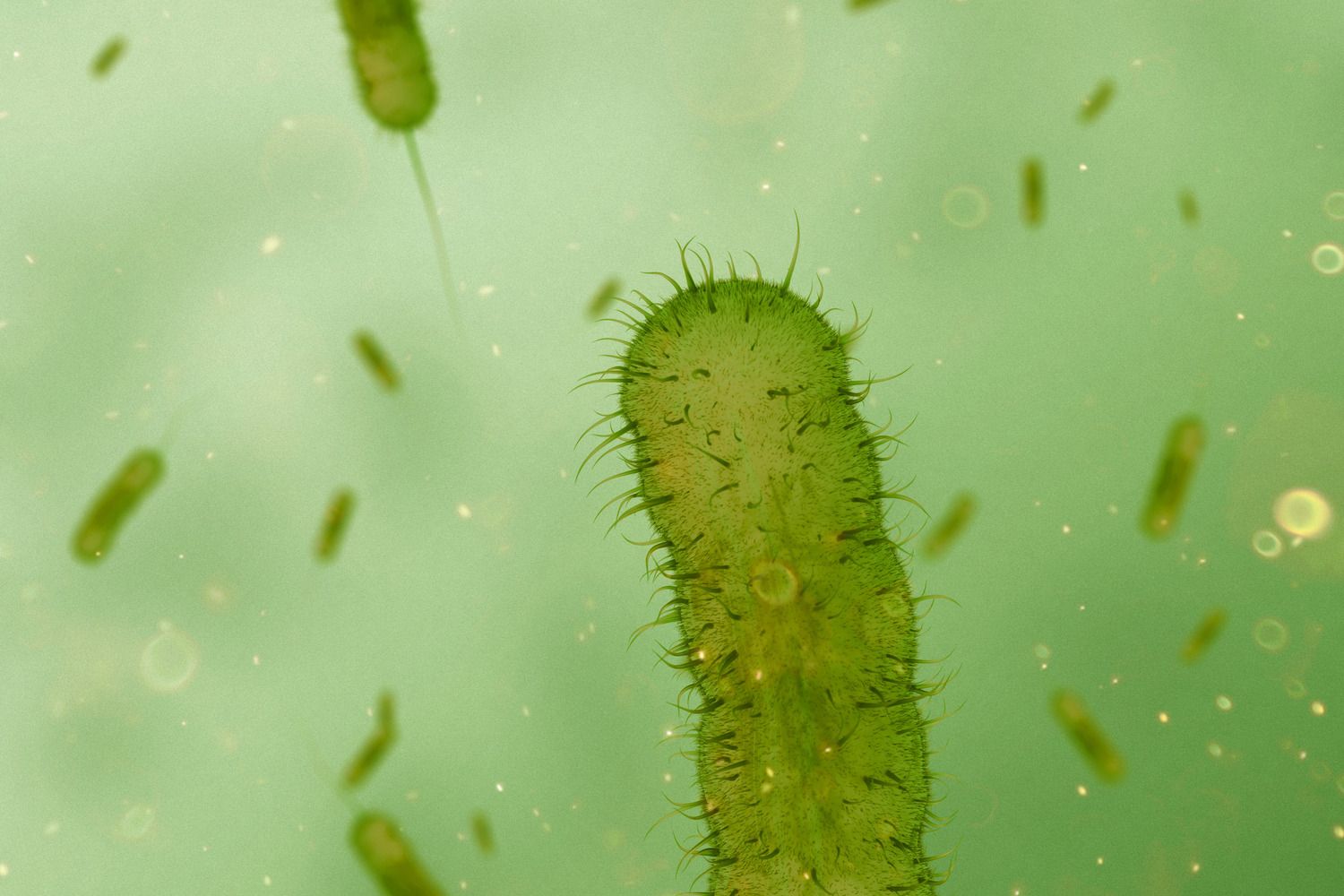
New research challenges the idea that all life descended from a single free-living cell, suggesting instead that Bacteria and Archaea may have evolved independently from a primitive, partly abiotic ancestor.
Mark Garlick/Science Photo Library (via Getty Images)
Few questions in biology are more debated than the origin of life. How did the first autonomous organisms—cells capable of converting molecules and capturing energy—emerge on early Earth?
Before the first cells appeared, scientists believe that important chemical reactions may have taken place around deep-sea hydrothermal vents. Heat, pressure and metals in Earth’s crust could have accelerated chemical reactions, producing increasingly complex compounds. Over time, these geochemical processes may have generated the building blocks of life.
Modern organisms depend on a core network of roughly 400 metabolic reactions. Many of these reactions are catalyzed by enzymes, proteins that help cells produce energy and manufacture essential compounds such as nucleic acids, amino acids and vitamins.
In a new paper published in Science Advances, researchers reconstructed how this metabolic network may have developed. Their findings suggest that life on Earth may have emerged not once, but twice.
“This raises so many questions in terms of what is alive, what life is, what is possible and what can be found elsewhere,” says senior author William Martin, an evolutionary biologist at Heinrich Heine University Düsseldorf in Germany.
/https://tf-cmsv2-smithsonianmag-media.s3.amazonaws.com/filer_public/75/8e/758e3e42-ef88-4fa6-8801-136883426e81/colourful_thermophilic_archaebacteria_stain_in_midway_geyser_basin.jpg)
Wing-Chi Poon, via Wikimedia Commons, CC BY-SA 2.5
All organisms alive today are generally considered descendants of the Last Universal Common Ancestor, or LUCA. This mysterious ancestor probably lived in Earth’s early oceans, possibly near hydrothermal vents.
However, the new research suggests that LUCA may not have been a fully independent, free-living cell. Instead, it may have relied heavily on small organic molecules and metals in its environment to carry out metabolism. The researchers estimate that environmental metals may have driven roughly half of LUCA’s core metabolic reactions before enzymes evolved to perform many of the same functions more efficiently.
“The great thing about this is that we are investigating the evolutionary stage at which geochemical reactions are being replaced and new enzymatic activities are still emerging, causing the metabolic coalescence of the ancestors of Archaea and Bacteria,” Martin says.
Archaea and Bacteria are two of the three major domains of life. The third domain, Eukaryota, includes animals, plants, fungi and other organisms whose cells contain a nucleus. Eukaryotic cells likely emerged later, possibly through a partnership between archaeal and bacterial lineages.
For decades, scientists have considered three possible explanations for the origins of Bacteria and Archaea: Bacteria may have evolved from Archaea, Archaea may have evolved from Bacteria, or both groups may have developed independently from LUCA. The new study supports the third possibility.
Scientists can investigate these scenarios by comparing the traits of modern organisms and determining when their ancestors acquired particular biological features. In earlier research, Martin and his colleagues examined the ribosome, the molecular structure responsible for producing proteins. They concluded that LUCA possessed a primitive ribosome containing 33 proteins. Afterward, bacterial lineages evolved 21 additional ribosomal proteins, while archaeal lineages evolved 29 of their own.
Each lineage appears to have independently refined and expanded the ribosome. In the latest study, Martin’s team applied a similar method to metabolism.
“We looked at metabolic genes and realized this was a similar pattern,” says lead author Natalia Mrunjavac, a graduate student in Martin’s laboratory.
The researchers reconstructed the evolutionary history of metabolic enzymes in modern Bacteria and Archaea. They then identified which reactions may have been present in LUCA and which could have been powered by metals or other substances available near hydrothermal vents.
The team reasoned that the earliest metabolic reactions would have relied on materials present in the environment or produced by other reactions. As these reactions built upon one another, they could have created increasingly complex biochemical networks.
Determining the order of hundreds of interconnected reactions is challenging, says Mike Steel, a mathematician at the University of Canterbury in New Zealand and a co-author of the study. “But it turns out there is a fast algorithm to do this.”
The analysis showed that Bacteria and Archaea share some enzymes with LUCA, but each lineage also contains enzymes that were not present in the ancestor. In several cases, the two groups independently evolved different enzymes to replace the same metal-catalyzed reactions.
“This shows that the reaction is older than the enzyme that catalyzes it,” says Joseph Moran, a chemist at the University of Ottawa and a co-author of the study.
According to Martin, these independent solutions to the same metabolic challenges suggest that Bacteria did not evolve directly from Archaea, and Archaea did not evolve directly from Bacteria.
“The simplest interpretation is that there were two independent transitions from LUCA to free-living cells,” he says.
/https://tf-cmsv2-smithsonianmag-media.s3.amazonaws.com/filer_public/87/c9/87c9b65d-06a7-421c-99dd-3fdef8f9ad62/thermophile_bacteria2.jpg)
Mark Amend, NOAA Photo Library, UAF West Coast and Polar Underwater Research Center, via Wikimedia Commons
Not all researchers agree with this interpretation of LUCA. Some scientists propose that LUCA was a more complex cell with a simple membrane made from archaeal and bacterial lipids, or a mixture of both. Under this model, a single complex ancestor could have eventually divided into the bacterial and archaeal lineages.
Protein crystallographer and origin-of-life researcher Juan Fontecilla Camps of the French Institute of Structural Biology, who was not involved in the study, supports considering this possibility.
Martin argues that such complexity is unlikely because Bacteria and Archaea use fundamentally different processes to produce the lipids in their cell membranes. “They are really quite different,” says Sonya Verena Albers, an archaeal biologist at the University of Freiburg in Germany who was not involved in the research. “Making different lipids requires completely different gene or enzyme systems.”
Based on LUCA’s metabolism, Martin believes the ancestor may have been simpler than a modern cell—and perhaps not fully alive by today’s definition. Free-living cells can grow, divide and survive independently. LUCA, by contrast, may have depended on organic molecules and metals supplied by Earth’s crust.
Martin has long argued that metals were the original catalysts for many metabolic reactions. Over time, enzymes evolved to replace those mineral catalysts.
“There is strong support for the idea that geochemistry would have led to the biochemistry of life,” says Donato Giovanelli, a microbiologist at the University of Naples Federico II in Italy who studies the origin of life.
Many modern enzymes contain metals at their catalytic sites, where chemical reactions take place. Recent experiments by biochemists including Martina Preiner have shown that some reactions involved in core metabolism can proceed when enzymes are replaced by metals. These findings suggest that mineral catalysts may have performed similar functions before biological enzymes evolved.
One crucial metabolic reaction produces energy-carrying molecules that power cellular activity. Modern cells primarily use ATP, but LUCA probably did not have access to ATP in the primordial ocean.
Martin’s team proposes that metals may have helped LUCA store energy as ADP, a precursor to ATP. In the suggested reaction, phosphite, a form of phosphorus, reacts with organic molecules with the help of palladium, a metal in the platinum group.
The ability to temporarily store energy could have transformed early metabolism. Energy storage would have supported other energy-intensive reactions, including the formation of peptide bonds between amino acids and the work of ribosomes during the translation of RNA into proteins.
This process may help explain how life gradually transitioned from geochemical reactions to biological metabolism—and why phosphorus became central to modern biochemistry.
“This is one of the key findings of this paper,” says Giovanelli, who was not involved in the research.
Reconstructing ancient metabolic networks is an important approach to studying the origin of life, Fontecilla Camps says. “The question is whether it really happened. It’s very difficult to know.”
Giovanelli describes the study as a “powerful paper” that connects several previously separate ideas. However, he cautions that the findings should be viewed as one plausible scenario rather than a definitive account of how life began.
“You can reconstruct how plausible things are, but it will be nearly impossible to know exactly how things happened,” he says.
Source: www.smithsonianmag.com