


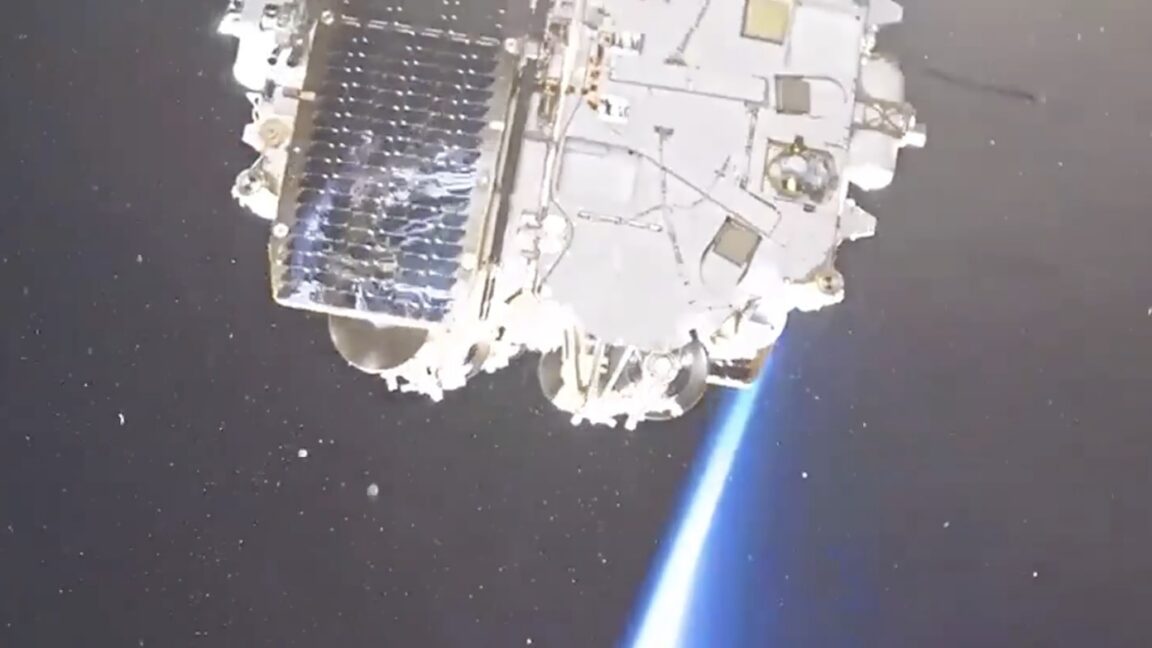
Some technical problems were expected. About 5 percent of SpaceX’s first batch of Starlink satellites failed shortly after launch. Over time, the original group of 60 Starlink prototypes experienced a failure rate of approximately 13%, according to Jonathan McDowell. SpaceX’s next 420 Starlink satellites performed significantly better, with a failure rate of about 3%. The company’s current-generation Starlink Version 2 satellites have recorded a failure rate of roughly 0.01%, according to McDowell’s satellite statistics.
The United States also operates its own fleet of military communications and data-relay satellites for applications including missile tracking, targeting, command, and control. Some of the first 42 operational satellites in the system experienced thermal and propulsion issues after launch last year, delaying their ascent into higher orbits.
The second batch of Russian Rassvet satellites “appears to have failed to reach its planned operating altitude,” the Institute for the Study of War wrote in an assessment Monday. None of the Rassvet satellites from the second launch group has reached an altitude of 500 miles. While no satellites from that batch are operating above 300 miles, many spacecraft from the first group appear to have settled into stable orbits.
However, significant uncertainty remains. Russian authorities may have changed their plans and intentionally abandoned the goal of placing Rassvet satellites at an altitude of 500 miles. Starlink satellites operate at roughly 300 miles, bringing them closer to users on the ground and improving performance. The trade-off is that low-Earth-orbit satellite networks require more spacecraft to deliver continuous global coverage.
In addition, satellite internet constellations such as Starlink, Rassvet, China’s Guowang, and Qianfan use multiple orbital planes. Russian ground teams may have deliberately placed some Rassvet satellites in lower orbits, allowing their orbital planes to drift for several months before aligning with their intended operating paths.
What is clear is that deploying a large satellite constellation is exceptionally difficult. Since the collapse of the Soviet Union, Russia’s satellite manufacturing industry has produced only a few dozen spacecraft per year. “It turns out we are not ready for this,” Yuri Borisov, the former head of Russia’s Roscosmos space agency, said in a 2023 interview.
Russia’s military has accelerated its push to develop Rassvet after SpaceX restricted unauthorized user terminals in Ukraine from accessing the Starlink network in February. The move disrupted Russia’s use of satellite communications for military operations. Rassvet had reportedly been in development for years, but the timing of its first launch gave Russian commanders hope that the system could eventually provide widespread satellite broadband coverage for military networks.
Source: arstechnica.com