


Nature Briefing: Dark Matter, Climate Change, AI, Long COVID and Conservation
Hello Nature readers. Would you like to receive this science news briefing free in your inbox every day? Sign up here.
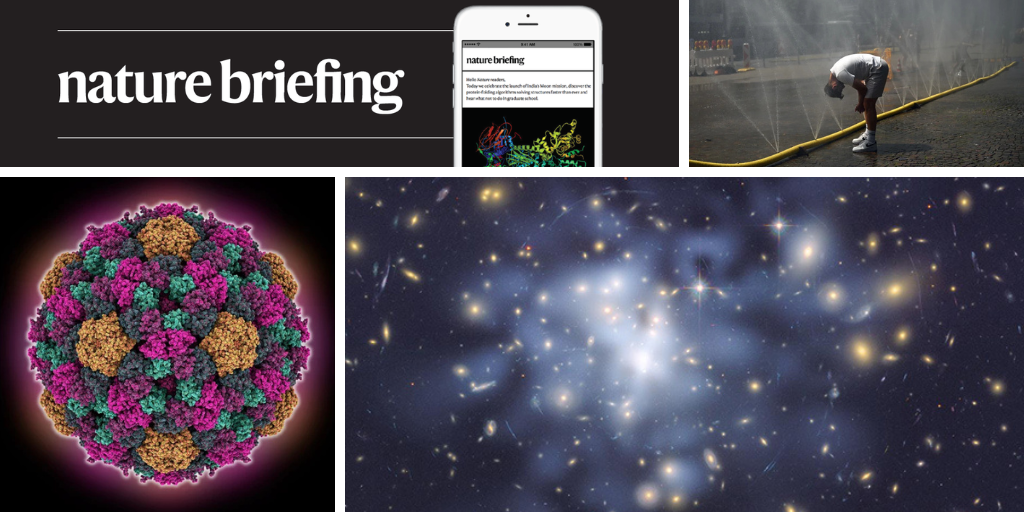
Images captured by the Hubble Space Telescope show dark matter concentrated at the centers of giant galaxy clusters.
Credit: NASA/JPL-Caltech/ESA/IAA, University of the Basque Country/JHU
Dark matter detector records possible WIMP signal
A single data point from a US dark matter detector could represent the first evidence of the elusive particle believed to make up much of the Universe’s mass. The LUX-ZEPLIN experiment, located at the Sanford Underground Research Facility in South Dakota, contains 10 tonnes of liquid xenon. Researchers search for weakly interacting massive particles, or WIMPs, by detecting tiny flashes of light produced when candidate particles collide with xenon nuclei. More data will be needed to determine whether the event is a genuine discovery of dark matter.
Nature | 5-minute read
Reference: Lawrence Berkeley National Laboratory preprint (not peer reviewed).
Climate report warns of global warming overshoot
A new report from the United Nations Environment Programme says the world is unlikely to meet the Paris Agreement goal of limiting global warming to 1.5°C above pre-industrial levels. At least 1.8°C of warming is expected this century under current projections. “Every path forward we take is an overshoot path,” says climate scientist and report co-author Debra Roberts.
The report also finds that rapid expansion of carbon dioxide removal could eventually help bring global temperatures back below 1.5°C by the end of the century. Every fraction of a degree matters: “The lower the peak warming, the lower the risk,” the report states.
Nature | 6-minute read
Reference: Limiting Overshoot: Navigating Exceedance report.
AI struggles to predict the effects of viral mutations
Researchers created more than 44,000 mutant versions of the well-studied bacteriophage ΦX174 to examine how changes to almost every DNA letter and amino acid affect viral survival. Most mutations reduced the virus’s fitness, while a small number improved it. However, the biological reasons behind many of these effects remain unclear.
The study also found that advanced artificial-intelligence models trained to identify harmful mutations struggled to predict the consequences of individual genetic changes. The researchers say that larger, higher-quality experimental datasets will be essential for improving AI models used in virology and genetic research.
Nature | 5-minute read
Reference: bioRxiv preprint (not peer reviewed).
India launches research fellowship to attract scientists home
In June, the Indian government launched the Prime Minister’s Research Council scheme to encourage Indian researchers working overseas to return home. The programme will offer research grants of up to 50 million rupees, approximately US$520,000, along with additional stipends. Up to 120 researchers will be supported for five years at institutions in India.
Scientists say the scheme could benefit researchers in fields such as theoretical physics. However, some experimental scientists question whether the grants will cover the costly equipment and infrastructure required for laboratory research. They also note that the programme does not yet establish a clear path for researchers after the initial five-year fellowship.
Nature | 5-minute read
Features and perspectives
Generative AI could make culture and communication more uniform
The widespread use of generative artificial intelligence in text, image creation and other areas of society may be reducing individuality, according to researchers studying AI-generated content. Early evidence suggests that increasingly similar outputs could influence decision-making, public opinion and cultural expression.
Researchers warn that widespread reliance on generative AI could make human culture and perception more homogeneous. In a worst-case scenario, this sameness could make society collectively less adaptable, says computer scientist Jivar Sourati.
Nature | 10-minute read
Scientists investigate how to identify adulterated honey
Fraudsters are diluting honey with inexpensive sugar syrups, making food authentication increasingly challenging. A 2023 European Commission report found signs of adulteration in 46% of 300 samples tested in laboratories.
Authentic honey is chemically complex, acidic and naturally variable, which makes reliable analysis difficult. As this report explains, honey can contain hundreds or even thousands of trace compounds. Differences in legal definitions of honey also complicate efforts to detect counterfeit products.
Chemistry World | 15-minute read
Long COVID research could transform post-infection care
Long COVID, a chronic condition associated with SARS-CoV-2 infection, has increased scientific interest in other post-acute infection syndromes. During the past six years, thousands of studies have examined the biological mechanisms behind prolonged COVID-19 symptoms and related conditions, supported in part by major investments from the US and German governments.
Although funding remains limited, some researchers believe the field is approaching a turning point that could improve the understanding and treatment of chronic illness more broadly. “It could potentially transform healthcare more broadly,” says infectious-disease clinician Michael Peluso.
Nature | 11-minute read
Good news for New Zealand’s endangered kākāpō
Today, I am celebrating the breeding success of New Zealand’s kākāpō (Strigops habroptilus), a remarkable and charismatic flightless parrot. This year has brought a record breeding season, driven by an abundant harvest of fruit from the rimu tree (Dacrydium cupressinum).
Kākāpō breeding is linked to years when rimu trees produce unusually large crops, a phenomenon known as a “mast”. The latest major rimu mast followed the previous event in 2022. Conservationists say the population may now have exceeded 300 birds for the first time in approximately 75 years.
The good news also gives me another opportunity to highlight Steve, the kākāpō who is especially well known to many Briefing readers. Watch Steve, voiced by comedian Rhys Darby.
We welcome your good news and feedback about this newsletter. You can email us at [email protected].
Thank you for reading,
Flora Graham, Nature Briefing Editor-in-Chief
Contributed by Jacob Smith
• Nature Briefing: Careers — insights, advice and award-winning journalism to help you optimize your work life.
• Nature Briefing: Microbiology — the microorganisms that shape health, the environment and our food systems.
• Nature Briefing: The Anthropocene — climate change, biodiversity, sustainability and geoengineering.
• Nature Briefing: AI and Robotics — 100% written by humans, of course.
• Nature Briefing: Cancer — a weekly newsletter for cancer researchers.
• Nature Briefing: Translational Research — biotechnology, drug discovery and pharmaceuticals.
Source: www.nature.com