


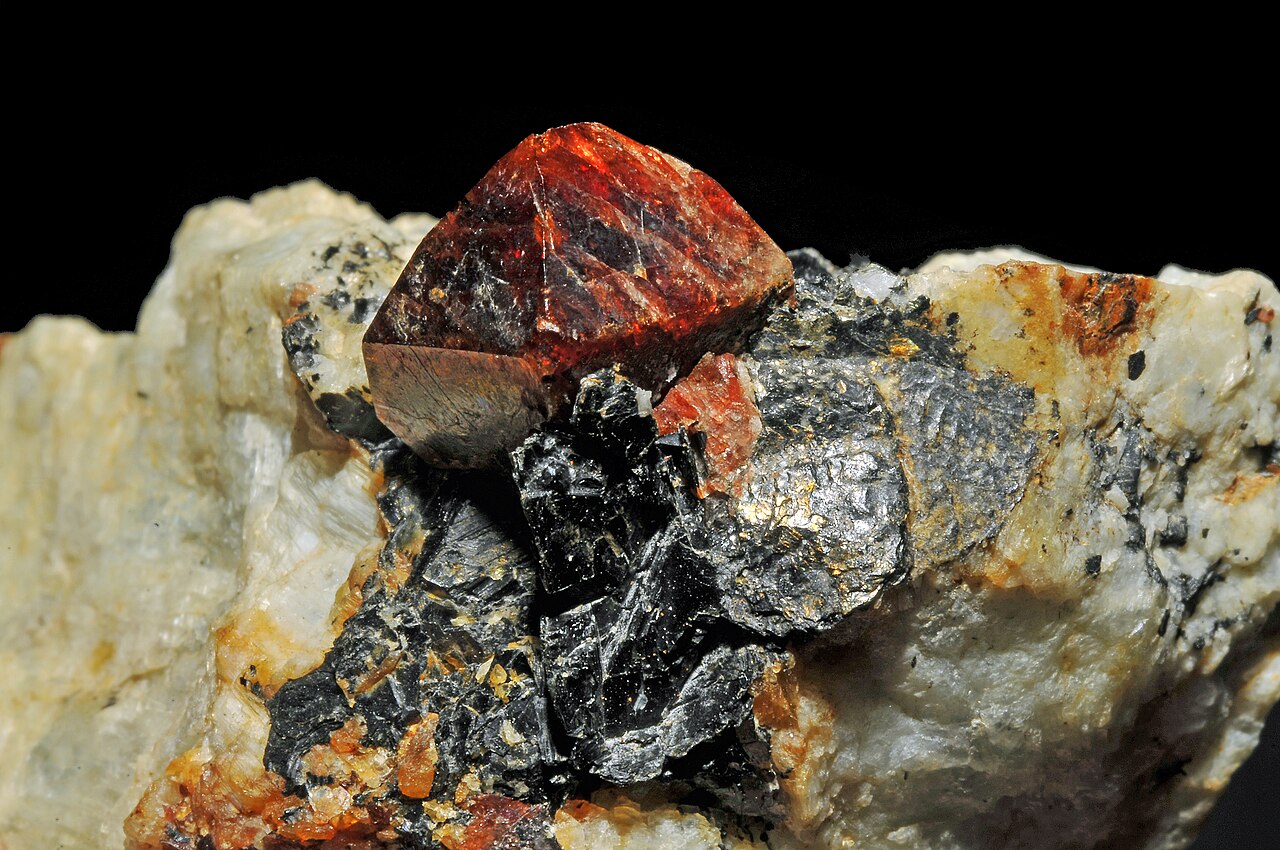
Earth’s continental crust formed over billions of years as hot rocks from the planet’s interior cooled, crystallized, and accumulated to create layered surface rocks. Scientists study ancient continental blocks called cratons to understand how the continents developed. These stable regions have survived for billions of years and now form the cores of Earth’s continents.
The upper 10 to 15 kilometers (6 to 9 miles) of continental crust contains relatively high concentrations of radioactive elements, including uranium and thorium. As these elements decay, they release heat. In contrast, the lower 20 kilometers (12 miles) of the crust contains far fewer radioactive elements. The cause of this large-scale chemical separation has remained uncertain because scientists have not fully understood which geological processes created it.
Previous studies proposed that the concentration of radioactive elements may change when tectonic plates collide. These collisions can raise temperatures in the lower crust, causing minerals that contain uranium and thorium, including zircon and monazite, to partially melt. The resulting magma can rise toward the upper crust, where it cools and crystallizes. To test this theory, researchers Andrew J. Smyi and Peter B. Kelemen combined global geochemical data with mathematical models to examine how radioactive-element concentrations change at different temperatures.
The researchers divided their analysis into two main categories of deep crustal rocks. The first category consisted of rocks formed from sediments that were buried deep beneath Earth’s surface and exposed to intense pressure and heat. These rocks are known as metasedimentary rocks. The second category included rocks formed when magma rose from deep within Earth and hardened before undergoing high-pressure and high-temperature conditions. These are classified as metamorphic rocks.
For each rock category, the researchers examined three temperature groups: rocks that experienced relatively low temperatures, rocks exposed to temperatures of 650–900°C (about 1,200–1,650°F), and rocks exposed to ultrahigh temperatures of 900–1,100°C (about 1,650–2,000°F). They then modeled the geochemical behavior of these rocks to determine whether ultrahigh-temperature metamorphism could separate radioactive elements within the continental crust.
Smyi and Kelemen found that monazite generally remains stable below 900°C in both metasedimentary and metamorphic rocks. This finding is consistent with the relatively high thorium concentrations observed in deep crustal rocks. However, when temperatures exceeded 900°C, uranium and thorium concentrations in metasedimentary rocks declined, indicating that minerals such as zircon and monazite began to dissolve. These melted minerals entered the magma and moved toward the upper crust, leaving behind rocks with lower radioactive-element concentrations—by approximately 0.10 parts per million.
The study concludes that the enrichment of uranium and thorium in the upper continental crust likely requires temperatures above 900°C. These extreme temperatures can dissolve zircon and monazite in the lower crust and are commonly associated with tectonic plate movement and continental collisions. The findings suggest that ultrahigh-temperature metamorphism played a major role in forming Earth’s layered continental crust and that this geological signature has been preserved for more than 3 billion years.
Post views: 104
Source: sciworthy.com