



Researchers found that land use, rather than other soil properties, was a significant factor in underwear decomposition.
Credit: Gabriela Brendle/Agroscope
The Nobel Prize is known for honoring groundbreaking research with a gold medal and a prize worth $1 million. Its playful counterpart, the Ig Nobel Prize, celebrates research that makes people laugh before encouraging them to think. Although the award does not offer the same financial reward, it often brings scientists considerable public attention.
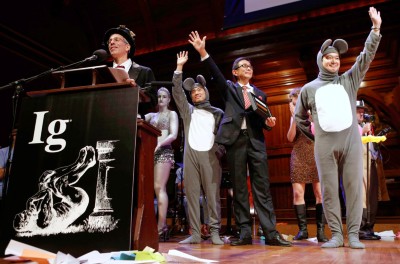
The 2026 Ig Nobel Prizes were presented on September 3 at a ceremony in Zurich, Switzerland. This year’s winners included a biomechanics team that developed an accurate definition of kissing across species, a physics team that designed a splash-resistant urinal, and soil scientists who buried 1,000 pairs of underwear to study how quickly textiles decompose.123 See the full list of 2026 Ig Nobel Prize winners below.
“I hope that not only do I find this research interesting, but that it makes people think a little differently about our place in the animal kingdom,” says Matilda Brindle, an evolutionary biologist at the University of Oxford and co-author of the kissing study. “My jaw hit the floor when I got the call. Without a doubt, this is one of the proudest accomplishments of my life.”
What is the scientific definition of kissing?
Brindle’s team defined kissing as “a directional, intraspecific, non-painful interaction involving mouth-to-mouth contact, involving movements of the lips or mouthparts, and no transfer of food.” Under this definition, polar bears, some birds and even ants can kiss.
The researchers also found evidence that kissing behavior may extend beyond humans and other modern primates. Their analysis traced the behavior back to the common ancestor of the great apes, approximately 21.5 million years ago. This suggests that early humans may have shared kissing behaviors with Neanderthals.
“We’ve shown that animals kiss and when kissing may have evolved in primates. Obviously, the next step is to understand why,” says Brindle. “If this award helps to stimulate more curiosity about these kinds of questions, that’s a really great achievement.”
From levitating frogs to unusual scientific discoveries
Past Ig Nobel Prize winners have investigated subjects ranging from unusual pizza toppings in Togo4 to the magnetic levitation of a live frog5 and the unusually large hippocampi found in London taxi drivers.6
Founded in 1991 by Annals of Improbable Research editor Mark Abrahams, the Ig Nobel Prize was initially viewed by some researchers as an insult. Today, many scientists regard the award as a valuable opportunity to reach new audiences and gain attention for unconventional research.
How a humorous science award changed my career
“The visibility they bring is huge. It exposes research to an audience that would never see it otherwise,” says Zhang-Hong Cao, a mechanical engineer at McGill University in Montreal, Canada. Cao is part of the team that won the 2026 technology award for showing that mosquito mouthparts can be adapted as nozzles for high-resolution, low-cost 3D printing.7
Cao says the research demonstrates how materials that people often find unpleasant can inspire useful technologies in unexpected ways.
Another example is the award-winning underwear decomposition study by Franz Bender and Marcel van der Heijden of the University of Zurich. Working with citizen scientists in more than 25 countries, the researchers buried underwear and recovered it two months later. The condition of the fabric helped them assess the biological activity of different soils.
Can a redesigned urinal reduce splashes?
Another 2026 Ig Nobel Prize recognized research into the physics of liquid splashes from urinals. Through experiments and theoretical modeling, the researchers proposed a redesigned urinal that could reduce splashing to just 1.4% of the amount commonly produced.
Source: www.nature.com