


Scientists Complete the First Connectome of the Male Fruit Fly Brain
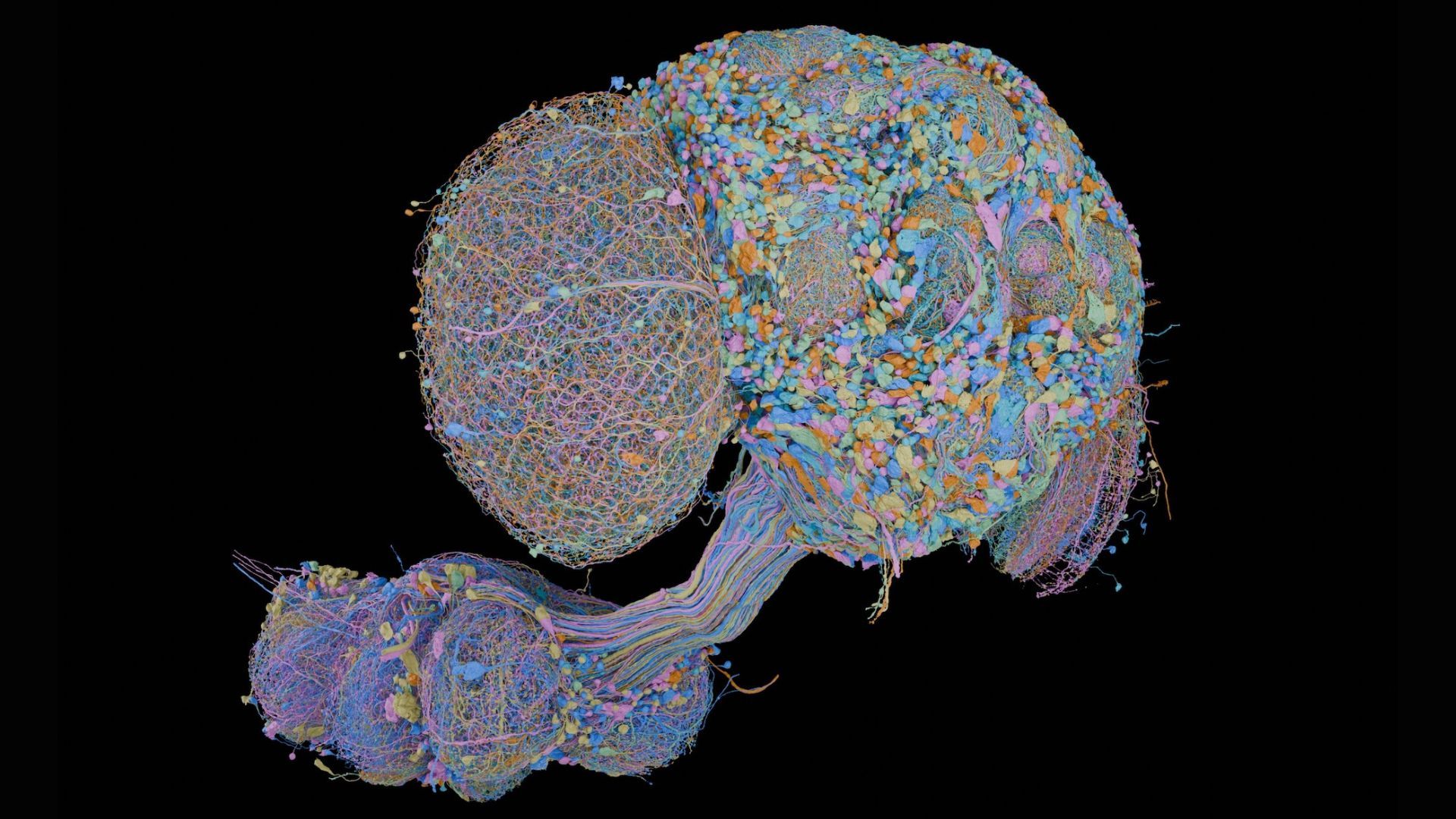
Although the fruit fly brain is roughly the size of a poppy seed, it contains more than 100,000 neurons. Researchers have now created the most complete map yet of the male Drosophila brain and central nervous system, charting more than 166,000 neurons in total.
Known as a connectome, this detailed wiring diagram shows how neurons are connected throughout the male fruit fly’s brain and ventral nerve cord, the insect equivalent of a spinal cord. The new map complements a previously published connectome of the female Drosophila brain, which contains approximately 140,000 neurons.
Comparing the male and female connectomes could help scientists determine how differences in neural wiring contribute to sex-specific behaviors, including courtship, mating and aggression. The maps may also reveal how similar neural circuits produce different behaviors in male and female flies.
“This is the first time we can compare the sexes of an animal with complex social behaviors,” study co-author Jerry Rubin, director of biology and senior group leader at the Howard Hughes Medical Institute’s Janelia Research Campus, said in a statement. “Male and female flies have many behavioral differences, and neuroscientists want to understand how the brain controls those behaviors. This makes it easier to identify the neurons responsible for those differences.”
This animation highlights neurons that are unique to the male connectome, along with neurons shared by both sexes that differ between male and female flies. The male connectome will allow researchers to compare the two nervous systems and investigate social behaviors such as mating and aggression.
(Image credit: Data was acquired and analyzed by the FlyEM project team at HHMI’s Janelia Research Campus, the Cambridge Connectomics Group and Google Research. Video: Philip Hubbard/HHMI Janelia Research Campus)
The male fruit fly brain map was initially released as a preprint. The research was later published in Cell and Current Biology on Thursday, September 3. The connectome study appeared alongside three additional papers examining different aspects of Drosophila neurobiology.
“The fly’s nervous system performs highly sophisticated calculations with relatively few neurons and little energy,” Carlos Ribeiro, a principal investigator at the Fondation Champalimaud in Lisbon, Portugal, said in a statement. “Its structure may suggest principles for designing more efficient artificial systems.” Ribeiro’s team helped create the connectome and led one of the related studies.
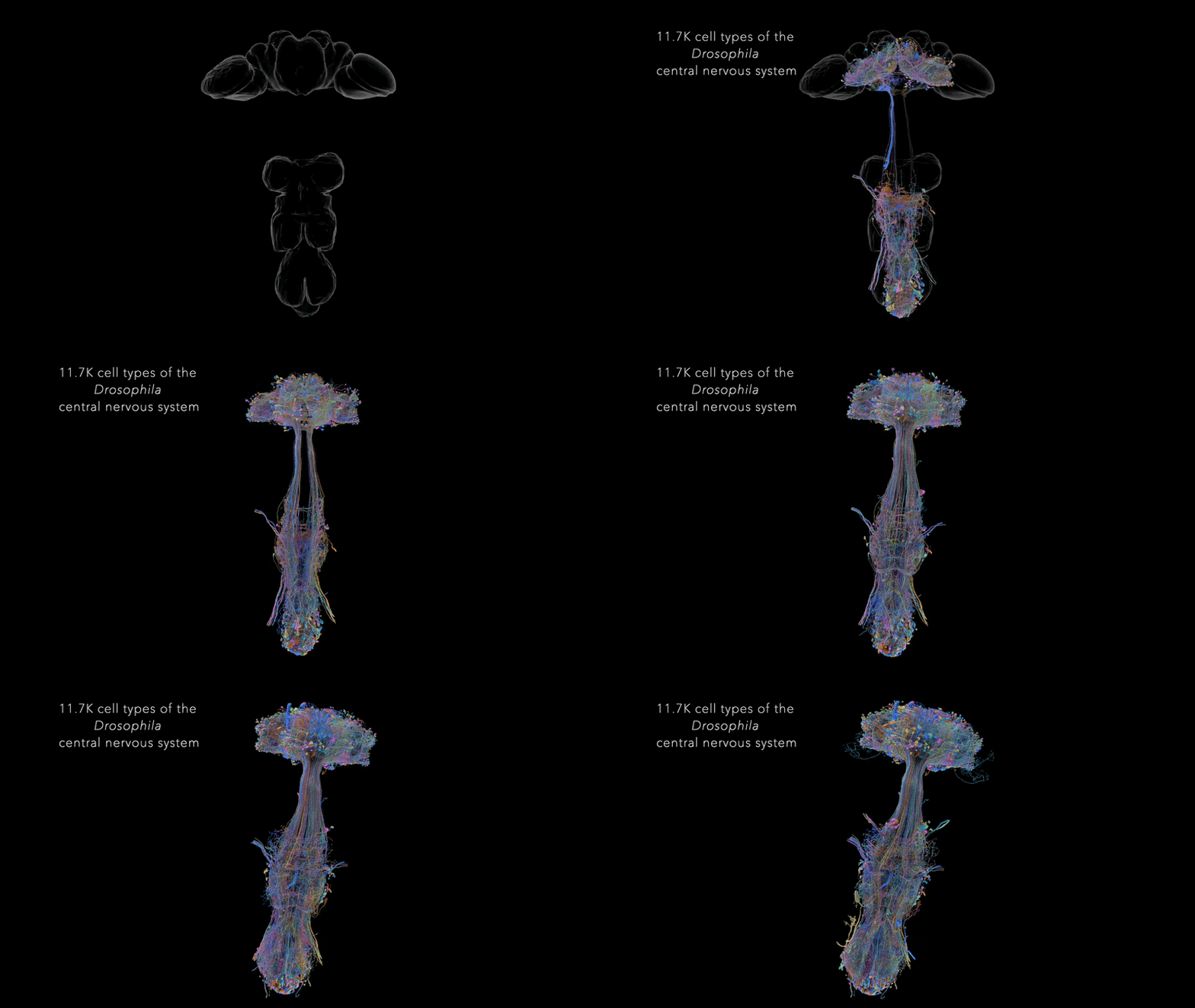
This animation shows the complete set of neuron types in the male fruit fly’s central nervous system. The connectome includes every neuron in the brain, including the optic lobes, as well as neurons in the ventral nerve cord.
(Image credit: Data was acquired and analyzed by the FlyEM project team at HHMI’s Janelia Research Campus, the Cambridge Connectomics Group and Google Research. Video: Philip Hubbard/HHMI Janelia Research Campus)
“This study also provides a technical roadmap for more ambitious connectomics projects in the future, including efforts to map the brains of mice and humans,” Ribeiro said in a separate statement from the Champalimaud Foundation.
In the near term, scientists hope to map the brains of larval zebrafish (Danio rerio) and adult danionine fish, including Danionella. Over the longer term, these projects could help researchers understand how vertebrate brains generate complex behaviors and provide new insight into the biological basis of neurological and psychiatric disorders.
Get the world’s most fascinating discoveries delivered straight to your inbox.

These neurons help the fruit fly detect and respond to taste.
(Image credit: Ines de Haan Vicente)
Research led by Ribeiro focused on the neural circuits that process taste. Fruit flies have taste receptors across much of their bodies, including their legs, wings, mouthparts and throats. The researchers identified these receptors and traced their connections into the brain, then examined how taste circuits interact with networks controlling behaviors such as swallowing and walking.
The findings suggest that these circuits help flies determine whether food is safe or potentially harmful before deciding whether to eat it.
The map is a “hypothesis-generating tool,” study co-author Ines de Haan-Vicente, a research technician in the Ribeiro laboratory, said in a Champalimaud statement. “If you’re interested in how taste controls movement, you can use the map to identify which sensory neurons connect to movement-control neurons and which intermediate neurons may be involved. That gives you a starting point for future experiments.”
The two other studies published alongside the connectome examined visual-processing circuits and sex-specific differences in male and female fly brains.
The visual-processing research showed that visual information travels deep into the brain and involves more than half of the approximately 11,000 neuron types identified in the map. The study of sex differences uncovered a network of cells in the male brain that may help regulate male-specific behaviors, including courtship and aspects of physical aggression. For example, female flies commonly headbutt opponents, while males tend to lunge toward them.
Although some neural networks appear to be unique to each sex, many sensory and motor circuits are shared by male and female flies. In some cases, differences may result from switches within common circuits that redirect signals to different destinations. Determining how these rerouted signals influence behavior will be an important focus of future research.
How much do you know about the human body’s most complex organ? Test your knowledge with our brain quiz!
Source: www.livescience.com