


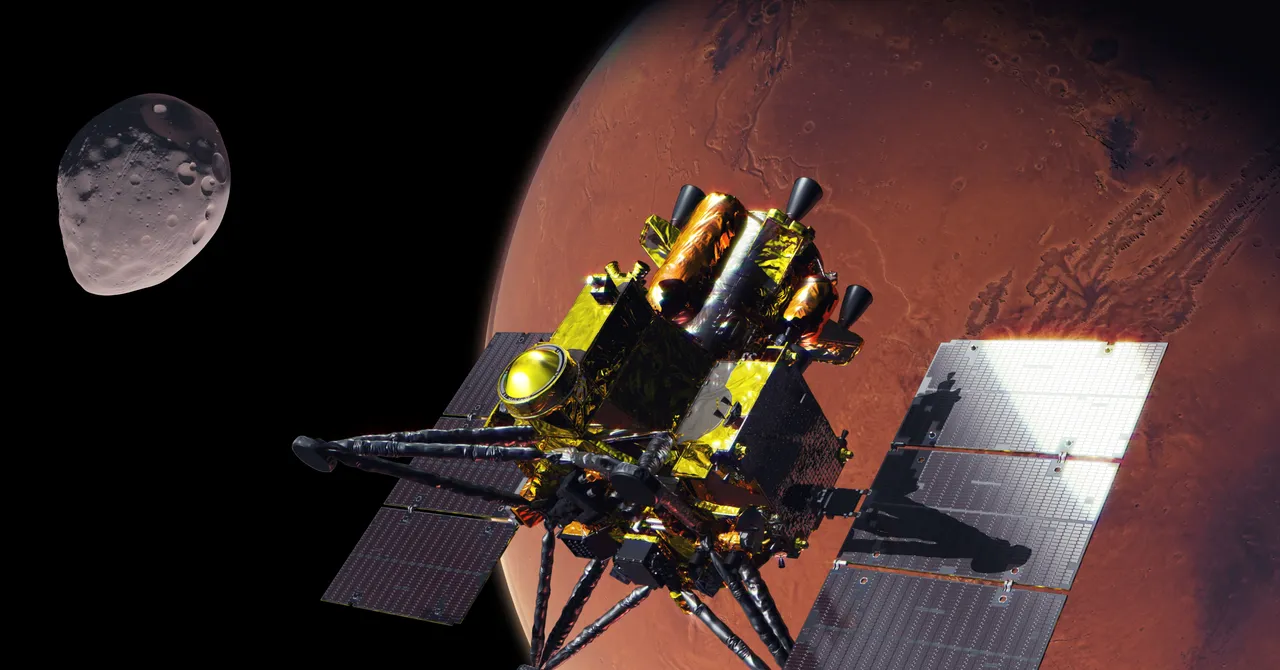
mars rover Japan’s space agency, JAXA, is preparing to answer some of the biggest questions about Mars and its moons. The Martian Moons Exploration mission, known as MMX, aims to collect at least 10 grams of material from Phobos, one of Mars’ two moons. If successful, MMX would bring the first samples from a Martian moon back to Earth.
The journey will take several years. The MMX spacecraft is expected to spend about one year traveling to Mars, followed by three years studying the Red Planet and collecting samples. It will then begin the yearlong journey back to Earth. If the mission proceeds as planned, scientists could receive Phobos samples in 2031.
One of the mission’s primary goals is to determine how Mars’ moons, Phobos and Deimos, formed. Scientists are considering two leading theories. The first suggests that Phobos formed from material blasted into orbit after a massive impact on Mars. The second proposes that Phobos was originally an asteroid from elsewhere in the solar system that was captured by Mars’ gravity.
Phobos has a dark surface and reflects light in a way that closely resembles water- and carbon-rich asteroids. However, its nearly circular orbit around Mars, aligned with the planet’s equatorial plane and following the same direction as Mars’ rotation, is more consistent with the giant-impact theory. Comparing samples from Phobos with material previously collected from Mars could help scientists resolve the debate over the moon’s origin.
Collecting and returning samples from Phobos will require the MMX mission to overcome major challenges in spacecraft engineering, navigation, and communications. The spacecraft will have a launch mass of approximately 4,480 kilograms (9,900 pounds), with more than half consisting of fuel. This propellant will be divided among three mission phases: the journey to Mars, exploration around the Martian moons, and the return trip to Earth. After reaching Mars and using its fuel, MMX will jettison its communications module. Following its exploration of Deimos, the spacecraft’s exploration module will also be discarded.
Designed by Mitsubishi Electric, the main probe will land on Phobos, which has a radius of only about 11 kilometers. That makes landing especially difficult compared with landing on Earth’s moon, which has a radius of more than 1,700 kilometers and far stronger gravity. Phobos’ gravity is also about 50 times stronger than that of the asteroid Ryugu, where JAXA previously landed a spacecraft. Although hovering is commonly used to land on small asteroids, maintaining a prolonged hover above Phobos would consume too much fuel for the MMX mission.
To address this challenge, MMX will use high-precision autonomous navigation. Radio signals can take up to 20 minutes to travel between Earth and the spacecraft, meaning mission controllers cannot guide every step in real time. Instead, MMX must independently plan and carry out its descent, landing, sample collection, and subsequent ascent from Phobos.
During its descent, the spacecraft will compare the surrounding terrain with detailed topographic maps of Phobos and use the data to refine its approach to the selected landing site. Below an altitude of 300 meters, onboard systems will analyze changes in the terrain and identify potentially hazardous areas. If necessary, MMX can adjust its landing location, abort the descent, or temporarily climb to a safer altitude.
Before the main spacecraft lands, the IDEFIX rover will be deployed to Phobos. Developed jointly by the French and German space agencies, the small rover is expected to explore the moon’s surface independently for about 100 days. Its preliminary survey will provide valuable reconnaissance and help mission planners identify a safer landing site for the MMX sample-return spacecraft.
Source: www.wired.com