


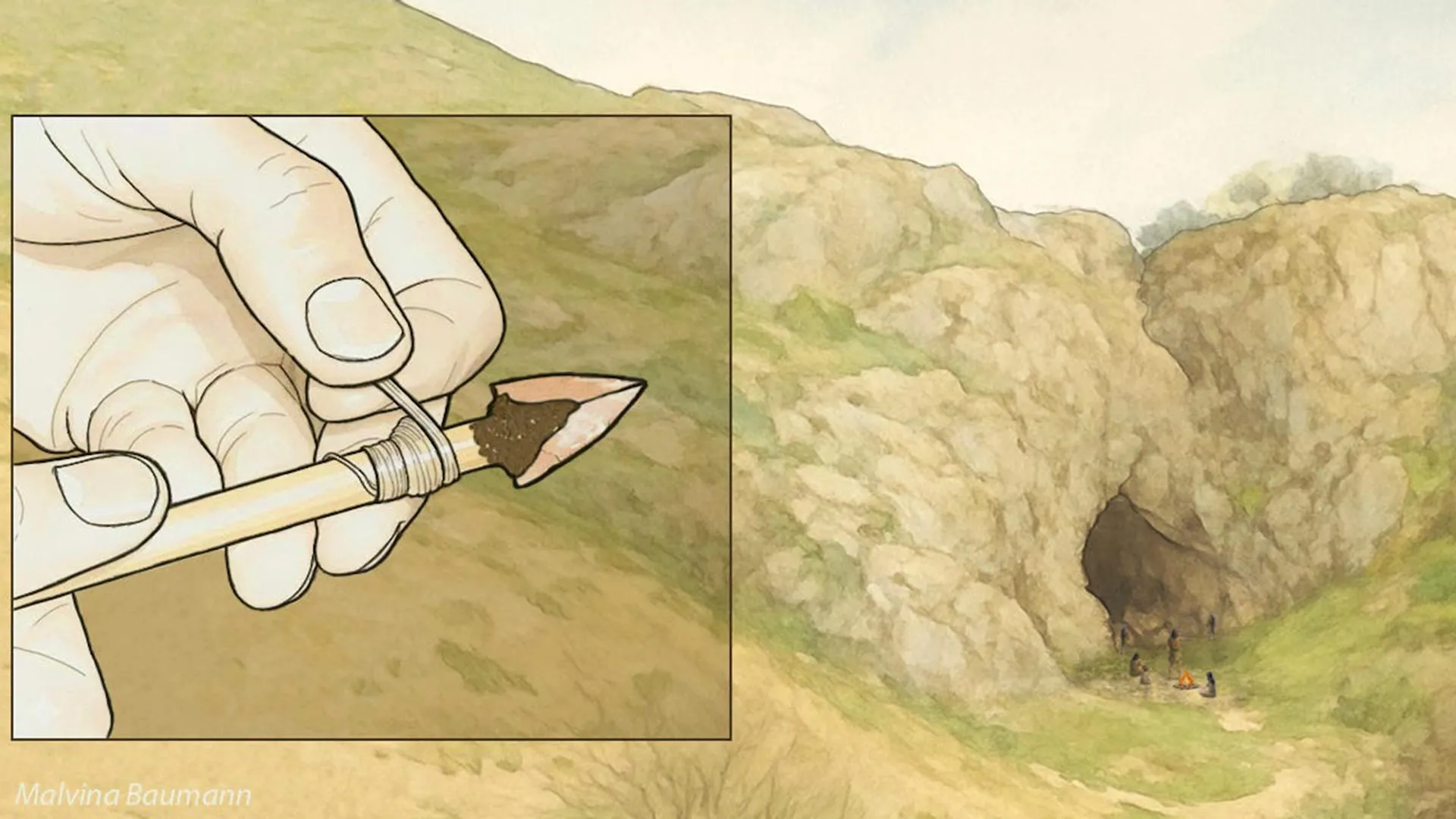
Impact damage analysis has identified the likely launch of unmodified triangular stone points from the oldest occupied layers at Ob Rakhmat in Uzbekistan, dating to approximately 80,000 years ago. Measuring less than two centimeters across, these points are comparable in size to projectile tips found at Mandrin Cave in France, where Homo sapiens entered Neanderthal territory roughly 25,000 years later. The new research, published in PLOS ONE, offers important evidence that could reshape current theories about the first Homo sapiens expansion into Europe.
Prehistoric chronocultural and anthropological frameworks were first developed in Western Europe—particularly France—in the late 19th century. These early models were largely linear and Eurocentric. Cro-Magnons, the early modern humans of Europe, were once viewed as the descendants of Neanderthals and as the founders of the cultural achievements associated with European civilization. A century later, archaeological and genetic evidence demonstrated that Homo sapiens originated in Africa. Researchers also recognized that many technological and social developments associated with the Western Upper Paleolithic—including symbolic expression, long-distance exchange networks, and diverse stone and bone tools—had much deeper and more complex origins.
The earliest evidence of Homo sapiens in Australia dates to approximately 65,000 years ago. This predates the earliest widely accepted evidence of modern humans in Europe by around 10,000 years. However, how our ancestors first entered and spread across Western Eurasia more than 45,000 years ago remains debated.
The chronological relationship between Europe’s earliest Upper Paleolithic sites and settlements in the Levant—often considered their closest technological and typological parallels—remains uncertain. Much of the Levantine evidence comes from older excavations, while other discoveries do not fit neatly into a direct evolutionary sequence. Although the Levant lies close to Africa, the origins of its Early Upper Paleolithic remain unclear. For this reason, some researchers have proposed that key technological developments may have emerged farther east, possibly in Central Asia. Archaeologist Ludovic Slimak highlighted this possibility in 2023.
Central Asian archaeological sites
Depending on environmental conditions, Central Asia may have functioned either as a migration corridor connecting the eastern and western parts of Eurasia or as a refuge during periods of climatic stress. Although the archaeological record remains limited, the region contains several important Paleolithic sites.
One of the most significant is the Ob Rakhmat rock-shelter complex in Uzbekistan, discovered in 1962. Recent excavations have been led by Andrei Krivoshapkin. Located at an elevation of approximately 1,250 meters on the southwestern edge of the Talas Alatau range in the Tien Shan Mountains, Ob Rakhmat was occupied between roughly 80,000 and 40,000 years ago.
The site contains a remarkably consistent stone-tool industry, including points, large blades, and blade fragments preserved across more than 10 meters of stratigraphy. This assemblage was initially classified as part of the Early Upper Paleolithic, but some of its technological characteristics appear to have deeper roots in the Levantine Middle Paleolithic.
Early Middle Paleolithic industries associated with Homo sapiens, such as those documented at Misliya Cave, disappeared from the Near East approximately 100,000 years ago. At Ob Rakhmat, a child’s skull discovered in geological layers dating to around 70,000 years ago displays a combination of Neanderthal and anatomically modern human characteristics. This mixture may reflect interaction or interbreeding between the two populations.
A large blade tradition and unusually small stone points
Within the oldest layers at Ob Rakhmat, an international multidisciplinary research team identified small, unmodified triangular stone points. Researchers distinguished these possible projectile tips by examining macroscopic and microscopic impact damage and comparing the results with experimental reference collections.
The points measure less than two centimeters in width and weigh only a few grams. Their small size and brittleness would have made them unsuitable for use on heavy spear shafts. Instead, their dimensions are consistent with lightweight projectile technology. The width of the cutting edge also corresponds to the diameter of a narrow projectile shaft, a relationship supported by ethnographic research and by physical and ballistic constraints observed across different cultures.
Why projectile design matters
Hunting weapons are complex systems designed to meet different requirements for strength, mass, speed, and penetration. Components developed for one type of weapon cannot necessarily be transferred to another.
A hand-held or thrown spear requires considerable mass and structural strength. Its weight helps generate impact force, maintain stability, and penetrate a target. By contrast, the penetrating power of a lightweight projectile launched from a distance depends primarily on velocity and sharpness. Humans cannot generate the necessary speed simply by extending the arm, so lightweight projectiles require a mechanical launching system.
For this reason, arrowheads, dart points, and spearheads are designed according to different mechanical principles and cannot be treated as interchangeable. The size, thickness, mass, and elasticity of a point all influence its trajectory and performance. Just as the shape of a fossil tooth can reveal an animal’s diet and locomotion, the characteristics of a stone point can provide clues about the weapon of which it formed a part.
Were small projectile points unique to Homo sapiens?
The small size of the Ob Rakhmat points does not appear to have resulted from a lack of suitable raw material. The site contains large blades made from high-quality stone. In addition, microscopic use-wear analysis shows that the same assemblage includes points 15 to 20 times heavier and three to four times thicker—dimensions more consistent with spear points or other robust tools used for axial impact.
Returning to the archaeological record, research on Middle Paleolithic tools has shown that multiple types of points and inserts can occur within the same assemblage. Some are very small and appear to have been deliberately manufactured for use as projectiles. However, the earliest secure examples currently associated with Homo sapiens come from South Africa, including the Still Bay cultural material dating to more than 77,000 years ago and later evidence from Sibudu Cave.
By comparison, stone points showing damage consistent with projectile use are relatively rare in the Neanderthal archaeological record. When they are present, they are generally larger and do not differ substantially in size, manufacture, or form from points used for other activities, including plant processing and butchery. This contrast in weapon design may have important implications for understanding the technological differences between Neanderthals and Homo sapiens.
Considering the age of the sites, the approximately 14,000-kilometer distance between South Africa and Central Asia, and the differences between the Ob Rakhmat and Sibudu technologies, an independent center of invention may be the most likely explanation. The evidence does not necessarily indicate that the technology spread directly from one region to the other.
From the Tien Shan Mountains to the Rhône Valley
The Ob Rakhmat micropoints currently have no known equivalents in the Eurasian Middle Paleolithic. However, traceology specialist Laure Metz has studied similar points from Mandrin Cave in France’s Rhône Valley.
The Mandrin remains come from geological layers dating to approximately 54,000 years ago—around 10,000 years before Neanderthals disappeared from the region. Notably, baby teeth attributed to Homo sapiens were also recovered from the same layer.
The similarities between the Ob Rakhmat and Mandrin micropoints are striking. Although the sites are separated by approximately 6,000 kilometers and more than 25,000 years, the points share comparable shapes and manufacturing characteristics. The similarities remain significant even when differences in raw material are taken into account.
Recent studies by paleogeneticists Leonardo Varini and Stéphane Mazière identify the region around the Persian Plateau and northeastern Central Asia as a possible population center for the ancestors of modern non-African peoples. These populations may have lived there during the early stages of the expansion out of Africa and the subsequent colonization of Eurasia, well before the conventional Upper Paleolithic.
This resource-rich environment may have provided a refuge during periods of demographic stress. It may also have encouraged interaction between different groups, genetic exchange, and the development of new technologies.
Ob Rakhmat and Mandrin could therefore represent two geographic and chronological milestones in a much broader dispersal process. As Ludovic Slimak has suggested, this process may have involved the spread of distinctive technological innovations associated with Homo sapiens. Because the Ob Rakhmat points are small, unmodified, and fragmentary, similar microprojectiles may have been overlooked at other sites between Central Asia and the western Mediterranean.
A new scenario for the arrival of Homo sapiens in Europe
This discovery is significant for several reasons.
It supports interpretations of the Mandrin evidence suggesting that Homo sapiens briefly entered Neanderthal territory while equipped with advanced lightweight projectile technology. Some aspects of this interpretation have been challenged, as is expected when new evidence conflicts with established models. Nevertheless, the predictive potential of the hypothesis remains important.
The similarities between the Mandrin and Ob Rakhmat micropoints are unlikely to be explained by shape alone. Their production required technical skill, including careful preparation of the striking platform and precise control during knapping. Researchers continue to debate the exact launching technology involved, including whether these points were fired from a bow or another type of lightweight projectile system. Regardless, their design differs substantially from the robust hunting weapons generally associated with Neanderthals.
Another important feature of this research is the convergence between archaeological and genetic evidence. These independent lines of investigation suggest a more complex history of Homo sapiens expansion into Europe.
Rather than moving directly from Africa into Europe approximately 45,000 years ago, some modern human populations may have lived for thousands of years in the heart of Eurasia before expanding westward. The Ob Rakhmat evidence suggests that Central Asia may have been more than a migration corridor: it may have been a long-term population refuge and a center of technological innovation.
Source: www.sciencedaily.com