


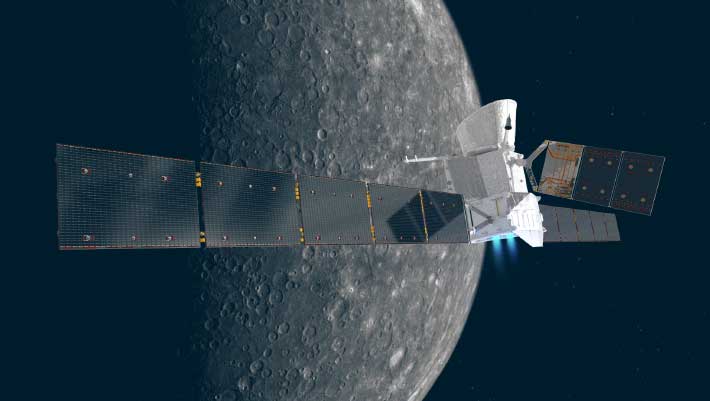
After nearly eight years and billions of kilometers of interplanetary travel, BepiColombo—a joint ESA and JAXA mission—has entered the final stage of its journey to Mercury, the smallest and innermost planet in the Solar System.
Artist’s impression of the ESA/JAXA BepiColombo spacecraft during its cruise to Mercury. The mission’s 7.2-year journey includes one Earth flyby, two Venus flybys and six Mercury flybys before the spacecraft enters orbit. The Mercury Transfer Module uses ion thrusters, while the Mercury Planetary Orbiter and Mio spacecraft are carried together during the cruise phase. Image credit: ESA / ATG Medialab / NASA / JPL.
BepiColombo launched from Europe’s Spaceport in Kourou, French Guiana, on October 20, 2018. The spacecraft has spent years using planetary flybys and electric propulsion to gradually reduce its speed and reach Mercury’s orbit.
The mission is the first European mission to Mercury and the first to send two spacecraft to the planet to make complementary measurements of its surface, interior, magnetic field and surrounding space environment.
BepiColombo consists of two dedicated orbiters: ESA’s Mercury Planetary Orbiter (MPO) and JAXA’s Mercury Magnetospheric Orbiter, also known as Mio. Together, they will study Mercury’s geology, exosphere, magnetic field and interaction with the solar wind.
The mission is named after Italian mathematician and engineer Giuseppe “Bepi” Colombo. He discovered that Mercury’s unusual spin-orbit resonance causes the planet to rotate three times for every two revolutions around the Sun.
Colombo also proposed using a gravity-assist maneuver at Venus to place NASA’s Mariner 10 spacecraft into an orbit around the Sun. That trajectory enabled Mariner 10 to conduct three flybys of Mercury in 1974 and 1975.
On September 3, 2026, mission controllers confirmed that BepiColombo’s Mercury Transfer Module (MTM) had successfully separated from the spacecraft stack, marking the beginning of the mission’s arrival phase at Mercury.
ESA confirmed the separation using deep-space tracking antennas in Spain and Argentina. Signals received by the ground stations verified that the maneuver had taken place successfully.
Telemetry also indicated that the spacecraft’s systems were operating normally and that the solar arrays on the Mercury Planetary Orbiter were charging its batteries.
The separation was a high-stakes operation conducted more than 200 million kilometers from Earth. At that distance, communication delays make real-time troubleshooting impossible, requiring the mission team to plan and program every step well in advance.
With the Mercury Transfer Module now detached, the MPO and Mio orbiters will continue toward Mercury while remaining connected. The Mercury Planetary Orbiter will supply power to the spacecraft configuration until the two science orbiters separate.
“The arrival phase will begin with the separation of MTM from the spacecraft stack on September 3, 2026,” BepiColombo team members said in a statement.
“The combined spacecraft will enter orbit around Mercury on November 21, 2026, and MPO and Mio are scheduled to separate on December 9–10, 2026.”
“The science phase of the mission is scheduled to begin in April 2027.”
Source: www.sci.news